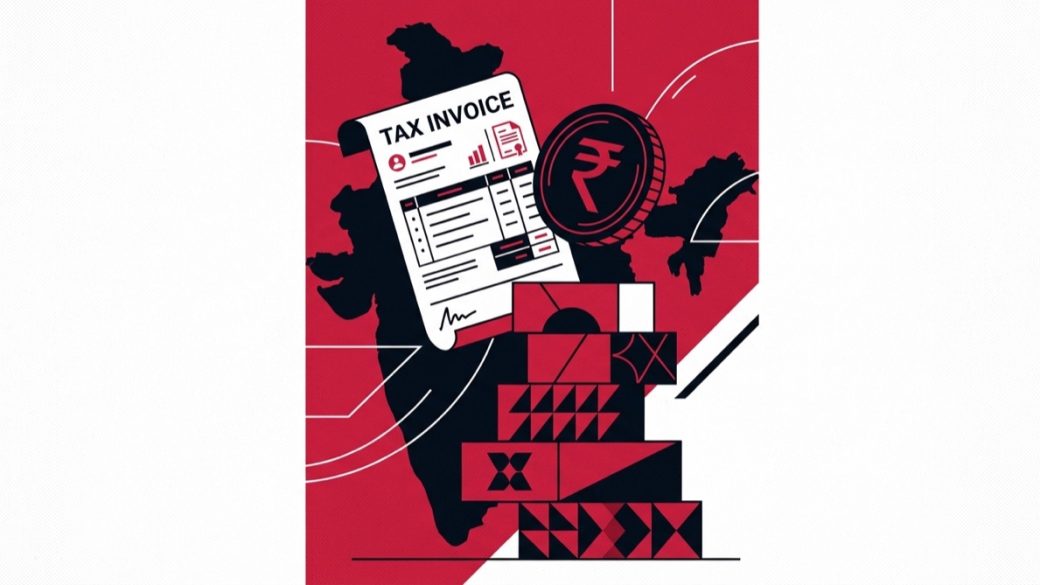
GST (Goods and Services Tax) is India’s single, nationwide indirect tax on the supply of most goods and services, in force since 1 July 2017. It replaced a tangle of central and state taxes—like excise duty, service tax and state VAT—with one tax collected at every stage of the supply chain, where businesses claim credit for the tax they already paid on inputs so the final consumer bears the cost only once. In short, GST turned India into “one nation, one tax, one market.”
- What is GST? Full form and meaning
- Why India introduced GST
- Types of GST: CGST, SGST, IGST & UTGST
- How GST works: the supply chain
- Input Tax Credit (ITC) explained
- GST tax slabs and rates
- GST registration thresholds
- GST returns and filing basics
- Advantages and criticisms of GST
- Frequently asked questions
What is GST? Full form and meaning
The full form of GST is Goods and Services Tax. It is a destination-based, value-added indirect tax levied on the supply of goods and services across India. Two phrases there do most of the work, so it is worth unpacking them in plain language.
Indirect tax means you do not pay it directly to the government from your income (that is income tax, a direct tax). Instead, the tax is built into the price of what you buy. The seller collects it from you and deposits it with the government. When you pay ₹118 for a product taxed at 18%, ₹18 of that is GST that the shop passes on.
Value-added means GST is charged only on the value each business adds, not on the full price again and again. A manufacturer, a wholesaler and a retailer each pay GST, but each one subtracts the GST already paid by the person before them. This mechanism—called Input Tax Credit—is the heart of GST and the main reason it is fairer than the old system.
Destination-based means the tax revenue goes to the state where the goods or services are finally consumed, not where they were produced. If a phone is made in Tamil Nadu but sold to a customer in Bihar, Bihar gets the state share of the tax.
Key takeaway: GST is one tax that absorbed more than a dozen older central and state taxes. It is collected in stages along the supply chain, but credit flows through the chain so that only the final consumer truly pays—and only once.
Why India introduced GST
Before 1 July 2017, India ran a fragmented indirect-tax system. The Centre levied taxes such as central excise duty, service tax and additional customs duties. Each state separately charged Value Added Tax (VAT), entry tax, octroi, luxury tax and more. The result was a maze: the same product could be taxed differently in two neighbouring states, and a truck crossing state borders faced check-posts and paperwork.
The biggest flaw was the cascading effect—a “tax on tax.” Under the old rules, a business often could not set off the VAT it paid against the service tax it owed, or vice versa, because they sat in separate silos. Tax piled on top of earlier tax, inflating prices and quietly punishing long supply chains.
GST was designed to fix exactly this. By merging central and state levies into one credit-linked tax, it removed most cascading, created a common national market, and made interstate trade smoother. The reform took years of negotiation between the Centre and states and required the 101st Constitutional Amendment, which also created the GST Council—the joint body of the Union and state finance ministers that decides rates and rules.
Types of GST: CGST, SGST, IGST & UTGST
A common point of confusion is that people expect “one tax” to mean “one component.” In practice, because India is a federal country where both the Centre and the states have the right to tax, GST is split into four components. Which ones apply depends on whether a sale happens within a state or across states.
The four components
- CGST (Central GST): the Centre’s share, charged on sales within a state.
- SGST (State GST): the state’s share, charged on the same within-state sale.
- IGST (Integrated GST): a single combined tax charged on inter-state sales and on imports. The Centre collects it and then shares the state portion with the destination state.
- UTGST (Union Territory GST): the equivalent of SGST for Union Territories without their own legislature (such as Chandigarh or Lakshadweep).
The simplest way to remember it: for a sale inside your own state, the GST rate is split equally into CGST and SGST. For a sale to another state, the same total rate is charged as one IGST.
| Type | Levied by | Applies to | Example (18% rate) |
|---|---|---|---|
| CGST | Central Government | Intra-state supply | 9% of value |
| SGST | State Government | Intra-state supply | 9% of value |
| IGST | Central Government (shared with states) | Inter-state supply & imports | 18% of value |
| UTGST | Union Territory | Intra-UT supply | 9% (with 9% CGST) |
How GST works: the supply chain
The mechanics of GST are best understood by following a product as it moves from factory to shopper. At each stage the seller charges GST on the sale price, but pays the government only the difference between the tax it collected and the tax it already paid on its own purchases. That difference is the tax on the value it added.
Let us trace a simple example at an 18% rate, ignoring the CGST/SGST split for clarity and treating the whole 18% as one number.
| Stage | Buys at | Sells at | GST collected (18%) | Credit on inputs | Net GST paid to govt |
|---|---|---|---|---|---|
| Manufacturer | — | ₹1,000 | ₹180 | ₹0 | ₹180 |
| Wholesaler | ₹1,000 | ₹1,500 | ₹270 | ₹180 | ₹90 |
| Retailer | ₹1,500 | ₹2,000 | ₹360 | ₹270 | ₹90 |
| Consumer | ₹2,000 | — | Pays ₹360 in GST | — | Total to govt: ₹360 |
Notice two things. First, the government ultimately collects ₹360—exactly 18% of the final ₹2,000 price—no more. Second, each business only handed over tax on the value it added (₹1,000, then ₹500, then ₹500). There is no tax-on-tax pile-up. That is the value-added principle working as intended, and it is the single biggest improvement over the pre-2017 system.
Input Tax Credit (ITC) explained
Input Tax Credit is the mechanism that lets a registered business reduce the tax it owes on sales (output tax) by the tax it already paid on business purchases (input tax). It is what prevents cascading and makes GST a true value-added tax.
Suppose your business collects ₹50,000 of GST from customers in a month but paid ₹30,000 of GST on raw materials, services and other business inputs. You do not pay ₹50,000 to the government—you claim ₹30,000 as credit and deposit only the ₹20,000 net.
Conditions to claim ITC
ITC is not automatic. To claim it, broadly you must hold a valid tax invoice, have actually received the goods or services, ensure your supplier has reported the sale (so it appears in your auto-populated statement), and use the purchase for business—not personal—purposes. Certain items are “blocked,” meaning credit is not allowed even if GST was paid; common examples include most personal-use motor vehicles, and goods or services used for personal consumption.
Why ITC matters for cash flow: Because credit depends partly on your suppliers correctly filing their returns, choosing GST-compliant vendors is now a real business decision. A supplier who fails to report your invoice can block your credit and raise your effective cost.
GST tax slabs and rates
GST is not a single flat rate. Goods and services are sorted into tax slabs so that essentials are taxed lightly (or not at all) while luxury and “sin” goods are taxed more. The main slabs have historically been 0%, 5%, 12%, 18% and 28%, with 18% being the standard rate for a large share of goods and services.
On top of the 28% slab, a compensation cess applies to a small set of items such as tobacco products, aerated drinks and large or luxury automobiles. Separately, a few goods sit outside the rate menu: gold and rough diamonds carry special low rates, while petrol, diesel, natural gas, crude oil and alcohol for human consumption remain outside GST for now and are still taxed by the old VAT/excise system.
Important — rates change: The GST Council reviews and revises slabs and item classifications periodically, and there has been ongoing discussion about simplifying the structure (for example, rationalising the number of slabs). Always confirm the current rate for a specific product on the official CBIC/GST portal before relying on it for invoicing.
| Slab | Typical category | Illustrative examples |
|---|---|---|
| 0% (exempt / nil) | Basic essentials | Fresh fruits & vegetables, most unbranded food grains, milk, education and healthcare services |
| 5% | Mass-use goods | Packaged staples, economy transport, many household necessities |
| 12% | Standard goods | Processed foods, certain apparel and utensils |
| 18% | Standard rate (most items) | Most electronics, many services, soaps, capital goods |
| 28% | Luxury & sin goods | High-end cars, tobacco, aerated drinks (often plus cess) |
Examples are illustrative of how the slab system works, not a definitive rate list—individual items are reclassified from time to time.
GST registration thresholds
Not every business has to register for GST. Registration becomes mandatory once your aggregate annual turnover crosses a threshold, though the limit differs for goods versus services and for “special category” (mostly north-eastern and hill) states.
As a general guide under the current rules: for suppliers of goods, the threshold is typically ₹40 lakh of annual turnover in normal-category states (and ₹20 lakh in special-category states). For suppliers of services, the threshold is usually ₹20 lakh (and ₹10 lakh in special-category states). Some businesses must register regardless of turnover—for instance, those making inter-state taxable supplies, e-commerce operators, and those required to pay tax under reverse charge.
The Composition Scheme
Small businesses below a turnover ceiling can opt for the Composition Scheme, which lets them pay GST at a low flat rate on turnover and file simplified quarterly returns instead of the regular monthly cycle. The trade-off: composition taxpayers cannot collect GST from customers in the usual way and cannot claim Input Tax Credit. It suits small local traders and restaurants that sell mainly to end consumers.
| Business type | Normal states | Special-category states |
|---|---|---|
| Supply of goods | ₹40 lakh turnover | ₹20 lakh turnover |
| Supply of services | ₹20 lakh turnover | ₹10 lakh turnover |
| Inter-state sellers / e-commerce | Registration generally required regardless of turnover | |
Thresholds and conditions can be revised; verify your exact obligation on the GST portal or with a tax professional.
GST returns and filing basics
Once registered, a business reports its sales, purchases and tax through periodic GST returns filed online on the GST portal. You do not need to memorise every form, but two are worth knowing because they come up constantly.
- GSTR-1: a statement of your outward supplies (sales). The details you file here flow into your buyers’ records and determine the ITC they can claim.
- GSTR-3B: a summary return where you declare total sales, claim your input tax credit, and pay the net tax due for the period.
Regular taxpayers typically file these monthly, while smaller taxpayers may opt for a quarterly filing scheme with monthly tax payment. There is also an annual return (GSTR-9) for eligible taxpayers. Late filing attracts a late fee and interest on unpaid tax, so timely compliance matters—especially because your customers’ credit depends on your GSTR-1.
What is a GSTIN?
On registering, a business receives a GSTIN (Goods and Services Tax Identification Number)—a 15-character, state-wise PAN-based identifier printed on every tax invoice. It is how the system tracks who collected and paid tax, and it lets buyers verify a seller’s registration.
Advantages and criticisms of GST
Nearly a decade in, GST has clear wins and genuine pain points. A balanced view helps—especially for business owners deciding how to plan around it.
Advantages of GST
- Removes cascading: Input Tax Credit largely ends tax-on-tax, lowering the embedded tax in long supply chains.
- One national market: uniform rules and the end of most interstate check-posts made goods move faster and cut logistics friction.
- Simpler tax map: one tax replaced a dozen-plus levies, reducing the number of compliances in principle.
- More transparency & formalisation: the invoice-matching, digital trail has widened the tax base and nudged businesses into the formal economy.
Common criticisms
- Compliance load for small firms: multiple returns and the dependence on suppliers’ filings can be burdensome for tiny businesses.
- Multiple slabs: several rates plus classification disputes make GST more complex than the “one rate” ideal.
- Exclusions: keeping petrol, diesel and alcohol outside GST means cascading still exists in those sectors.
- Working-capital strain: credit getting blocked due to supplier defaults can hurt cash flow.
Bottom line: GST is one of independent India’s largest indirect-tax reforms. It is not perfect—multiple slabs and compliance overhead remain real issues—but it replaced a chaotic, cascading system with a single, more transparent, technology-driven tax that treats the whole country as one market.
Frequently asked questions
What is the full form of GST?
GST stands for Goods and Services Tax. It is a single, destination-based indirect tax on the supply of goods and services in India, in effect since 1 July 2017.
What are the types of GST in India?
There are four components: CGST (collected by the Centre on intra-state sales), SGST (collected by the state on the same sale), IGST (a single tax on inter-state sales and imports, collected by the Centre and shared with states), and UTGST (the SGST equivalent for Union Territories without a legislature).
What is the difference between CGST, SGST and IGST?
For a sale within a state, the total GST rate is split equally into CGST (Centre) and SGST (state). For a sale between states or on imports, the same total rate is charged as one IGST. The buyer pays the same overall rate either way—only how it is divided changes.
How does GST work with an example?
GST is charged at every stage of the supply chain, but each business deducts the tax it already paid on inputs (Input Tax Credit) and pays only the difference. On a product finally sold for ₹2,000 at 18%, the government collects ₹360 in total—exactly 18% of the final price—because credit flows down the chain and the consumer bears the tax once.
What is Input Tax Credit (ITC)?
ITC lets a registered business reduce the GST it owes on sales by the GST it already paid on business purchases. You need a valid invoice, must have received the goods or services, and your supplier must have reported the sale. It is the mechanism that prevents tax-on-tax.
What are the GST slabs and rates?
The main slabs are 0%, 5%, 12%, 18% and 28%, with 18% as the standard rate for many items and an extra compensation cess on a few luxury/sin goods. Rates and item classifications are revised by the GST Council from time to time, so confirm the current rate on the official GST portal.
Who needs to register for GST?
Registration is mandatory once turnover crosses the threshold—generally ₹40 lakh for goods and ₹20 lakh for services in normal-category states (lower in special-category states). Inter-state sellers, e-commerce operators and certain others must register regardless of turnover.
What are GSTR-1 and GSTR-3B?
GSTR-1 is the return where you report your sales (outward supplies); GSTR-3B is a summary return where you declare totals, claim ITC and pay the net tax due. Regular taxpayers usually file both monthly, while smaller taxpayers may file quarterly with monthly payment.
Disclaimer: This article is for educational purposes only and is not investment/financial advice. Read all scheme/offer documents and consult a SEBI-registered adviser where relevant.