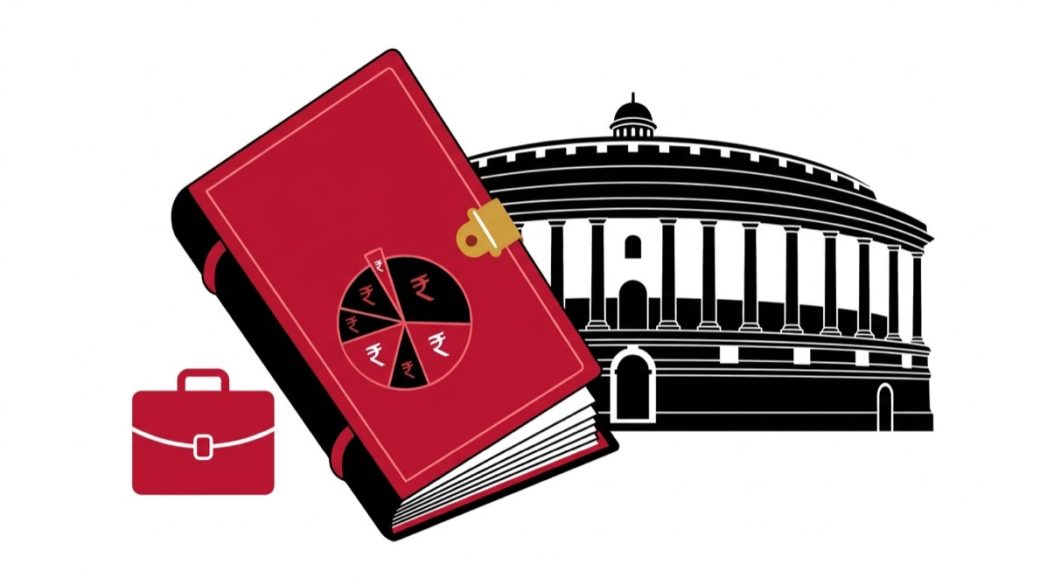
The Union Budget is the Government of India’s annual financial statement — a detailed account of how much money the government expects to earn and how much it plans to spend in the coming financial year (1 April to 31 March). Presented in Parliament by the Finance Minister, usually on 1 February, it is mandated by Article 112 of the Constitution and shapes everything from your income tax to the price of petrol, the cost of a home loan, and the funds flowing to schools, highways and the armed forces.
What is the Union Budget?
The Union Budget is officially called the Annual Financial Statement. The word “budget” comes from the old French bougette, meaning a small leather bag — a reminder that a budget is simply a plan for the money you carry in and the money you take out. For a country, that “bag” runs into trillions of rupees, but the idea is the same: estimate income, plan spending, and account for the gap.
Article 112 of the Constitution requires the President to have this statement of estimated receipts and expenditure laid before both Houses of Parliament for every financial year. In practice the Finance Minister presents it. Because tax and spending proposals need Parliament’s approval to become law, the budget is as much a political and policy document as a financial one — it signals the government’s priorities for the year ahead.
It is important to separate the Union Budget from related terms. The Union Budget is the Central government’s budget. Each state government presents its own state budget. And the budget is distinct from the Economic Survey, a report card on the economy that the Finance Ministry usually tables a day before the budget.
How the Union Budget is prepared
Making the budget is a months-long marathon led by the Department of Economic Affairs in the Ministry of Finance, working with the Department of Expenditure, the Department of Revenue, ministries, NITI Aayog and other stakeholders. Preparation typically begins around August–September, roughly five to six months before presentation.
Step 1: Circulars and data gathering
The Budget Division issues circulars to all ministries, departments, states and union territories asking them to submit estimates of their spending needs and expected receipts. They report against the previous year’s figures so the Finance Ministry can compare requests with actual performance.
Step 2: Estimates and negotiation
Ministries send their demands. Top officials of the Finance Ministry then hold detailed discussions with each department to scrutinise these numbers, because requested spending almost always exceeds available resources. This is where trade-offs are made.
Step 3: Consultations
The Finance Minister consults industry bodies, farmer groups, trade unions, economists and state representatives to understand on-the-ground needs and to gather views on tax policy. NITI Aayog provides inputs on allocation between sectors.
Step 4: Revenue and deficit decisions
The Department of Revenue and the Department of Economic Affairs project tax and non-tax income, decide on any changes to tax rates, and settle on the borrowing required to bridge the gap — the deficit. This balancing act is the heart of budget-making.
Step 5: The “Halwa” ceremony and printing
By tradition, the printing of budget documents begins with the Halwa ceremony, where the sweet is prepared and served to staff. From that point, officials involved in preparation are effectively secluded — a “lock-in” to prevent leaks — until the Finance Minister rises to speak in the Lok Sabha.
The two big parts: revenue and capital
Every rupee in the budget is sorted along two lines: whether it is revenue or capital, and whether it is a receipt (money coming in) or expenditure (money going out). Get these four boxes straight and the whole budget becomes readable.
| Receipts (money in) | Expenditure (money out) | |
|---|---|---|
| Revenue (recurring, no change in assets/liabilities) | Taxes (income tax, GST, customs), interest received, dividends from PSUs, fees | Salaries, pensions, interest payments, subsidies, day-to-day running costs |
| Capital (one-off, changes assets/liabilities) | Borrowings, loan recoveries, money raised by selling stakes in PSUs (disinvestment) | Building highways, railways, ports; buying machinery; loans given to states |
Revenue budget
The revenue budget covers the government’s regular income and its regular running expenses. Revenue receipts neither create a liability (you do not have to pay them back) nor reduce an asset. Revenue expenditure is spending that does not create a lasting asset — paying a teacher’s salary keeps a school running but does not build a new one.
Capital budget
The capital budget deals with money that changes the government’s assets or liabilities. Borrowing is a capital receipt because it creates a liability. Building a new expressway is capital expenditure (often called capex) because it creates a long-lasting asset. Economists watch capital expenditure closely, since productive capex can boost growth and jobs more durably than routine spending.
Deficits explained: fiscal, revenue and primary
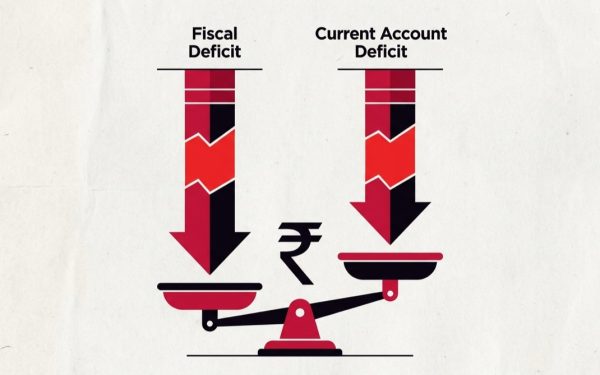
A deficit simply means spending more than you earn. Because the government usually plans to spend more than it collects, it borrows to cover the gap. The budget reports several deficit measures, and each answers a different question.
Fiscal deficit
The fiscal deficit is the most-watched number. It is total expenditure minus total receipts excluding borrowings. In plain terms, it is how much the government has to borrow in a year to meet all its spending. It is expressed as a percentage of GDP so it can be compared across years and countries. A high fiscal deficit can fuel inflation and raise interest costs; a very tight one can choke growth.
Revenue deficit
The revenue deficit is revenue expenditure minus revenue receipts. It tells you whether the government is borrowing just to cover its routine running costs — the equivalent of taking a loan to pay your monthly grocery bill, which is generally seen as unhealthy.
Primary deficit
The primary deficit is the fiscal deficit minus interest payments. It strips out the cost of past borrowing to show how much new borrowing is being driven by current-year choices. A falling primary deficit signals improving fiscal discipline.
| Deficit | Simple formula | What it tells you |
|---|---|---|
| Fiscal deficit | Total spending − receipts (excl. borrowing) | Total borrowing needed this year |
| Revenue deficit | Revenue spending − revenue receipts | Borrowing used for day-to-day costs |
| Primary deficit | Fiscal deficit − interest payments | Borrowing minus the burden of old debt |
India’s fiscal targets are guided by the FRBM Act (Fiscal Responsibility and Budget Management Act, 2003), which pushes the government toward gradually lowering the fiscal deficit and managing public debt responsibly.
The budget documents you should know
The budget is not a single speech — it is a thick set of documents, several of them constitutionally required. The most useful ones to know are below.
| Document | What it contains |
|---|---|
| Annual Financial Statement | The core estimate of receipts and expenditure under the Consolidated Fund, Contingency Fund and Public Account (the constitutional budget under Article 112). |
| Finance Bill | The proposals to impose, change or abolish taxes. Passing it gives legal force to tax changes. |
| Demands for Grants | Ministry-by-ministry requests for money that Parliament votes on. |
| Budget at a Glance | A short, reader-friendly summary of receipts, spending and deficits — the best starting point for beginners. |
| Expenditure & Receipt Budgets | Detailed breakdowns of where money is spent and where it comes from. |
| Macro-Economic Framework Statement | The government’s view on growth, the deficit and the economy (required under the FRBM Act). |
Since 2021, the budget has been presented in a largely paperless, digital format, and the documents are made freely available on the official budget website and a dedicated mobile app on budget day.
Budget jargon glossary
Budget coverage is full of shorthand. Here is a plain-English glossary of the terms you will hear most often.
| Term | Meaning in plain English |
|---|---|
| Consolidated Fund of India | The government’s main account; all revenues and borrowings flow in, and most spending flows out (needs Parliament’s nod). |
| Contingency Fund | An emergency reserve the President can tap for urgent, unforeseen spending, to be replaced later. |
| Public Account | Money where the government is just a banker — like provident funds and small savings — which it must eventually return. |
| Direct tax | Tax paid directly on income or profits, such as income tax and corporate tax. |
| Indirect tax | Tax on goods and services, collected through the seller, such as GST and customs duty. |
| Cess & surcharge | Extra levies on top of a tax, usually for a specific purpose (a cess) or on higher incomes (a surcharge). |
| Subsidy | Government support that lowers the price of essentials such as food, fertiliser or cooking fuel. |
| Disinvestment | The government selling part of its stake in a public-sector company to raise money. |
| Capital expenditure (capex) | Spending that builds lasting assets like roads, railways and ports. |
| Fiscal consolidation | A deliberate plan to shrink the deficit and control debt over time. |
| Vote on Account | Interim approval to spend for a few months, used when a full budget cannot be passed in time (common in an election year). |
Who is affected by the budget?
The short answer is: everyone. The budget decides tax rates, the funds available for public services, and the policy direction for entire industries. Here is how it lands on different groups.
Salaried individuals and the middle class
Changes to income-tax slabs, the standard deduction, and exemptions decide how much of your salary you keep. The choice between the old and new tax regimes is often shaped by budget tweaks.
Businesses and startups
Corporate tax rates, customs duties on inputs, sector incentives and ease-of-doing-business measures affect company costs and competitiveness. Startups watch for incentives, capital-gains rules and credit support.
Farmers and rural India
Allocations for agriculture, fertiliser subsidies, irrigation, rural employment schemes and crop support influence rural incomes and food prices.
Investors and markets
Capital-gains tax rules, the size of capital expenditure, the fiscal-deficit target and the government’s borrowing plan move stock and bond markets, which is why budget day is one of the busiest sessions of the year.
States
The budget reflects how central taxes are shared with states (based on Finance Commission recommendations) and how much is transferred through grants and centrally sponsored schemes.
Consumers
Customs and excise changes can raise or lower the price of items from cars and electronics to fuel and imported goods, affecting household budgets directly.
How to read the Union Budget
You do not need an economics degree to make sense of budget day. Use this simple, evergreen checklist to cut through the noise.
| Step | What to check | Why it matters |
|---|---|---|
| 1 | Open “Budget at a Glance” first | It summarises receipts, spending and deficits on a couple of pages. |
| 2 | Note the fiscal-deficit target (% of GDP) | Signals borrowing and the government’s appetite for spending vs. discipline. |
| 3 | Compare “budget estimate” vs. “revised estimate” | Shows whether last year’s plan actually held up. |
| 4 | Look at capital expenditure | Higher productive capex can support growth and jobs. |
| 5 | Read the income-tax section if salaried | Tells you the take-home impact for the year. |
| 6 | Scan top spending ministries | Reveals the government’s real priorities for the year. |
Frequently asked questions
What is the Union Budget in simple words?
It is the Government of India’s yearly plan for its money — an estimate of how much it will earn (mainly through taxes and borrowing) and how much it will spend on services, salaries, subsidies and building assets like roads and railways, for the financial year running 1 April to 31 March.
Who presents the Union Budget and when?
The Finance Minister presents it in the Lok Sabha, usually on 1 February. It is mandated by Article 112 of the Constitution as the Annual Financial Statement and must be laid before both Houses of Parliament.
What is the difference between the revenue budget and the capital budget?
The revenue budget covers recurring income and routine running costs (like taxes received and salaries paid) that do not change assets or liabilities. The capital budget covers one-off items that do — such as borrowings, disinvestment receipts, and spending on long-lasting assets like highways and ports.
What is the fiscal deficit?
The fiscal deficit is the gap between the government’s total spending and its total receipts excluding borrowing. In plain terms, it is how much the government must borrow in a year. It is shown as a percentage of GDP so it can be compared over time.
What is the difference between the Union Budget and the Economic Survey?
The Economic Survey is a review of how the economy performed and where it is headed, usually tabled a day before the budget. The Union Budget is the forward-looking financial plan with the actual tax and spending proposals.
What is a Vote on Account?
It is Parliament’s interim approval allowing the government to spend money for a few months when a full budget cannot be passed in time — typically used in an election year before a new government presents the full budget.
Where can I read the Union Budget documents?
All budget documents, including “Budget at a Glance,” the Finance Bill and the Annual Financial Statement, are published free on the official Government of India budget website and a dedicated app on budget day. “Budget at a Glance” is the best place for beginners to start.
Disclaimer: This article is for educational purposes only and is not investment/financial advice. Read all scheme/offer documents and consult a SEBI-registered adviser where relevant.