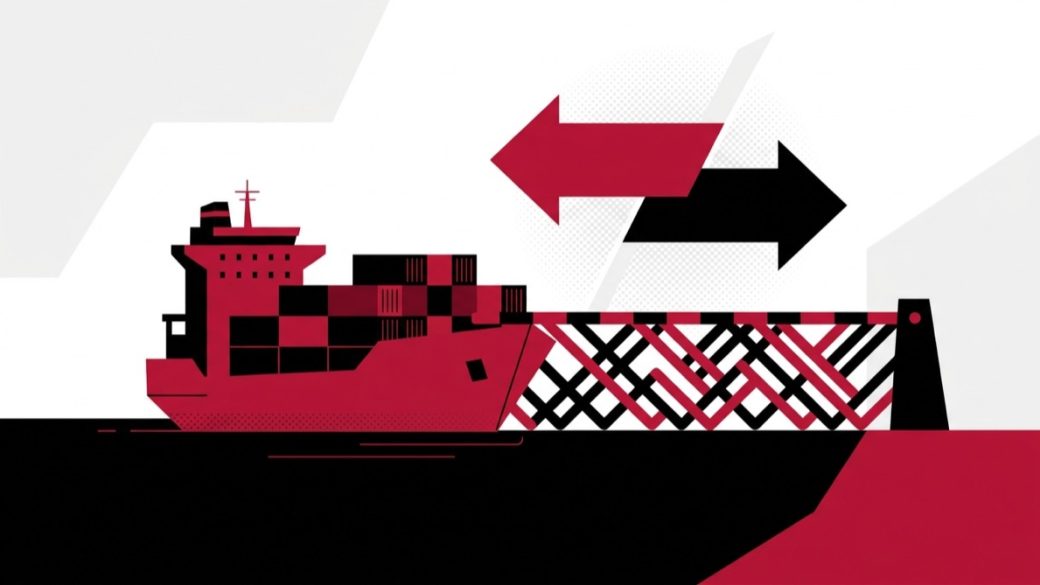
A tariff is a tax that a government charges on goods imported from another country. It is collected at the border by customs, paid by the importer, and usually passed on to consumers as a higher price. Governments use tariffs to protect local industries, raise revenue, and gain leverage in trade negotiations. When two countries retaliate by raising tariffs on each other, it becomes a trade war—and as a large importer and exporter, India feels the effects through prices, supply chains, and export demand.
What Is a Tariff and How Does It Work?
A tariff (also called a customs duty or import duty) is a tax levied on goods as they cross a national border. The simplest way to picture it: imagine a smartphone shipped from a factory abroad to a warehouse in India. Before that phone can be cleared and sold, the importer must pay a percentage of its value to Indian Customs. That payment is the tariff.
Although the importing company writes the cheque, the cost rarely stops there. Businesses typically build the duty into their selling price, so the final burden lands on the customer who buys the product. Economists call this the “incidence” of the tax—and for most consumer goods, a large share of a tariff is ultimately paid by buyers in the importing country, not by the foreign exporter.
Tariffs are usually expressed in one of two ways. An ad valorem tariff is a percentage of the goods’ value—for example, 20% of an imported television’s invoice price. A specific tariff is a fixed amount per unit—say, a set number of rupees per kilogram or per piece, regardless of price. Some products carry a compound tariff that combines both.
Types of Tariffs
Not all tariffs work the same way. They differ by how they are calculated and by the policy goal behind them. Understanding the main categories helps you read trade headlines accurately.
| Type of tariff | How it works | Example use |
|---|---|---|
| Ad valorem | A percentage of the imported item’s value | 10% on imported cars |
| Specific | A fixed charge per unit, weight, or quantity | A set amount per tonne of steel |
| Compound | Combines a percentage and a fixed per-unit charge | 5% of value plus a fixed sum per litre |
| Protective | Set high deliberately to shield domestic producers | High duty on a product made locally |
| Revenue | Set mainly to raise money for the government | Modest duty on widely imported goods |
| Retaliatory | Imposed to hit back at another country’s tariffs | Counter-duties during a trade war |
Anti-dumping and countervailing duties
Two specialised tariffs deserve a mention because India uses them often. An anti-dumping duty is charged when a foreign company sells goods in India below their normal price (“dumping”), which can damage local manufacturers. A countervailing duty (CVD) offsets subsidies that a foreign government gives its own exporters. Both are permitted under World Trade Organization (WTO) rules when an investigation finds genuine injury to domestic industry, and India has applied anti-dumping duties on a range of products over the years, including certain chemicals, steel, and goods imported from China.
Tariffs vs Other Trade Barriers
A tariff is the most visible trade barrier, but it is not the only one. Governments also use non-tariff barriers—rules and limits that restrict imports without charging a tax directly. For Indian importers and exporters, these can matter just as much as the duty rate.
| Barrier | What it does | Tax involved? |
|---|---|---|
| Tariff / customs duty | Taxes imports, raising their price | Yes |
| Import quota | Caps the quantity that may be imported | No |
| Import ban / licensing | Prohibits or requires permission to import certain goods | No |
| Standards & certification | Requires goods to meet quality, safety, or labelling rules | No |
| Subsidies to local firms | Makes domestic goods cheaper than imports | No (a spend, not a tax) |
Why Do Governments Impose Tariffs?
If tariffs raise prices for consumers, why use them at all? Because they serve several political and economic purposes at once. The main reasons governments—including India’s—impose tariffs are:
- Protecting domestic industry: Higher import prices give local manufacturers room to compete, grow, and add jobs. This is the logic behind “infant industry” protection—shielding a young sector until it can stand on its own.
- Raising government revenue: Customs duty is a steady source of income, especially valuable for developing economies. In India, customs duty is collected centrally and forms part of the Union government’s tax revenue.
- Correcting unfair trade: Anti-dumping and countervailing duties answer underpriced or subsidised imports.
- Negotiating leverage: The threat of tariffs is a bargaining chip in trade talks and free-trade-agreement negotiations.
- National security and self-reliance: Governments may protect strategic sectors—such as defence, energy, or critical electronics—so they are not dependent on a single foreign supplier. This aligns with India’s Atmanirbhar Bharat (self-reliant India) push.
Who Wins and Who Loses From Tariffs?
Tariffs redistribute costs and benefits across the economy. They are rarely win-win: a gain for one group is usually a loss for another. The chart below summarises the typical pattern.
One group often overlooked is manufacturers who import raw materials and components. An Indian electronics assembler or auto-parts maker that depends on imported chips, machinery, or metals can be hurt by tariffs on those inputs—its own costs rise even though the policy was meant to help “local industry.” This is why tariff design is delicate: a duty meant to protect one sector can damage another further down the value chain.
Trade Wars and the US-China Example
A trade war happens when countries retaliate against each other with rising tariffs and other barriers. Country A raises duties on Country B’s goods; B hits back on A’s goods; A escalates again. Each round raises prices, disrupts supply chains, and creates uncertainty for businesses worldwide.
How the US-China trade war unfolded
The best-known modern example began in 2018, when the United States imposed tariffs on a wide range of Chinese imports, citing trade-deficit and intellectual-property concerns. China retaliated with its own tariffs on American goods such as agricultural products. Several rounds of escalation followed, covering hundreds of billions of dollars of trade between the world’s two largest economies. A “Phase One” agreement in early 2020 paused some escalation, but many tariffs stayed in place, and trade tensions between the two countries have continued into the mid-2020s.
What a trade war does to the world
Trade wars tend to slow global growth, raise consumer prices, and force companies to rethink where they manufacture. One major consequence has been the “China-plus-one” strategy—multinationals diversifying production away from China to countries such as Vietnam, Mexico, and India to reduce tariff and concentration risk. For India, that shift has been both an opportunity and a competitive challenge.
How Tariffs Affect India
India is deeply woven into global trade, so tariffs—its own and other countries’—ripple through the economy in several ways.
Impact on Indian exporters
When foreign markets raise tariffs, Indian exporters face higher prices abroad and can lose orders to competitors from countries with lower duties or free-trade access. Sectors that sell heavily overseas—textiles and garments, gems and jewellery, pharmaceuticals, engineering goods, and IT-linked hardware—are the most exposed. A higher US or EU tariff on a category India exports can directly shrink that order book.
Impact on Indian importers and manufacturers
India imports crude oil, electronics, machinery, and many industrial inputs. Tariffs on these raise costs for domestic factories and, eventually, for consumers. A manufacturer that imports components to assemble products in India can see margins squeezed when input duties rise—an important tension within the “Make in India” goal of building local manufacturing while still relying on some imported parts.
The opportunity from global realignment
The flip side is real. As companies diversify supply chains away from a single country, India has positioned itself as an alternative manufacturing base, supported by production-linked incentive (PLI) schemes in sectors such as electronics, pharmaceuticals, and more. If India can offer competitive costs and reliable logistics, trade tensions elsewhere can channel investment toward Indian factories.
India’s Trade Policy and Tariff Structure
India’s tariffs are set mainly through the Customs Tariff Act and revised each year in the Union Budget, with the Central Board of Indirect Taxes and Customs (CBIC) administering collection. Duties are organised under the globally standard Harmonized System (HS) of nomenclature, which assigns a code to every traded product so that rates can be applied consistently and goods classified at customs.
Key features of India’s approach
- WTO membership: India is a founding member of the World Trade Organization and applies tariffs within its WTO commitments, including “bound” maximum rates it has agreed not to exceed.
- Free trade agreements (FTAs): India has signed trade agreements with partners such as the UAE and Australia and continues to negotiate others. FTAs lower or remove tariffs on many goods between the partners, which can boost exports but also expose some domestic sectors to more competition.
- Selective protection: India has, at various times, raised customs duties on certain finished goods—such as some electronics and consumer items—to encourage local manufacturing under Atmanirbhar Bharat and Make in India.
- Trade-defence tools: The Directorate General of Trade Remedies (DGTR) investigates dumping and subsidy complaints and recommends anti-dumping or countervailing duties where injury is found.
The balancing act
India’s policymakers constantly weigh competing goals: protect domestic industry and jobs, keep prices affordable for consumers, secure access to foreign markets for exporters, and honour international commitments. Tariff decisions sit at the centre of that balance, which is why every Union Budget’s customs-duty changes are watched closely by businesses and investors alike.
Frequently Asked Questions
What is a tariff and how does it work?
A tariff is a tax a government charges on imported goods. It is collected at the border by customs and paid by the importer, who usually passes the cost on to consumers through higher prices. It can be a percentage of the goods’ value (ad valorem) or a fixed amount per unit (specific).
What is the purpose of a tariff?
Tariffs are used to protect domestic industries from foreign competition, raise revenue for the government, counter unfair trade such as dumping, gain leverage in trade negotiations, and protect strategically important sectors.
What are the main types of tariffs?
The main types are ad valorem (a percentage of value), specific (a fixed charge per unit), and compound (a mix of both). By purpose, tariffs can be protective, revenue-raising, or retaliatory. Specialised duties include anti-dumping duties and countervailing duties.
What is a trade war?
A trade war is when countries retaliate against each other by repeatedly raising tariffs and other trade barriers. Each round increases prices and disrupts supply chains. The most prominent recent example is the US-China trade war that escalated from 2018.
Who pays for a tariff?
The importing business pays the duty to customs, but it typically builds that cost into its selling price. So in most cases consumers in the importing country ultimately bear a large share of the tariff, not the foreign exporter.
How do tariffs affect India?
Foreign tariffs can reduce demand for Indian exports such as textiles, gems, and pharmaceuticals, while India’s own tariffs on imports such as oil, electronics, and machinery raise costs for factories and consumers. At the same time, global supply-chain diversification can bring manufacturing investment to India.
What is the difference between a tariff and a quota?
A tariff taxes imports and raises their price, while a quota limits the quantity of a good that can be imported. A tariff generates revenue for the government; a quota simply restricts supply. Both are used to protect domestic producers.
Disclaimer: This article is for educational purposes only and is not investment/financial advice. Read all scheme/offer documents and consult a SEBI-registered adviser where relevant.