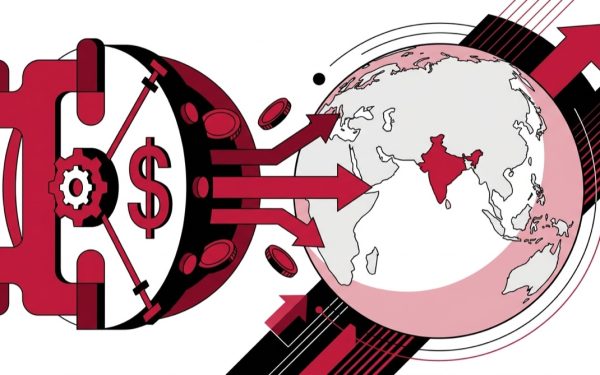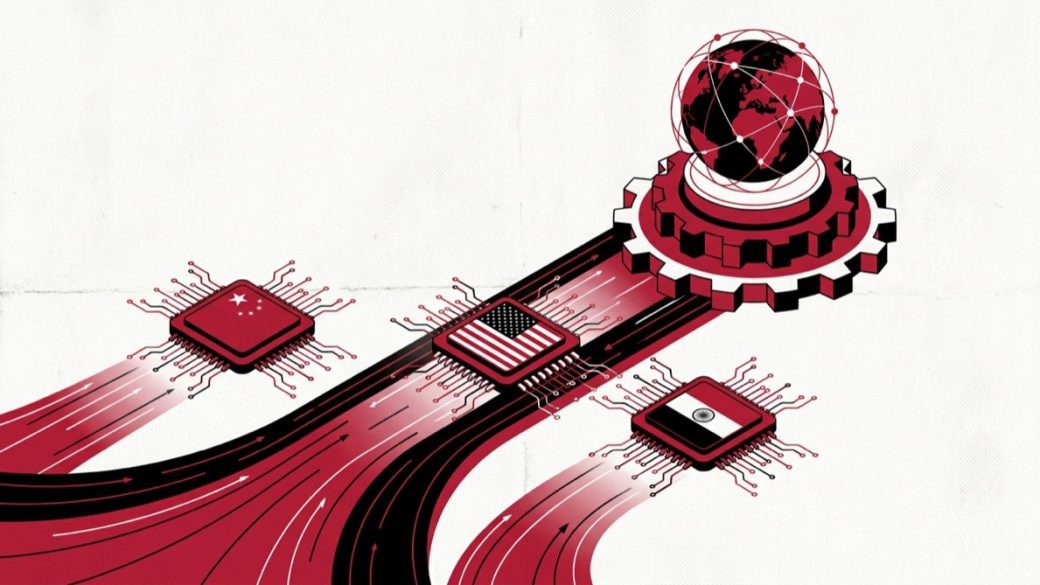
The global AI race is the contest between the United States and China to dominate artificial intelligence, with India emerging as a serious third player. The US leads on frontier models, advanced chips and capital; China leads on scale, manufacturing and state-backed deployment; and India holds the world’s largest pool of AI talent and digital users. Whoever controls the three real battlegrounds — compute, talent and data — will shape the economy, security and balance of power of the next several decades.
Why AI is a geopolitical race, not just a tech trend
For most of the internet era, technology leadership was treated as a commercial matter — a question of which company built the better product. Artificial intelligence has changed that. Governments now treat AI the way earlier generations treated nuclear technology, the space programme or control of oil: as a strategic asset that decides national power. That is why people call it a “race” and not simply a market.
There are three reasons AI has become geopolitical. First, it is a general-purpose technology — like electricity or the internet, it improves almost every other industry, from drug discovery to weapons to agriculture. A country that is meaningfully ahead in AI compounds that advantage across its entire economy. Second, AI has direct military and security uses: surveillance, cyber operations, autonomous systems and intelligence analysis. Third, the inputs to advanced AI — especially the most powerful chips — are concentrated in a handful of countries and companies, which makes AI a lever for sanctions, alliances and pressure.
This is the heart of the US–China AI race, and increasingly the reason India is treated as a country that must not be left behind. The contest is not about who has the cleverest chatbot this year. It is about who owns the underlying capability — the chips, the models, the talent and the data — that everything else will be built on.
How to think about “leadership” in AI
“Who is winning?” is the wrong single question, because leadership is layered. It helps to separate the AI stack into four layers and ask who leads each one:
- Chips and hardware — the processors that train and run AI models.
- Foundation models — the large, general-purpose AI systems (the “frontier”).
- Applications — products built on top of those models for real users.
- Deployment and adoption — how widely AI is actually used across the economy and government.
As the comparison below shows, no single country leads all four layers — which is exactly what makes the race genuinely contested.
The United States: the frontier leader
The United States is, as of 2026, the clear leader at the frontier of AI — the most capable, most general systems. Its lead rests on four reinforcing strengths.
1. The world’s most capable models
The best-known foundation models — built by companies such as OpenAI, Google DeepMind, Anthropic, Meta and others — are American. These are the systems that set the benchmark for what AI can do, and they attract users, developers and enterprise customers worldwide. Leadership at this layer matters because everyone else builds on, fine-tunes or competes against these models.
2. Chips and the hardware stack
This is arguably America’s deepest advantage. The chips that train and run advanced AI — high-end GPUs (graphics processing units) — are designed mainly by US firms, with Nvidia the dominant name and AMD a major challenger. The software ecosystem that runs on those chips (such as Nvidia’s CUDA platform) is also American and very hard to replace. The US does not manufacture most of these chips itself — that happens largely in Taiwan and South Korea — but it controls the design and the critical tools, which is what gives it leverage (see the section on export controls below).
3. Capital
Training a frontier model costs an enormous amount of money — for compute, electricity, data and talent. The US has the world’s deepest pools of venture capital, the largest technology companies by market value, and capital markets that are willing to fund expensive, long-horizon AI bets. This funding firepower lets American labs run experiments and build data centres at a scale few others can match.
4. Talent and an open ecosystem
American universities and companies attract top AI researchers from around the world — including, importantly, large numbers from India and China. An open research culture, a dense start-up ecosystem and the ability to commercialise quickly turn that talent into products. The main risks to the US position are high costs, energy and power constraints for data centres, and immigration policy that can choke off the inflow of foreign talent.
China: scale, state and self-reliance
China is the only country running neck-and-neck with the US across most of the AI stack, and it is the clear number two. Its approach is different from America’s in important ways.
A state-driven strategy
China treats AI as a national mission. Beijing has set long-term goals to become a world leader in AI, and the state actively channels funding, talent, data and policy support toward that aim. Where the US model is led by private companies and capital markets, China’s is a partnership between large technology firms — names such as Baidu, Alibaba, Tencent, Huawei and a wave of newer AI labs — and the government. This lets China move fast on national priorities and deploy AI widely in areas like surveillance, smart cities, manufacturing and public services.
Strengths: scale, data and manufacturing
China’s advantages are real and structural:
- Scale of users and data — a vast domestic market generates enormous quantities of data for training and refining AI systems.
- Manufacturing and deployment — China is the world’s factory, so it can embed AI into hardware, robotics and industrial processes at speed.
- A huge STEM workforce — China produces a very large number of science, technology, engineering and maths graduates and AI researchers each year.
- Cost efficiency — Chinese labs have shown they can build highly capable models with leaner resources, partly out of necessity because of chip restrictions.
The big constraint: advanced chips
China’s central weakness is access to the most advanced chips and the equipment to make them. US-led export controls (covered below) restrict China’s ability to buy top-end AI chips and the cutting-edge machines — especially advanced lithography tools — needed to manufacture them domestically. China is investing heavily to build its own chip industry and has made progress, but closing the gap at the leading edge is slow and expensive. This is the single biggest factor shaping how the US–China AI race plays out.
Where India actually stands
India is not yet competing with the US and China at the frontier of model-building — and it is important to be honest about that. But India is far from a bystander. It holds a genuinely strong position on some of the most valuable inputs to AI, and it is the country most often named as the credible “third pole” in the race.
India’s real strengths
- Talent. India has one of the largest pools of software engineers and AI/ML practitioners in the world, and Indians lead AI efforts at many of the biggest global technology companies. This is India’s single greatest asset in the race.
- A massive digital user base and data. India is among the largest internet and smartphone markets on earth. Its world-leading digital public infrastructure — Aadhaar (digital identity), UPI (real-time payments) and related systems, often grouped as “India Stack” — generates data and rails on which AI services can be built and delivered at population scale.
- Adoption and applications. Indian start-ups and enterprises are quick to adopt AI, especially in fintech, software services, healthcare, agriculture and education. The IT services industry is also retooling around AI for global clients.
- A national push. The Government of India’s IndiaAI Mission is a dedicated programme to build the country’s AI ecosystem — with a focus on subsidised computing capacity (GPUs), datasets, skilling, start-up funding and applications in Indian languages and for Indian problems.
India’s real gaps
The challenges are equally real. India does not yet have a home-grown frontier model in the same league as the top US or Chinese systems. It is heavily dependent on imported AI chips, has limited domestic semiconductor manufacturing (though this is now being built up under the India Semiconductor Mission), and has had relatively thin deep-tech research funding and home-grown AI capital compared with the two leaders. The strategic question for India is whether it can convert its enormous talent and data advantages into capability it actually owns.
| Dimension | United States | China | India |
|---|---|---|---|
| Frontier models | Clear leader | Strong #2, closing fast | Early stage; building first large models |
| Advanced chips | Designs & controls the stack | Restricted; racing for self-reliance | Import-dependent; new fabs being set up |
| Capital | Deepest in the world | Large, state-directed | Growing, but smaller |
| Talent | Top global talent magnet | Huge domestic STEM base | One of the largest talent pools |
| Data & users | Large, high-value | Very large domestic data | Massive base + digital public infrastructure |
| Deployment | Strong in enterprise & software | Aggressive, state-backed, broad | Fast-rising adoption |
| Lead model | Private-sector + capital markets | State + national champions | Public infrastructure + private start-ups |
The real battleground: compute, talent and data
Strip away the headlines and the AI race comes down to three inputs. Win these, and the models, products and economic gains follow. The country that secures all three at scale is the one that leads.
Compute: the most contested resource
“Compute” means raw processing power — the advanced chips, the data centres that house them, and the electricity to run them. Training a frontier model can require tens of thousands of high-end chips running for weeks. Compute is the most contested input precisely because it is the most concentrated and the easiest to restrict. The US can limit who gets the best chips; China is racing to make its own; and India is trying to build up subsidised national compute so its researchers and start-ups are not priced out. Increasingly, compute is also an energy story — data centres need vast and reliable power, which makes electricity policy an AI policy.
Talent: the scarcest resource
There are only so many people in the world who can build, train and safely deploy advanced AI systems. This talent is mobile and fought over. The US currently wins by attracting the best from everywhere (including India and China). China leans on a very large domestic pipeline. India produces a huge share of the world’s AI talent — but historically has exported much of it, which is why “reverse brain drain” and retaining talent at home is a central theme of India’s strategy.
Data: the renewable resource
AI systems learn from data. The quantity, quality and diversity of data a country can ethically harness — across languages, industries and government services — shapes how useful its AI becomes. China’s scale and India’s digital public infrastructure both matter here. For India specifically, building high-quality datasets in Indian languages is both a competitive edge and a way to make sure AI works for its own population, not just English-speaking, Western users.
Export controls and the chip war
You cannot understand the US–China AI race without understanding export controls. These are government rules that restrict the sale of specific advanced technologies — in this case, the most powerful AI chips and the equipment used to manufacture them — to particular countries.
What the US has done, and why
Starting in 2022 and tightening repeatedly since, the United States has restricted the export of cutting-edge AI chips and advanced chip-making equipment to China. The logic is straightforward: if advanced AI depends on advanced compute, then limiting China’s access to the best chips slows its progress at the frontier — especially for the largest, most capable models and military applications. Because these controls also involve allies that make the chips and the machines (such as the Netherlands, home to the leading maker of advanced lithography equipment, and partners in Japan and elsewhere), they function as a coordinated technology blockade at the leading edge.
How China has responded
China’s response has three parts: pour money into building a domestic chip industry; design more efficient models that squeeze more capability out of less powerful, permitted hardware; and tighten control over critical inputs it dominates, such as certain rare-earth elements and minerals used across electronics. The result is a slower but determined drive toward self-reliance.
What this means for India
For India, the chip war is both a risk and an opportunity. The risk is dependence: India imports the advanced chips it needs. The opportunity is “friend-shoring” — as the US and its partners look to reduce reliance on any single country (especially for manufacturing concentrated in Taiwan), India is positioning itself as a trusted location for chip assembly, testing and, over time, fabrication, through the India Semiconductor Mission and state incentives.
What India must do to compete
India’s goal is realistic, not fantastical: it does not need to “beat” the US and China on every layer. It needs to turn its talent and data advantages into capability it owns, and to make itself indispensable to the global AI supply chain. Analysts and India’s own strategy documents tend to converge on the following priorities.
1. Build sovereign compute — and the power to run it
India needs affordable, large-scale computing capacity so its researchers, start-ups and public institutions are not locked out by cost or by other countries’ export rules. That means subsidised national GPU clusters (a core aim of the IndiaAI Mission), more data centres, and a serious plan for the reliable, affordable electricity those data centres consume.
2. Retain and attract talent
India must make it attractive for its best AI minds to build at home and for global researchers to come to India. That means stronger research funding, world-class labs, better academia–industry links, and policies that reward deep-tech entrepreneurship rather than only services.
3. Invest in semiconductors for the long term
Full leading-edge chip manufacturing takes years and enormous capital, so India is sensibly starting with assembly, testing and packaging and moving up the value chain. Positioning India as a trusted manufacturing partner reduces dependence and earns strategic leverage.
4. Build for India — then the world
India’s edge is solving Indian problems at scale: AI in many Indian languages, for agriculture, healthcare, governance, education and financial inclusion, delivered over its digital public infrastructure. Models and products proven on India’s diversity and scale can then be exported to the rest of the developing world.
5. Get the rules right
Smart, light-touch but clear AI governance — on safety, data protection and accountability — can be a competitive advantage. It builds trust at home and makes India a credible partner abroad, including in global efforts to set AI standards.
| Area | Where India stands | Priority action |
|---|---|---|
| Talent | Major strength; large global pool | Retain & attract; fund deep-tech research |
| Data & digital rails | Major strength (India Stack, huge user base) | Build quality Indian-language datasets |
| Compute | Gap; import-dependent | Subsidised national GPU capacity + power |
| Chips | Gap; early-stage manufacturing | Climb the chip value chain via incentives |
| Frontier models | Gap; first large models emerging | Back home-grown foundation models |
| Applications | Rising fast | Solve India-scale problems, then export |
Frequently asked questions
Who is winning the US–China AI race?
As of 2026, the United States leads at the frontier — the most capable AI models, the most advanced chip designs and the deepest capital. China is a strong and fast-closing number two, with major advantages in scale, data, manufacturing and state-backed deployment, but it is constrained by limited access to the most advanced chips. So the US leads on capability while China leads on scale and breadth of deployment; neither has decisively “won.”
Where does India stand in the global AI race?
India is widely seen as the credible third player. It is not yet competing at the frontier of model-building, but it holds one of the world’s largest pools of AI talent, a massive digital user base, and world-leading digital public infrastructure (Aadhaar, UPI and the wider India Stack). Through the IndiaAI Mission and the India Semiconductor Mission, it is building national compute, datasets, skilling and chip capacity. Its main gaps are home-grown frontier models, advanced chip manufacturing and deep-tech capital.
Why is AI considered a geopolitical race?
Because AI is a general-purpose technology that improves almost every industry, has direct military and security uses, and depends on inputs — especially advanced chips — that are concentrated in a few countries. That combination makes AI leadership a question of national power, not just commercial success, so governments treat it as strategic infrastructure.
What are export controls and how do they affect the China AI race?
Export controls are government rules limiting the sale of specific advanced technologies to certain countries. Since 2022 the US, working with allies, has restricted China’s access to the most advanced AI chips and the equipment to make them. This slows China’s progress at the leading edge and is the single biggest factor shaping the US–China AI race — pushing China to build its own chips and to design more efficient models.
What is the real battleground in the AI race?
Three inputs: compute (advanced chips, data centres and the power to run them), talent (researchers and engineers who can build and deploy AI), and data (users, languages and industry information to train systems on). Whoever secures all three at scale leads, because the models, products and economic gains follow from these inputs.
Can India become an AI superpower?
It is possible but not guaranteed. India’s realistic strategy is to convert its talent and data advantages into capability it owns, secure affordable national compute and power, climb the semiconductor value chain, build AI for Indian languages and problems, and set clear, trust-building rules. If it executes on these, India can be a genuine third pole even without leading every layer of the stack.
Why are chips so important in the AI race?
Advanced AI models are trained and run on specialised, very powerful chips — mainly high-end GPUs. Without enough of these chips (and the electricity and data centres to run them), a country cannot build or operate frontier models. Because chip design and the tools to manufacture them are concentrated in a few countries, controlling chips means controlling who can compete at the top of AI — which is why the “chip war” sits at the centre of the race.
Disclaimer: This article is for educational purposes only and is not investment or financial advice. Geopolitical and technology developments move quickly; figures and positions described are general and current as of 2026. Read primary sources and consult a SEBI-registered adviser before making any investment decision related to the themes discussed here.