The US Federal Reserve (the “Fed”) is the central bank of the United States. It sets American interest rates, manages the dollar money supply and keeps the US financial system stable. Because the dollar is the world’s reserve currency, the Fed’s decisions ripple far beyond America — moving foreign investor flows into and out of India, the rupee–dollar exchange rate, and the Sensex and Nifty.
What is the Federal Reserve? ·
How the Fed is structured ·
The FOMC & how rates are decided ·
The Fed’s policy toolkit ·
Why the whole world watches the Fed ·
How Fed moves affect India ·
Fed vs RBI ·
How to follow the Fed ·
FAQ
What is the Federal Reserve?
The Federal Reserve System — usually shortened to “the Fed” — is the central bank of the United States. It was created by the US Congress in 1913, after a series of banking panics, to give the country a safer and more flexible monetary system. In simple terms, the Fed is to America what the Reserve Bank of India (RBI) is to India: the institution that controls interest rates, supervises banks and acts as the ultimate backstop when the financial system is under stress.
The US Congress has given the Fed a “dual mandate“: to pursue maximum employment and stable prices (low, predictable inflation, which the Fed targets at around 2% over the long run). Almost everything the Fed does — raising or cutting rates, buying or selling bonds — flows from trying to balance these two goals. When inflation runs hot, the Fed tightens. When the job market weakens and growth stalls, it eases.
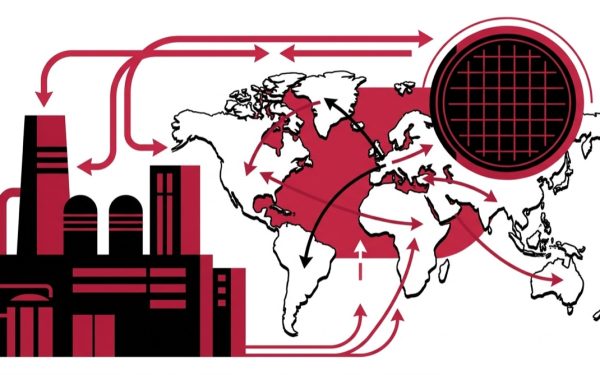
What makes the Fed unusual is its global reach. The RBI’s decisions mostly affect India. The Fed’s decisions affect everyone, because the US dollar is the currency in which most global trade, oil and cross-border debt is priced. When the Fed moves, capital moves — and emerging markets like India feel it quickly.
How the Federal Reserve is structured
The Fed is not a single building or one all-powerful banker. It is a system with three main parts, deliberately spread out so that no single region or political office controls it.
1. The Board of Governors
Based in Washington, D.C., the Board of Governors is the central, federal-government part of the system. It has up to seven governors, nominated by the US President and confirmed by the Senate, each serving long 14-year terms so they are insulated from short-term politics. The Board’s leader is the Chair of the Federal Reserve — the single most-watched economic official in the world. Jerome Powell has served as Fed Chair since 2018; the role sets the public tone for US monetary policy.
2. The 12 regional Federal Reserve Banks
The country is divided into 12 districts, each with its own regional Federal Reserve Bank (New York, Chicago, San Francisco and others). These banks carry out day-to-day operations — distributing currency, clearing payments, and supervising local banks. The Federal Reserve Bank of New York is especially important because it executes the Fed’s market operations.
3. The Federal Open Market Committee (FOMC)
The FOMC is the body that actually sets interest rates. This is the part of the Fed that markets in Mumbai, London and Tokyo wait for. We cover it in detail in the next section.
The FOMC and how interest rates are decided
The Federal Open Market Committee (FOMC) is the Fed’s policy-making engine. It has 12 voting members: the seven governors, the president of the New York Fed, and four other regional bank presidents who rotate. The FOMC meets eight times a year — roughly every six weeks — and these scheduled gatherings are simply called the “Fed meeting” or “FOMC meeting” in financial news.
What the FOMC actually decides
The headline decision is the target range for the federal funds rate — the interest rate at which US banks lend to each other overnight. This single number is the anchor for almost every other interest rate in the United States: mortgages, car loans, credit cards and, crucially for India, the yield investors can earn on safe US assets. When commentators say “the Fed raised rates” or “the Fed cut rates,” they mean the FOMC changed this target range.
The rhythm of a rate decision
Each meeting follows a familiar pattern. Officials review the latest data on inflation, jobs and growth, debate the outlook, and then vote. The decision is announced in a statement, followed by a press conference with the Fed Chair. Four times a year the Fed also publishes the “dot plot” — a chart showing where each official expects rates to go — and updated economic projections. Markets often react more to the tone and the dot plot (“hawkish” means leaning toward higher rates; “dovish” means leaning toward cuts) than to the rate change itself.
The Fed’s policy toolkit
Changing the interest rate is the Fed’s most famous lever, but not its only one. Understanding the full toolkit helps explain headlines about “QE,” “QT” and “tightening.”
| Tool | What it does | When the Fed uses it |
|---|---|---|
| Federal funds rate | Sets the cost of short-term money for the whole economy | The main, everyday tool at every meeting |
| Open market operations | Buying or selling US government bonds to add or drain cash from the banking system | To steer the funds rate to its target |
| Quantitative easing (QE) | Large-scale bond buying that floods the system with money and lowers long-term rates | In crises, when rates are already near zero (e.g. 2008, 2020) |
| Quantitative tightening (QT) | Shrinking the Fed’s bond holdings, pulling money back out | When the economy is strong and inflation needs cooling |
| Lender of last resort | Emergency loans to banks to prevent panics and bank runs | During financial-system stress |
“Tightening” is the umbrella term for the Fed making money scarcer and more expensive — raising rates and/or doing QT. “Easing” is the opposite. For Indian markets, the single most important thing to track is the direction of this cycle, because a tightening Fed and an easing Fed produce very different outcomes for the rupee and for foreign flows.
Why the whole world watches the Fed
No other central bank gets the kind of global attention the Fed does. There are three core reasons, and all of them trace back to the dominance of the US dollar.
1. The dollar is the world’s reserve currency
Most international trade — including crude oil, which India imports heavily — is invoiced in dollars. Countries hold a large share of their foreign-exchange reserves in dollars, and a huge volume of global debt is denominated in dollars. When the Fed changes the cost of dollars, it changes borrowing costs and currency values everywhere.
2. US rates set the “global risk-free rate”
US government bonds (Treasuries) are treated as the safest asset in the world. The yield on them effectively becomes the baseline return against which every other investment — including Indian stocks and bonds — is judged. When the Fed pushes US yields up, safe dollar returns rise, and riskier emerging-market assets must offer more to stay attractive.
3. Capital chases yield across borders
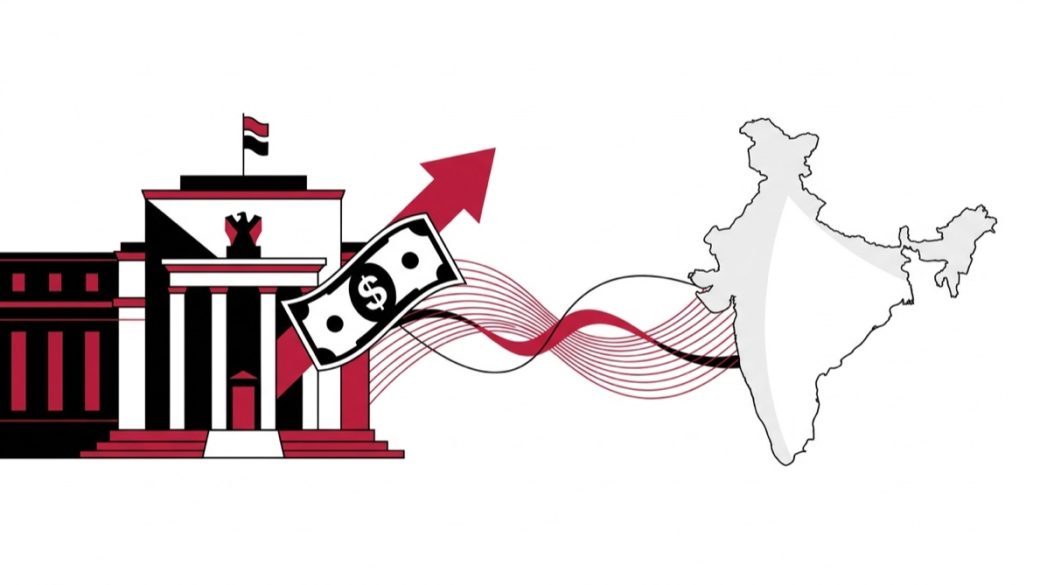
Global investors constantly move money to wherever the risk-adjusted return looks best. Higher US rates pull money toward the United States; lower US rates push money out in search of better returns in markets like India. This flow is the main channel through which the Fed reaches Dalal Street.
How Fed moves affect India
This is the part that matters most for Indian investors, students and business owners. The Fed sits in Washington, but its decisions show up in the value of your rupee, the level of the Sensex and the cost of borrowing for Indian companies. There are four main transmission channels.
1. Foreign investor (FPI/FII) flows
Foreign Portfolio Investors — often called FIIs — are among the biggest movers of the Indian stock market. When US rates rise, parking money in safe American assets becomes more rewarding, so FPIs often sell Indian equities and pull money home. When US rates fall, India’s higher growth and returns look more attractive, and foreign money tends to flow in. Big FPI selling can drag the Nifty down even when India’s own economy is doing fine.
2. The rupee–dollar exchange rate
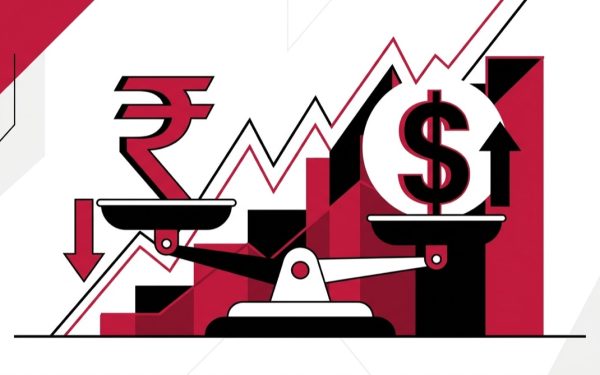
When foreign investors sell Indian assets, they convert rupees back into dollars, increasing demand for dollars and weakening the rupee. A stronger dollar (driven by a hawkish Fed) therefore usually means a weaker rupee. A weaker rupee makes India’s imports — especially crude oil and electronics — more expensive, which can feed domestic inflation.
3. Indian stock markets (Sensex & Nifty)
Indian indices are sensitive to Fed signals for two reasons: the direct effect of FPI buying or selling, and sentiment. A surprise hawkish Fed can trigger a sell-off across global markets, and India rarely escapes the mood. Conversely, signals of Fed rate cuts often spark rallies in emerging-market equities, India included.
4. The RBI’s room to manoeuvre
The Fed even shapes what the RBI can do. If the Fed keeps US rates high while the RBI cuts aggressively, the interest-rate gap between the two countries narrows, which can pressure the rupee and encourage outflows. So the RBI often watches the Fed closely when timing its own rate decisions — not because it must copy the Fed, but because ignoring it can destabilise the currency.
Fed vs RBI: how the two central banks compare
Indian readers naturally compare the Fed with the Reserve Bank of India. They do similar jobs, but the scale, mandate and reach differ in important ways.
| Feature | US Federal Reserve | Reserve Bank of India (RBI) |
|---|---|---|
| Founded | 1913 | 1935 |
| Key policy rate | Federal funds rate (target range) | Repo rate |
| Rate-setting body | Federal Open Market Committee (FOMC) | Monetary Policy Committee (MPC) |
| Mandate | Dual: maximum employment + stable prices (~2% inflation) | Primarily price stability: flexible inflation target of 4% (+/- 2%) |
| Currency managed | US dollar (world reserve currency) | Indian rupee |
| Global impact | Worldwide — moves markets everywhere | Mainly domestic, with regional spillovers |
| Meetings per year | 8 FOMC meetings | 6 MPC meetings (typically) |
The headline difference is reach. When the RBI changes the repo rate, it is steering the Indian economy. When the Fed changes the funds rate, it is steering the US economy and sending shockwaves through every emerging market — which is exactly why an Indian investor needs to understand the Fed almost as much as the RBI.
How to follow the Fed (without getting lost)
You do not need a finance degree to track the Fed intelligently. You need to know what to watch and how to interpret it. Here is a practical routine for an Indian investor or student.
What to watch
| Signal | Why it matters | How often |
|---|---|---|
| The FOMC rate decision | The headline move — hike, cut or hold | 8 times a year |
| The Chair’s press conference | Tone (hawkish vs dovish) often matters more than the number | After each meeting |
| The “dot plot” & projections | Shows the expected future path of rates | 4 times a year |
| FOMC minutes | Detailed record revealing the debate behind the decision | ~3 weeks after each meeting |
| US inflation & jobs data | Drives what the Fed is likely to do next | Monthly |
A simple way to read the signal
Boil it down to direction. If the Fed is hawkish (worried about inflation, leaning toward higher or “higher-for-longer” rates), expect potential pressure on the rupee and on FPI flows into India. If the Fed turns dovish (signalling cuts), emerging-market assets including Indian equities often benefit. You are not trying to predict the exact rate — you are tracking the cycle.
Where to follow it
The Fed publishes everything on its official website (federalreserve.gov), including statements, the dot plot and meeting calendar. For an India-centric lens, reputable Indian business media translate each decision into what it means for the rupee, Nifty and FPI flows — which is usually the most useful framing for a domestic reader.
Frequently asked questions about the Federal Reserve
What is the Federal Reserve in simple terms?
The Federal Reserve is the central bank of the United States. It sets US interest rates, controls the supply of dollars, supervises banks and acts as a backstop in financial crises. It plays the same broad role in America that the RBI plays in India — but because the dollar is the world’s main currency, its decisions affect markets globally.
What is the FOMC and what does it do?
The Federal Open Market Committee (FOMC) is the part of the Fed that sets interest rates. It has 12 voting members and meets eight times a year. At each “Fed meeting” it decides the target range for the federal funds rate — the benchmark that influences almost every other interest rate in the US economy.
How does the Fed raising interest rates affect India?
When the Fed raises rates, safe US returns rise and the dollar tends to strengthen. Foreign investors (FPIs) often pull money out of Indian stocks and bonds to chase those US returns. That can weaken the rupee, pressure the Sensex and Nifty, and make India’s imports — like crude oil — more expensive. A Fed rate cut broadly reverses these effects.
Why does the whole world watch the US Federal Reserve?
Because the US dollar is the world’s reserve currency. Global trade, oil and a huge amount of international debt are priced in dollars, and US government bonds set the global “risk-free” benchmark return. When the Fed changes the cost of dollars, borrowing costs, currencies and capital flows shift everywhere, including in India.
What is the difference between the Federal Reserve and the RBI?
Both are central banks, but the Fed manages the US dollar and has a dual mandate (maximum employment plus ~2% inflation), with rates set by the FOMC. The RBI manages the Indian rupee with a primary focus on price stability (a 4% inflation target, +/- 2%), and rates are set by the Monetary Policy Committee. The biggest difference is reach: Fed decisions move markets worldwide, while the RBI’s impact is mainly domestic.
Who is the head of the Federal Reserve?
The Federal Reserve is led by the Chair of the Board of Governors, who is nominated by the US President and confirmed by the Senate. Jerome Powell has served as Fed Chair since 2018. The Chair runs the post-meeting press conferences and is the most closely watched economic official in the world.
What do “hawkish” and “dovish” mean for the Fed?
“Hawkish” means the Fed is leaning toward higher interest rates to fight inflation. “Dovish” means it is leaning toward lower rates to support growth and jobs. Markets often react more to whether the Fed sounds hawkish or dovish than to the actual rate decision, because the tone signals where rates are headed next.
Disclaimer: This article is for educational purposes only and is not investment/financial advice. Read all scheme/offer documents and consult a SEBI-registered adviser where relevant.