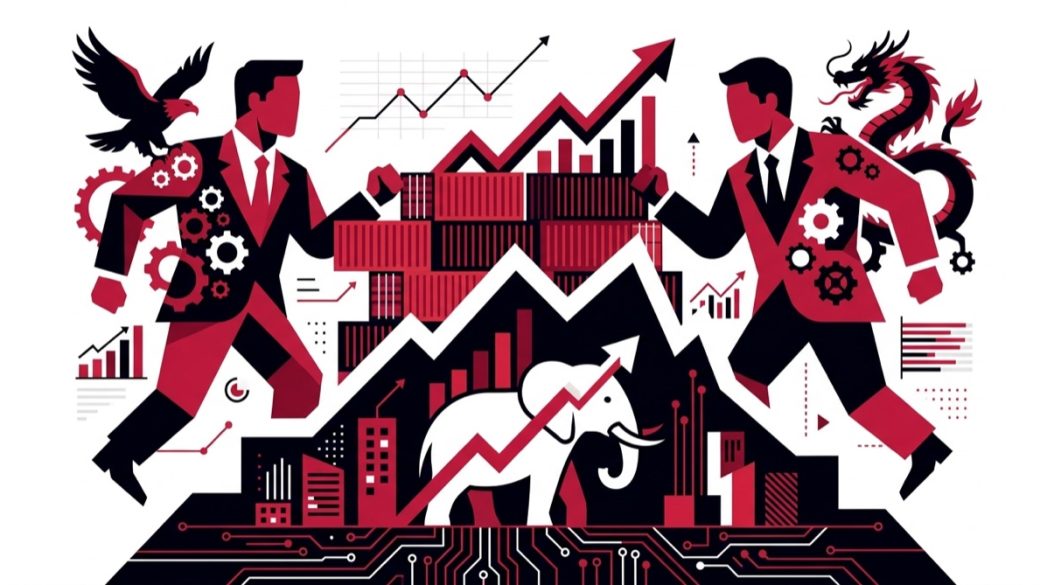
The US-China trade war is a years-long economic standoff between the world’s two largest economies that began in 2018, when the United States started imposing steep tariffs (import taxes) on Chinese goods and Beijing retaliated in kind. It has since widened from tariffs into a “tech war” over semiconductors, export controls and supply chains. For India, the conflict is a double-edged sword: it raises the risk of cheap Chinese goods being dumped into our markets, but it also opens a once-in-a-generation “China+1” opportunity as global firms look for an alternative manufacturing base.
What is the US-China trade war?
A trade war is what happens when two countries repeatedly raise barriers against each other’s goods and services — usually through tariffs (taxes on imports), but also through quotas, export bans, blacklists and other restrictions. The US-China trade war is the most consequential example in modern history, pitting the world’s largest economy (the United States) against its largest manufacturer and second-largest economy (China).
At its simplest, the conflict is about a few overlapping grievances: a very large US trade deficit with China (the US buys far more from China than it sells back), American complaints about unfair Chinese trade practices — forced technology transfer, intellectual-property theft and heavy state subsidies — and a deeper strategic contest over who will dominate the technologies of the future, from artificial intelligence to advanced chips.
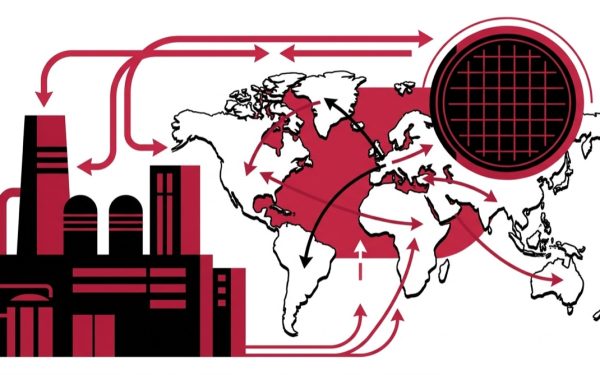
What started in 2018 as a tariff fight has, by 2026, matured into something broader that economists call “decoupling” (or, in its softer form, “de-risking”) — a deliberate effort to reduce how dependent the two economies are on each other. Because the US and China sit at the heart of global supply chains, every other economy, India included, feels the aftershocks.
Origins: why it started
To understand the trade war, you have to start with the numbers that made Washington uncomfortable. For two decades after China joined the World Trade Organization (WTO) in 2001, Chinese manufacturing boomed and the US ran a persistent, growing trade deficit with China — meaning the value of goods America imported from China far exceeded what it exported there.
The core grievances
American policymakers across both political parties came to share a set of complaints about how China competed:
- Forced technology transfer: foreign companies were often required to partner with Chinese firms and share know-how to access the Chinese market.
- Intellectual-property concerns: US firms alleged large-scale copying of designs, patents and trade secrets.
- State subsidies: Beijing’s industrial policy poured state money into strategic sectors, which critics said created unfair competition.
- The trade imbalance itself: seen in Washington as evidence that the relationship was lopsided.
In 2017-2018, the US administration used these grievances to justify tariffs under American trade laws — chiefly “Section 301,” a provision that lets the US act against trade practices it deems unfair. The first tariffs landed in 2018, and China retaliated almost immediately, targeting US farm exports such as soybeans. The trade war had begun.
Why it goes beyond economics
It would be a mistake to read the trade war as a pure accounting dispute. Underneath the tariffs is a strategic rivalry: a contest over which power will set the rules and own the cutting-edge technologies of the 21st century. That is why, even after tariffs stabilised, the conflict kept escalating in new areas like semiconductors and AI. This is the single most important thing to grasp — the trade war is really a technology and power competition wearing the clothes of a tariff dispute.
Key events & tariffs: a timeline
The trade war has unfolded in waves. The broad arc below traces how it moved from opening shots to a fragile truce, a tech-focused escalation, and renewed tariff brinkmanship in the mid-2020s. (Exact tariff rates have changed repeatedly and have at times been paused, raised, or partially rolled back, so treat specific figures as direction-of-travel rather than today’s live rate.)
The main phases at a glance
| Phase | Roughly when | What happened |
|---|---|---|
| Opening shots | 2018-2019 | The US imposed tariffs on hundreds of billions of dollars of Chinese goods; China retaliated on US farm and industrial exports. |
| “Phase One” truce | Early 2020 | A partial deal in which China agreed to buy more US goods; most tariffs stayed in place. |
| Tech-war escalation | 2020-2023 | Focus shifted to semiconductors: US blacklists, equipment bans and sweeping export controls on advanced chips and chipmaking tools. |
| Tariff revival | 2024-2026 | New and higher tariffs targeted strategic sectors (electric vehicles, batteries, chips, solar), with periodic threats, pauses and partial deals on both sides. |
The tech war: chips & export controls
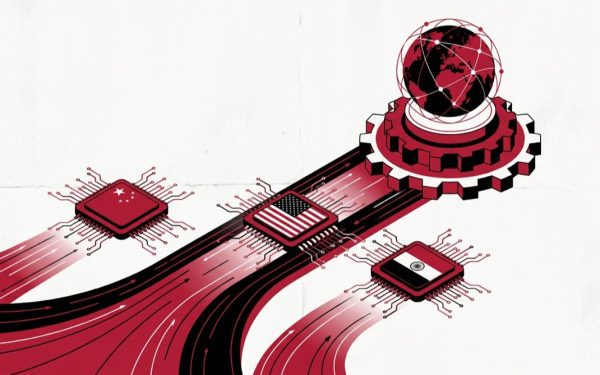
If tariffs were Act One, the technology war over semiconductors is the part that matters most for the future — and it is where the conflict became genuinely strategic rather than just commercial.
Why chips became the battlefield
Semiconductors — the tiny chips that power everything from smartphones and cars to AI data centres and missiles — are the chokepoint of the modern economy. The most advanced chips are made by a remarkably small number of companies, and the equipment to manufacture them is even more concentrated. Whoever controls advanced chips controls the pace of progress in artificial intelligence, which is why both Washington and Beijing treat them as a national-security issue, not just a trade item.
Export controls explained
An export control is a government rule that restricts which products, technologies or know-how can be sold to a particular country or company. Rather than relying on tariffs (which simply make trade more expensive), the US increasingly used export controls to block China’s access to the most advanced chips and the machines that make them. The logic is bluntly strategic: slow down a rival’s progress in AI and advanced computing by cutting off the hardware it depends on.
China’s response has been twofold: pour enormous resources into building its own domestic chip industry (a drive for “self-sufficiency”), and use its own leverage — for example, restricting exports of critical minerals and rare-earth materials where it dominates global supply, and which the rest of the world (including chipmakers and defence firms) needs.
| Tool | What it does | Used mainly by |
|---|---|---|
| Tariffs | Tax imports to make them costlier and protect home industry | Both sides |
| Export controls | Ban or license the sale of advanced chips & chipmaking tools | United States |
| Entity blacklists | Bar named foreign companies from buying US technology | United States |
| Critical-mineral curbs | Restrict exports of rare earths & key materials | China |
| Subsidies / self-sufficiency drives | Fund domestic industry to reduce reliance on rivals | Both sides |
This is the crucial shift: the conflict moved from “how expensive is trade?” (tariffs) to “who is allowed to access the most powerful technology at all?” (export controls). That is a far harder dispute to resolve, because it is tied to national security rather than balance sheets.
Decoupling & supply chains
The combined effect of tariffs and tech restrictions has been to push companies to rethink where they make things. This rewiring of global supply chains is the trade war’s most far-reaching consequence — and the one with the most direct relevance to India.
Decoupling vs de-risking
Two pieces of jargon dominate the debate:
- Decoupling: a full separation of the US and Chinese economies — fewer shared supply chains, less mutual dependence. In practice, a complete divorce is extremely hard because the two economies are so deeply intertwined.
- De-risking: the more realistic version. Instead of cutting China off entirely, companies and governments try to reduce dependence in sensitive areas (chips, pharmaceuticals, critical minerals) while continuing to trade in everything else.
The “China+1” strategy
The most important business response is what is known as “China+1.” Rather than abandoning China, multinational companies keep their Chinese operations but add at least one more manufacturing location elsewhere — to spread risk, dodge tariffs, and avoid being caught in the crossfire of future restrictions. The big winners of China+1 are economies that can credibly host large-scale manufacturing: Vietnam, Mexico, parts of Southeast Asia — and, increasingly, India.
China+1 and India’s opportunity
This is where the story comes home. For India, the US-China trade war is not just foreign news — it is one of the biggest external tailwinds for the economy in a decade, if the country can capture it.
Why India is well placed
Several factors make India a natural beneficiary of China+1 and the broader push to diversify away from China:
- Scale and labour: a vast, young workforce and a large domestic market that global firms want to serve.
- Government push: programmes such as Make in India and Production-Linked Incentive (PLI) schemes offer financial incentives to manufacture locally in sectors like electronics, mobile phones, pharmaceuticals and solar.
- Existing momentum: India has already become a major assembly hub for smartphones, with leading global brands expanding local production and exports.
- Geopolitical fit: as a large democracy and a member of groupings like the Quad, India is seen by Western firms and governments as a “trusted” partner for sensitive supply chains.
Where the opportunity is concentrated
| Sector | Why the trade war helps India |
|---|---|
| Electronics & smartphones | Brands shifting assembly out of China need large, low-cost bases; India’s PLI scheme directly targets this. |
| Semiconductors (assembly & testing) | India is courting chip packaging, testing and eventually fabrication to plug into the diversifying chip supply chain. |
| Pharmaceuticals & APIs | The world wants to reduce reliance on China for key drug ingredients; India is already a pharma powerhouse. |
| Solar, batteries & clean tech | Tariffs on Chinese solar and EV inputs push buyers to seek alternative suppliers. |
| Engineering & auto components | Global supply-chain diversification creates demand for Indian-made parts. |
What still holds India back
The opportunity is real but not automatic. India competes with Vietnam, Mexico and others for the same factories, and it carries its own constraints: higher logistics costs, regulatory complexity, infrastructure gaps and a manufacturing base that — despite progress — still relies heavily on imported Chinese components and machinery. In other words, even as India tries to become the “+1,” it is itself dependent on China for many inputs, which is a vulnerability the trade war exposes rather than solves.
Risks for India
A neutral assessment has to weigh the dangers alongside the upside. The trade war creates several distinct risks for India.
1. Dumping and import surges
When Chinese exporters are shut out of the US market by tariffs, they look for other places to sell. That can mean a flood of cheap Chinese goods — steel, chemicals, electronics, toys — being “dumped” into markets like India at prices local manufacturers struggle to match. India has periodically responded with anti-dumping duties, but managing this is a constant balancing act.
2. Supply-chain and input costs
Because Indian factories rely on Chinese components and capital equipment, restrictions, shortages or price spikes in China can raise costs for Indian producers — even those trying to export to the West. The same critical-mineral curbs that hurt the US can ripple into Indian industry too.
3. Global slowdown and market volatility
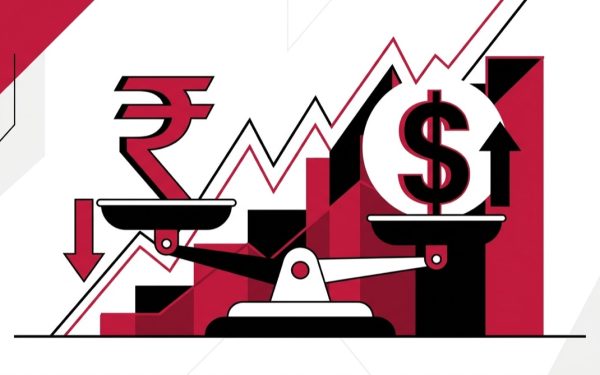
Trade wars dampen global growth and rattle financial markets. Sharp tariff announcements have repeatedly triggered swings in stock markets and currencies worldwide. As an open economy, India is exposed to this volatility through foreign investment flows, the rupee’s exchange rate and demand for its exports.
4. Pressure to pick sides
A deeper US-China split can force “friend-shoring” choices, where trade and technology flow along geopolitical lines. India’s traditional preference for strategic autonomy becomes harder to maintain when both blocs want commitments.
Outlook: what happens next
Predicting the precise course of the trade war is a fool’s errand — it has repeatedly defied expectations. But a few structural conclusions are reasonably safe.
First, the rivalry is here to stay. Support for a tougher line on China is one of the few things both major US political parties agree on, and Beijing’s drive for technological self-sufficiency is a long-term national project. Specific tariff rates will rise and fall with negotiations, but the underlying competition — especially over chips and AI — is structural, not seasonal.
Second, de-risking will continue even if full decoupling never arrives. Expect more “friend-shoring,” more incentives for domestic chip and clean-tech production in many countries, and a steady, messy reorganisation of supply chains.
Third, for India the window is real but time-bound. The China+1 shift is happening now, and the countries that fix their manufacturing fundamentals fastest will capture the most. India’s task is execution: power, ports, predictable policy, skilling and lower logistics costs. Get those right, and the trade war could be remembered as the moment global supply chains tilted India’s way; get them wrong, and the gains flow elsewhere.
Frequently asked questions
What is the US-China trade war in simple terms?
It is a prolonged economic conflict in which the United States and China repeatedly raise barriers against each other’s goods and technology. It began in 2018 with US tariffs (import taxes) on Chinese products and Chinese retaliation, and has since expanded into a “tech war” over semiconductors, export controls and competing efforts to reduce reliance on each other’s economies.
Why did the US-China trade war start?
The US cited a large trade deficit with China and complaints about unfair practices — forced technology transfer, intellectual-property concerns and heavy state subsidies. Underneath those grievances is a deeper strategic rivalry over who will lead in critical future technologies such as artificial intelligence and advanced chips.
What is the impact of the US-China trade war on India?
It is mixed. On the upside, the “China+1” strategy — where global firms add a manufacturing base outside China — positions India to win factories, exports and investment, especially in electronics, pharma and clean tech, helped by Make in India and PLI schemes. On the downside, India faces risks of cheap Chinese goods being dumped here, continued dependence on Chinese inputs, and exposure to global market volatility.
What is “China+1” and why does it matter for India?
“China+1” is a business strategy where companies keep their operations in China but add at least one additional manufacturing location to spread risk and avoid tariffs. It matters for India because India is one of the leading candidates — alongside Vietnam and Mexico — to become that “+1,” which could bring significant investment and jobs.
What is the “tech war” over semiconductors?
It is the part of the conflict focused on advanced chips. The US has used export controls to block China’s access to the most advanced semiconductors and the equipment to make them, aiming to slow China’s progress in AI and computing. China has responded by investing heavily in its own chip industry and restricting exports of critical minerals where it dominates.
What is the difference between decoupling and de-risking?
Decoupling means fully separating the US and Chinese economies — far less shared trade and dependence. De-risking is the more realistic approach: reducing reliance in sensitive areas like chips, medicines and critical minerals, while continuing to trade in most other goods. In practice the world is de-risking, not fully decoupling.
Is the US-China trade war over?
No. There have been partial deals and pauses, but the underlying rivalry — especially over technology and chips — is structural and bipartisan in the US, and tied to long-term national goals in China. Specific tariffs may rise or fall with negotiations, but the broader competition is expected to continue for years.
Disclaimer: This article is for educational purposes only and is not investment/financial advice. Read all scheme/offer documents and consult a SEBI-registered adviser where relevant.