The “crude oil price” is the cost of one barrel (159 litres) of unrefined petroleum, quoted in US dollars and set on global markets — mainly through two benchmarks, Brent and WTI. It matters enormously to India because we import close to 88% of the crude we use, so every change in the dollar-per-barrel price ripples into our import bill, the rupee, inflation, and the petrol and diesel you pay for at the pump.
What “crude oil price” actually means ·
How crude oil is priced (Brent, WTI, the basket) ·
Brent vs WTI: the difference ·
What moves crude oil prices ·
Why crude oil prices matter to India ·
From crude barrel to your petrol tank ·
How to follow crude oil prices ·
FAQ
What “crude oil price” actually means
When the news says “crude oil is at $80 a barrel,” it is quoting the price to buy one barrel of unrefined petroleum — the thick, raw liquid pumped out of the ground before it is turned into petrol, diesel, jet fuel, LPG, plastics and a hundred other products. A barrel is a fixed unit equal to 42 US gallons, or about 159 litres. Prices are quoted almost universally in US dollars per barrel (often written USD/bbl), because crude is a globally traded commodity and the dollar is the world’s main settlement currency for it.
There is no single “world price” for crude. Different oil fields produce slightly different grades of crude, so the market uses a handful of benchmark prices — reference grades whose prices everyone watches and prices other crude against. The two you will see quoted every day are Brent (the global benchmark) and WTI (the main US benchmark). India tracks both, plus its own purchase price called the Indian Basket.
Why it is measured in barrels and dollars
The “barrel” is a historical hangover from the 1800s American oil industry, when crude really was shipped in wooden barrels. The unit stuck even after pipelines and tankers took over. The dollar pricing matters for India specifically: because we pay for imported crude in dollars, the price we actually bear depends on two things — the dollar price of oil and the rupee-dollar exchange rate. A barrel can stay flat in dollars but still get costlier for India if the rupee weakens.
How crude oil is priced (Brent, WTI, the basket)
Crude oil prices are not “announced” by any government or by OPEC. They are discovered continuously in two linked places:
1. The physical market
Refiners, national oil companies and trading houses buy and sell actual cargoes of crude to be delivered by tanker or pipeline. The price agreed in these real deals reflects the specific grade, the delivery location and the timing.
2. The futures market
Most of the price you see on screen comes from futures — standardised contracts to buy or sell crude at a set price on a future date, traded on exchanges like ICE (for Brent) and NYMEX/CME (for WTI). Futures let airlines, refiners and producers lock in prices (hedging) and let traders speculate. Because thousands of participants trade them every second, futures are the fastest, most visible signal of what the market thinks crude is worth right now.
The benchmarks and the Indian Basket
A benchmark is simply a widely accepted reference grade. Other crudes are sold at “benchmark price plus or minus a differential” depending on quality. India does not consume much Brent or WTI directly; it buys a mix of grades from many suppliers. The government’s Petroleum Planning & Analysis Cell (PPAC) therefore publishes the Indian Basket — a weighted average of the crude grades India actually imports — which is the number that feeds into India’s import-bill and fuel-pricing maths.
| Benchmark | What it represents | Where it trades | Why India watches it |
|---|---|---|---|
| Brent Crude | Light, sweet crude from North Sea fields; the global benchmark for roughly two-thirds of traded oil | ICE Futures Europe (London) | India’s imports are priced more off Brent than WTI, so Brent is the headline number for us |
| WTI (West Texas Intermediate) | Light, sweet US crude delivered at Cushing, Oklahoma | NYMEX / CME (New York / Chicago) | A key signal of US supply and global sentiment; usually trades a few dollars below Brent |
| Indian Basket | Weighted average of the actual crude grades India imports (a mix of sour and sweet) | Published by PPAC (not exchange-traded) | This is the price that actually drives India’s import bill and domestic fuel-pricing formula |
| OPEC Reference Basket | Average of major crude grades from OPEC members | Published by OPEC | Indicates OPEC’s pricing and helps explain supply decisions affecting India |
Brent vs WTI: the difference
Brent and WTI are both “light, sweet” crudes — meaning they are relatively low-density (light) and low-sulphur (sweet), which makes them easier and cheaper to refine into petrol and diesel. They move closely together because they respond to the same global forces. But they are not identical, and the small, persistent gap between them — the Brent–WTI spread — tells its own story.
Why WTI usually trades below Brent: WTI is delivered inland at Cushing, Oklahoma, far from coasts and export terminals, so it carries extra cost to get it to global buyers. Brent is produced offshore and is effectively “waterborne,” so it is easier to ship to refineries in Europe and Asia. When US production surges or pipeline bottlenecks build up, the discount on WTI widens; when global supply tightens, the spread narrows. For an Indian reader, Brent is the more relevant of the two because India’s imported crude is priced closer to Brent than to WTI.
What moves crude oil prices
At its core, the crude oil price is set by supply and demand — but several powerful forces push those two around, often within hours. Understanding them is the difference between being surprised by a fuel-price hike and seeing it coming.
1. OPEC and OPEC+ supply decisions
OPEC (the Organization of the Petroleum Exporting Countries) is a group of major oil-producing nations led by Saudi Arabia; OPEC+ adds allies including Russia. Together they control a large share of global output. When they agree to cut production, supply tightens and prices tend to rise; when they raise output, prices tend to fall. Because India is a big importer with very little of its own production, OPEC+ decisions land directly on our import bill.
2. Geopolitics and conflict
A great deal of the world’s crude flows from the Middle East, much of it through narrow sea routes such as the Strait of Hormuz. Wars, sanctions, attacks on tankers or pipelines, and political instability in producing regions can threaten supply and send prices spiking on fear alone — sometimes before a single barrel is actually lost. India, sourcing heavily from the Gulf, is highly exposed to these shocks.
3. Global demand and the economy
Oil demand rises when the world economy is growing — more flights, more freight, more factories, more driving. It falls in recessions and slowdowns. China and India, as huge and growing consumers, are watched especially closely; a strong Indian or Chinese economy supports prices, while a global downturn drags them down.
4. The US dollar
Because crude is priced in dollars, the dollar’s strength matters. When the dollar strengthens, oil can become more expensive for buyers using other currencies, which can soften demand and weigh on the dollar price — and it makes oil costlier in rupee terms for India regardless.
5. Inventories, shale and the energy transition
Weekly stockpile data (especially from the US) signals whether supply is loose or tight. US shale production has made America a swing producer that can ramp up relatively quickly, capping big price spikes. Over the longer term, the shift toward electric vehicles and renewables shapes expectations of future demand.
Why crude oil prices matter to India
Few global numbers affect ordinary Indians as directly as the crude oil price. India is the world’s third-largest consumer of oil and imports the overwhelming majority of its crude — roughly 85–88% of what it uses, according to government (PPAC) data. That import dependence turns the dollar-per-barrel price into a national economic variable.
1. The import bill and the current account
Crude is consistently among India’s single largest imports by value. When prices rise, the country spends far more dollars to buy the same volume of oil, widening the trade deficit and pressuring the current account deficit (CAD) — the broad measure of whether India is earning enough abroad to cover what it spends abroad. A rough rule of thumb often cited by economists is that every sustained $10/barrel rise adds billions of dollars to the annual oil import bill.
2. The rupee
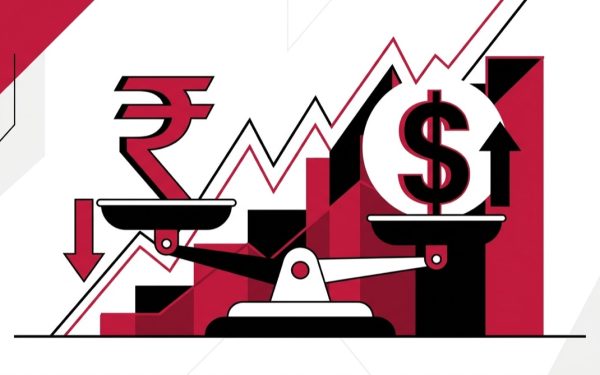
A bigger import bill means more demand for dollars to pay for oil, which tends to weaken the rupee. A weaker rupee then makes all imports — not just oil — more expensive, creating a feedback loop. This is why oil and the rupee are watched together.
3. Inflation
Oil feeds into prices across the economy. Costlier diesel raises the cost of transporting goods, which lifts the price of food and almost everything that moves by road. Higher LPG and fuel costs hit households directly. This is why a crude spike can push up inflation, which in turn influences how the Reserve Bank of India (RBI) sets interest rates.
4. Government finances and fuel taxes
Petrol and diesel carry heavy central excise duty and state VAT. When global crude falls, the government can either pass relief to consumers or retain higher taxes to support its finances; when crude rises, it may cut taxes to shield consumers, sacrificing revenue. So the crude price also shapes Budget maths and subsidy decisions (for example on LPG).
| If crude oil prices… | Effect on the import bill | Effect on the rupee | Effect on you (inflation / fuel) |
|---|---|---|---|
| Rise sharply | Widens — more dollars spent on the same oil | Tends to weaken (more dollar demand) | Petrol, diesel, transport and many goods get costlier |
| Stay range-bound | Broadly stable, predictable | Relatively steady, all else equal | Limited fresh pressure on fuel and prices |
| Fall sharply | Narrows — savings on imports | Tends to strengthen / steady | Room for cheaper fuel or lower inflation, if passed on |
From crude barrel to your petrol tank
The price of crude is only the starting point of what you pay at the pump. A barrel of crude goes through a long journey before it becomes the petrol or diesel in your vehicle — and taxes, not crude, often make up the largest share of the final price in India.
What makes up the pump price
By the time petrol reaches you, the retail price is built from several layers: the cost of crude (and refining it into petrol), the dealer’s commission, central excise duty, and state VAT. The exact split changes with policy and varies by state, but in India taxes have frequently formed a very large slice of the final retail price — which is why pump prices do not fall as fast as global crude, and sometimes barely move at all.
How to follow crude oil prices (without getting lost)
You do not need a trading terminal to track crude sensibly. Here is a practical approach for an Indian reader.
1. Watch Brent first
For India, Brent is the more relevant headline number than WTI. Note the level (dollars per barrel) and, more importantly, the direction and speed of change.
2. Always pair it with the rupee
A barrel can be flat in dollars but costlier for India if the rupee weakens. Track Brent and the USD/INR rate together to gauge the real impact on the import bill and fuel.
3. Use the Indian Basket for the India-specific number
The Petroleum Planning & Analysis Cell (PPAC) publishes the Indian Basket crude price — the figure that actually drives our import bill and fuel-pricing maths.
4. Convert “per barrel” to something intuitive
If a barrel is, say, $80 and the rupee is around ₹83 to the dollar, that barrel costs about ₹6,640. Divide by 159 litres and the crude works out to roughly ₹42 per litre — before refining, taxes and margins, which is why pump prices are much higher. (These are arithmetic examples to show the method, not today’s quote.)
| Step | What to check | Why it matters for India |
|---|---|---|
| 1 | Brent crude level & trend (USD/bbl) | The headline price India’s imports track most closely |
| 2 | USD/INR exchange rate | Sets the real rupee cost of each dollar of oil |
| 3 | Indian Basket price (PPAC) | The official India-specific crude cost |
| 4 | OPEC+ meeting outcomes & geopolitics | The biggest sources of sudden supply-side moves |
| 5 | Convert per-barrel to per-litre (÷159) | Turns an abstract dollar figure into intuitive fuel maths |
Frequently asked questions
What is the price of 1 barrel of crude oil in rupees?
It depends on two moving numbers: the dollar price of the barrel and the rupee-dollar exchange rate. To work it out yourself, multiply the dollar-per-barrel price by the current USD/INR rate. For example, $80 × ₹83 ≈ ₹6,640 per barrel. Because both inputs change constantly, the rupee figure changes daily. We deliberately avoid quoting a fixed “today” price here because it would be out of date immediately — use a live source for the current number.
Why is crude oil priced in US dollars?
Crude is a globally traded commodity, and the US dollar is the world’s main currency for international trade and settlement. Pricing in one common currency lets buyers and sellers everywhere compare and transact easily. For India this is significant: because we pay in dollars, our real cost depends on both the oil price and the rupee-dollar rate.
What is the difference between Brent and WTI crude?
Both are light, sweet crudes that move closely together. Brent comes from the North Sea, is effectively waterborne, and is the global benchmark for most traded oil. WTI (West Texas Intermediate) is a US crude delivered inland at Cushing, Oklahoma, and usually trades a few dollars below Brent because of its location and US supply dynamics. For India, Brent is the more relevant benchmark.
How do crude oil prices affect petrol prices in India?
Crude is the raw material for petrol, so it is the starting point of the pump price — but not the whole story. After crude comes refining, distribution, dealer margins and, crucially, heavy central excise duty and state VAT. Because taxes and margins are a large, relatively fixed share of the retail price, pump prices do not always fall as quickly or as far as global crude.
Why does crude oil matter so much to the Indian economy?
India imports roughly 85–88% of the crude it uses, so the price is effectively a national economic variable. Higher crude widens the import bill, pressures the current account deficit, tends to weaken the rupee, and pushes up inflation through costlier transport and fuel — which in turn influences RBI interest-rate decisions and government Budget choices.
What causes crude oil prices to rise or fall?
Fundamentally, supply and demand. Prices tend to rise when OPEC+ cuts output, when conflict or sanctions threaten supply, or when global demand is strong. They tend to fall when OPEC+ raises output, when US shale and other non-OPEC supply grows, when inventories build up, or when the world economy slows. A stronger US dollar can also weigh on the dollar price.
What is the Indian Basket crude price?
The Indian Basket is a weighted average of the actual crude grades India imports, published by the government’s Petroleum Planning & Analysis Cell (PPAC). Because India buys a specific mix of crudes rather than Brent or WTI directly, the Indian Basket is the most accurate single number for India’s real crude cost and feeds into the import-bill and fuel-pricing calculations.
Disclaimer: This article is for educational purposes only and is not investment/financial advice. Read all scheme/offer documents and consult a SEBI-registered adviser where relevant. Crude oil and currency prices are volatile; always check a live, reputable source for current figures.