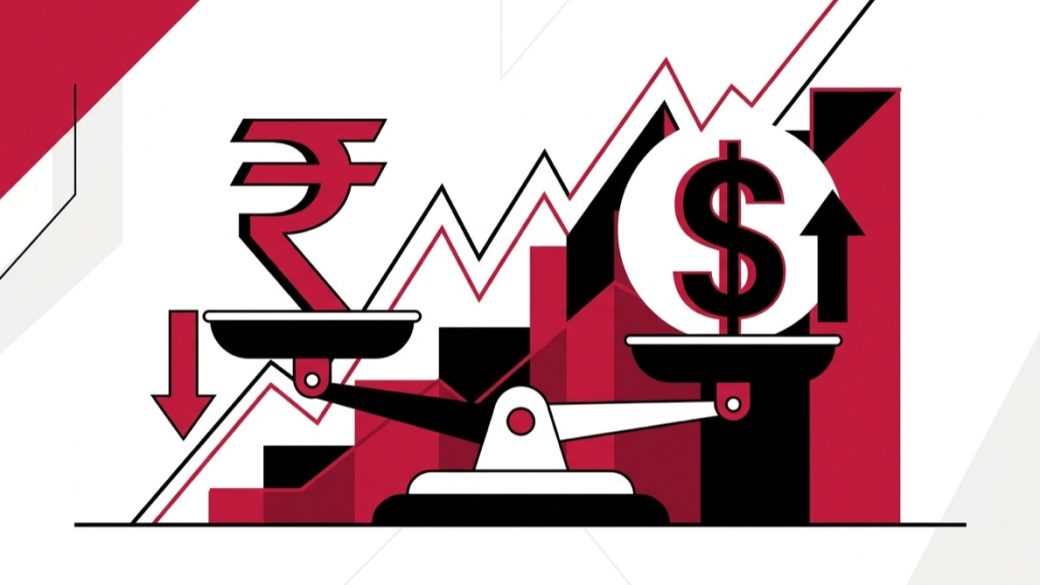
An exchange rate is simply the price of one currency measured in another — so the rupee vs dollar rate tells you how many Indian rupees it takes to buy one US dollar. India runs a “managed float,” meaning the rate is set mainly by supply and demand in the currency market, while the Reserve Bank of India (RBI) steps in to smooth out wild swings. When more dollars flow out of India than in, the rupee weakens (the number rises); when dollars flow in, it strengthens.
- What an exchange rate actually is
- Floating vs fixed vs managed float: where India fits
- Why the rupee rises and falls
- How to read “USD/INR” and currency news
- Who is affected: importers, exporters, travellers, students
- The RBI’s role and its forex reserves
- A short history of the rupee vs the dollar
- Is a weak rupee always bad?
- Frequently asked questions
What an exchange rate actually is
Every currency is a product with a price. The exchange rate is that price, expressed in terms of another currency. When you see a headline that the rupee is “at 85 to the dollar,” it means you need roughly 85 Indian rupees (INR) to buy one US dollar (USD). Flip it around and one rupee is worth about 1.2 US cents. Nothing more mystical is going on: it is a price, and like any price it moves every second that markets are open.
The pair is almost always written USD/INR. In foreign-exchange (forex) notation, the first currency is the “base” and the second is the “quote.” So USD/INR = 85 reads as: 1 US dollar = 85 Indian rupees. This is the convention you will see on the RBI reference rate, on news tickers, and in your trading app.
Appreciation vs depreciation: the words that confuse everyone
Because the rupee is the quote currency, the number behaves in a way that feels backwards at first:
- Rupee depreciation (weakening): the USD/INR number goes up — say from 83 to 86. It now takes more rupees to buy the same dollar, so the rupee has lost value.
- Rupee appreciation (strengthening): the USD/INR number goes down — say from 86 to 83. Fewer rupees buy a dollar, so the rupee is worth more.
A useful mental shortcut: a bigger USD/INR number is bad news for the rupee. Keep that straight and most currency headlines suddenly make sense.
Floating vs fixed vs managed float: where India fits
Countries choose how their exchange rate is set. There are broadly three systems, and understanding them is the single biggest step to “getting” currency news.
Fixed (pegged) exchange rate
The government or central bank fixes the currency at a set value, usually against the dollar, and defends that level by buying or selling its own currency. Gulf currencies like the UAE dirham and Saudi riyal are classic pegs. Pegs give businesses certainty but force the country to give up control of its own interest rates.
Free-floating exchange rate
The rate is left entirely to market supply and demand, with no routine intervention. The US dollar, the euro, the British pound and the Japanese yen are essentially free-floating. The upside is flexibility; the downside is that the currency can be volatile.
Managed float — India’s system
India uses a managed float (sometimes called a “dirty float”). Day to day, the USD/INR rate is decided by buyers and sellers in the market. But the RBI watches closely and intervenes — selling dollars to support a falling rupee or buying dollars to stop it from rising too fast — to prevent disorderly, panic-driven swings. The RBI is explicit that it does not target a particular level; it only aims to curb excess volatility.
| Feature | Fixed / Pegged | Managed float (India) | Free float |
|---|---|---|---|
| Who sets the rate? | Central bank fixes it | Market sets it; RBI smooths | Market only |
| Volatility | Very low (until peg breaks) | Moderate | Can be high |
| Central-bank intervention | Constant, to defend the peg | Occasional, to curb swings | Rare / none |
| Example currencies | UAE dirham, Saudi riyal | Indian rupee | US dollar, euro, yen |
| Main trade-off | Stability vs lost policy control | Balance of both | Flexibility vs volatility |
Why the rupee rises and falls
At its heart, the rupee’s value is about the flow of dollars in and out of India. When dollars are flowing in, there is high demand for rupees (foreigners must convert dollars to rupees to invest or buy here), and the rupee strengthens. When dollars are flowing out, demand for dollars rises, and the rupee weakens. Here are the main forces behind those flows.
1. The trade balance (imports vs exports)
India imports more than it exports — a “trade deficit.” Crucially, India buys most of its crude oil from abroad and pays in dollars. When oil prices rise, India needs even more dollars, which pushes the rupee down. Strong exports (software services, pharma, engineering goods) bring dollars in and support the rupee.
2. Foreign investment flows (FPI and FDI)
Foreign Portfolio Investors (FPIs) buy and sell Indian stocks and bonds, often in large amounts and at short notice. When global investors are optimistic about India, they pour dollars in and the rupee firms up. When they turn cautious — during global shocks or a US rate hike — they pull money out (“risk-off”), and the rupee slips. Foreign Direct Investment (FDI), such as a company building a factory, is steadier and more supportive over the long run.
3. Interest rates — especially the US Federal Reserve
Money chases higher, safer returns. When the US Federal Reserve raises interest rates, US assets become more attractive, dollars flow back to America, and emerging-market currencies including the rupee tend to weaken. This is why Indian markets react so strongly to Fed decisions thousands of kilometres away.
4. Inflation
If prices in India rise faster than in the US over time, Indian goods become relatively expensive and the rupee tends to lose value to keep exports competitive. Persistently higher domestic inflation is a long-run reason currencies of developing economies drift weaker against the dollar.
5. The dollar’s own strength and global sentiment
The dollar is the world’s reserve currency and a “safe haven.” In times of war, recession fear or financial stress, global investors rush into dollars regardless of what is happening in India. A broadly strong dollar — tracked by the Dollar Index (DXY) — pushes the rupee and most other currencies down at the same time.
How to read “USD/INR” and currency news
Once you know the vocabulary, financial headlines become easy to decode. Here is the same kind of event described three ways you will actually encounter:
- “Rupee falls 30 paise to close at 85.60 against the dollar” — the rupee weakened; it now takes 85.60 to buy a dollar.
- “Rupee hits a record low” — the USD/INR number reached its highest ever (most rupees per dollar).
- “Rupee gains 20 paise on FPI inflows” — the rupee strengthened because foreign investors brought dollars in.
Which rate is the “real” one?
You will see slightly different numbers in different places, and all of them can be correct at once:
| Rate you’ll see | What it is | Where it matters |
|---|---|---|
| RBI reference rate | An official daily benchmark published by the RBI | Contracts, accounting, news reporting |
| Interbank / market rate | The live rate banks trade at with each other | The “headline” rate on tickers |
| Card / forex card rate | Bank’s rate for your card spends abroad, plus a markup | Travel & online USD purchases |
| Money-changer rate | Cash rate at the airport or a forex shop, with a spread | Buying physical dollars |
The gap between the headline market rate and the rate you get is the bank’s or changer’s margin (the “spread”), plus fees and taxes. That is why the dollars you buy for a trip always cost a little more than the number on TV.
Two terms worth knowing
Spot rate is the price for an exchange happening now (settled in a day or two). Forward rate is an agreed price for a future date, used by businesses to lock in costs — a practice called hedging. An importer expecting a dollar bill in three months can book a forward rate today so a sudden rupee fall does not blow up the budget.
Who is affected: importers, exporters, travellers, students
The exchange rate is not an abstract number for traders alone. It quietly reshapes the cost of everyday life and business for millions of Indians.
Importers and exporters
A weaker rupee hurts importers: every dollar of crude oil, electronics, machinery or edible oil now costs more rupees, which can feed into local prices. The same weak rupee helps exporters: IT services firms, textile makers and pharma companies earn dollars and convert them into more rupees, boosting their revenues. This is why a falling rupee produces both worried importers and cheerful exporters at the same time.
Indian travellers and tourists
When the rupee weakens, an overseas holiday gets pricier — the hotel that cost a certain number of dollars now eats more of your rupees. Forex cards, international flight tickets priced in dollars, and duty-free shopping all become more expensive.
Students studying abroad
For families funding education in the US, UK, Canada or Australia, the exchange rate is one of the biggest hidden costs. Tuition and living expenses are billed in foreign currency, so a weaker rupee can add a substantial amount to the total rupee outlay over a multi-year degree. Many families track the rate closely and remit fees in stages to manage the risk.
NRIs, freelancers and online earners
A weaker rupee is a windfall for anyone earning in dollars: Non-Resident Indians sending money home, freelancers billing foreign clients, and creators paid by global platforms all get more rupees per dollar. The same move that pinches an importer rewards a remitter.
The RBI’s role and its forex reserves
The Reserve Bank of India is the referee of the currency market. It does not set the rupee’s price the way it sets the repo rate, but it has powerful tools to influence it and keep markets orderly.
How the RBI intervenes
- Selling dollars: when the rupee is falling sharply, the RBI sells dollars from its reserves and buys rupees. More demand for rupees and more dollar supply slows the fall.
- Buying dollars: when too many dollars flood in and the rupee is rising fast (which can hurt exporters), the RBI buys dollars and adds them to reserves.
- Interest-rate signals: the RBI’s broader monetary policy and rate decisions affect how attractive Indian assets are, which indirectly moves the rupee.
Why foreign-exchange reserves matter
India’s forex reserves — among the largest in the world — are the war chest the RBI draws on to defend the rupee. They are held mostly in foreign currency assets and gold. Healthy reserves reassure global investors that India can pay its import bills and external debts even in a crisis, which itself supports the currency. A common yardstick is whether reserves can cover several months of imports.
A short history of the rupee vs the dollar
The rupee has not always floated. Its journey explains why a weaker number over the decades is not, by itself, a sign of failure.
- 1947–1970s: After independence, the rupee was pegged, first to the British pound and later effectively to the dollar at a fixed value.
- 1991: A severe balance-of-payments crisis forced India to devalue the rupee sharply and begin economic liberalisation. This was the turning point toward a market-determined rate.
- 1993 onward: India moved to a market-determined exchange rate — the managed float that still operates today.
- 2000s–2020s: The rupee has gradually weakened against the dollar over the long term, with sharp moves during global events such as the 2008 financial crisis, the 2013 “taper tantrum,” and the 2020 pandemic shock.
The broad, multi-decade drift weaker is largely explained by India’s structurally higher inflation than the US and its persistent trade deficit — not by any single policy mistake. We have deliberately avoided quoting a specific “today’s rate” here, because it changes every minute; always check a live source such as the RBI reference rate or your bank for the current figure.
Is a weak rupee always bad?
Headlines treat a falling rupee as a national emergency, but the reality is more balanced. A weaker rupee has clear winners and losers, and so does a stronger one.
| Scenario | Who benefits | Who is hurt |
|---|---|---|
| Weak rupee (USD/INR rises) | Exporters, IT/pharma firms, NRIs, freelancers earning in USD, domestic tourism | Importers, oil/electronics buyers, students abroad, overseas travellers |
| Strong rupee (USD/INR falls) | Importers, travellers, students abroad, inflation control | Exporters, IT services margins, remittance receivers |
For the overall economy, the key risks of a rapidly weakening rupee are imported inflation (costlier oil and goods raise prices at home) and a heavier burden on companies and the government that have borrowed in dollars. The benefit is more competitive exports. A government and central bank therefore aim not for a “strong” rupee at any cost, but for a stable and orderly one that reflects economic fundamentals.
Frequently asked questions
Why does the rupee keep falling against the dollar?
Over the long run the rupee tends to weaken because India usually has higher inflation than the US and runs a trade deficit (it imports more than it exports, especially oil paid for in dollars). Shorter, sharper falls are usually driven by foreign investors pulling money out, the US Federal Reserve raising rates, costlier oil, or a broadly strong dollar during global uncertainty.
Is a higher USD/INR number good or bad for India?
A higher USD/INR number means a weaker rupee — it takes more rupees to buy a dollar. That is good for exporters, IT firms and NRIs who earn dollars, but bad for importers, travellers and students who spend dollars, and it can push up domestic prices through costlier imports. It is neither purely good nor purely bad; it depends on which side you are on.
What is the difference between a fixed and a floating exchange rate?
Under a fixed (pegged) rate, the central bank sets and defends a specific value, as Gulf countries do with the dollar. Under a floating rate, the market sets the price through supply and demand, as the US and eurozone do. India uses a managed float in between: the market decides the rate, but the RBI intervenes to prevent extreme swings.
How does the RBI control the value of the rupee?
The RBI does not fix the rupee, but it influences it. To slow a falling rupee it sells US dollars from its foreign-exchange reserves and buys rupees; to slow a rising rupee it buys dollars. Its broader interest-rate and monetary-policy decisions also affect how attractive Indian assets are, which moves the currency indirectly. The goal is orderly markets, not a specific target level.
How does a weak rupee affect students studying abroad?
Tuition and living costs abroad are billed in foreign currency, so when the rupee weakens, the same dollar fee converts into more rupees — raising the total cost of an overseas degree. Families often remit fees in stages, use education-specific forex services, and watch the rate to manage this risk over a multi-year course.
What does USD/INR mean?
USD/INR is the exchange-rate pair for the US dollar against the Indian rupee. The dollar is the “base” currency and the rupee is the “quote” currency, so USD/INR = 85 means one US dollar is worth 85 Indian rupees. When the number rises the rupee is weaker; when it falls the rupee is stronger.
Where can I check the official rupee-to-dollar rate?
For an official benchmark, use the RBI’s daily reference rate. For the live market rate you will see figures on financial news tickers and trading apps. For the rate that actually applies to you — travel, card spends or buying cash — check your bank or money changer, since they add a margin and fees on top of the market rate.
Disclaimer: This article is for educational purposes only and is not investment/financial advice. Read all scheme/offer documents and consult a SEBI-registered adviser where relevant.