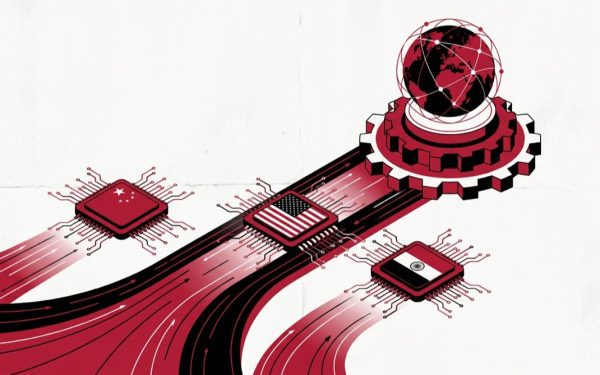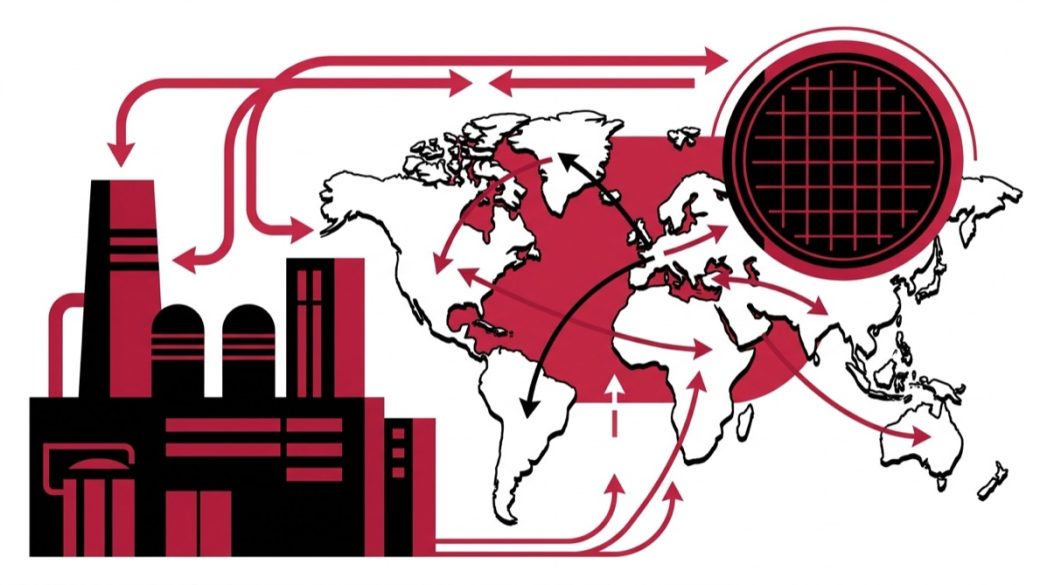
The semiconductor supply chain is the global network that turns sand-derived silicon into the microchips inside every phone, car, missile and AI server. No single country can make an advanced chip alone: the design happens in the United States, the manufacturing machines come from the Netherlands and Japan, the chips themselves are fabricated mostly in Taiwan and South Korea, and the final assembly and testing happen across Southeast Asia and China. This extreme specialisation makes chips astonishingly cheap and powerful, but it also concentrates the world’s most important industry into a handful of choke points, which is exactly why semiconductors are now at the centre of geopolitics, and why India is spending billions to get in.
Why chips run the world
A semiconductor, also called a chip, integrated circuit or IC, is a tiny slab of engineered silicon carrying anywhere from a few thousand to tens of billions of microscopic switches called transistors. Those switches store and process information as the 1s and 0s that make all modern electronics work. The word “semiconductor” describes the raw material: silicon conducts electricity better than an insulator like glass but worse than a metal like copper, and that in-between property is what lets engineers turn it into controllable on/off switches.
Chips are not just in laptops and smartphones. A modern car contains anywhere from several hundred to well over a thousand chips. Banking, electricity grids, hospitals, defence systems, telecom networks and the data centres that train artificial intelligence all depend on a steady flow of chips. When that flow stopped during the 2020-2022 global chip shortage, car factories around the world, including plants in India, idled production lines for months. That shortage was the moment governments realised the chip supply chain was a strategic vulnerability, not just a business issue.
Commentators often call semiconductors the “new oil,” with one twist: oil is found in many countries, but the ability to manufacture the most advanced chips sits in very few, most of them in Taiwan and South Korea. That concentration gives a handful of companies and countries enormous leverage, the central tension running through the rest of this guide.
How a chip is made: design to fab to assembly
The single most important thing to understand about the semiconductor supply chain is that it is split into specialised stages, and almost no company does all of them. Understanding these stages explains why so many countries are involved and where the choke points lie. The journey runs through three broad phases: design, fabrication (the “fab”), and assembly, test and packaging (often shortened to ATP or OSAT).
Stage 1: Design
Every chip begins as a design, an incredibly detailed blueprint of where billions of transistors and the wires connecting them will sit. Designers use specialised software called EDA (Electronic Design Automation) tools, a niche dominated by a few US firms such as Synopsys and Cadence. Many designers also license ready-made circuit blueprints called IP (intellectual property) cores, the most famous being the CPU designs from the UK-headquartered firm Arm, whose instruction set powers almost every smartphone in the world.
A crucial distinction here is between two business models. A “fabless” company designs chips but owns no factory, sending its blueprints out to be manufactured; Nvidia, Qualcomm, Apple, AMD and most Indian chip-design houses are fabless. An “IDM” (integrated device manufacturer) both designs and makes its own chips, Intel and Samsung being the best-known examples. The fabless model created the modern global supply chain by separating the people who design chips from the people who build them.
Stage 2: Equipment and materials
Before anyone can manufacture a chip, they need the machines and the raw inputs. This is one of the most concentrated and least understood parts of the chain. The single most important machine is the lithography system, which uses light to print circuit patterns onto silicon. The most advanced version, called EUV (extreme ultraviolet) lithography, is made by exactly one company on the planet: ASML of the Netherlands. No EUV machine, no leading-edge chip. Other critical tool-makers include Applied Materials and Lam Research of the US and Tokyo Electron of Japan.
The raw materials matter too. Chips start as ultra-pure silicon wafers, thin discs cut from silicon crystals. Photoresist chemicals, specialty gases such as neon and high-purity rare materials are needed at various steps, and Japan is a dominant supplier of many of these chemicals. This is why a supply shock anywhere, even in a single specialty gas, can ripple through the whole industry.
Stage 3: Fabrication (the “fab”)
Fabrication happens inside a “fab,” a factory so clean its air has thousands of times fewer dust particles than an operating theatre. A modern leading-edge fab can cost upwards of US$20 billion, which is why so few exist. Through hundreds of precise steps, machines deposit, pattern and etch dozens of microscopic layers onto a silicon wafer, building up billions of transistors. A single wafer holds hundreds of chips, and the process from blank to finished wafer can take around three months.
This is the stage most associated with the term “chip maker.” A company that manufactures chips for other companies on a contract basis is called a “foundry,” and the foundry model is overwhelmingly dominated by one firm, TSMC of Taiwan, with Samsung of South Korea a distant second. The “node” you hear about, such as 3-nanometre or 2-nanometre, is roughly a marketing label for how advanced and dense a manufacturing process is; smaller numbers generally mean more transistors and better efficiency.
Stage 4 and 5: Assembly, test, packaging and the end product
A finished wafer is not yet a usable chip. It must be cut into individual pieces (called dies), each die tested, and the good ones packaged, encased in protective material with electrical connections so they can be soldered onto a circuit board. This back-end work is called assembly, test and packaging (ATP), or the OSAT (outsourced semiconductor assembly and test) stage. Being more labour-intensive and less capital-intensive than fabrication, it clustered in lower-cost economies across Asia, including Malaysia, China, Vietnam, the Philippines and increasingly India. Advanced packaging, stacking and connecting multiple chips into one high-performance unit, has itself become a competitive battleground, especially for AI chips.
The key players: TSMC, ASML, Nvidia & more
A useful way to grasp the supply chain is to know who sits at each choke point. A handful of companies hold near-monopoly positions, and that is what makes the whole system both efficient and fragile. The table below maps the most important players to their stage in the chain.
| Company | Country / HQ | Role in the chain | Why it matters |
|---|---|---|---|
| TSMC | Taiwan | Foundry (manufacturing) | The world’s largest contract chip maker; produces the bulk of leading-edge logic chips for Apple, Nvidia and others |
| ASML | Netherlands | Equipment (lithography) | The only company that makes EUV machines; without it, the most advanced chips cannot be built |
| Nvidia | United States | Fabless design | Designs the GPUs that dominate AI; outsources manufacturing to TSMC |
| Samsung | South Korea | IDM + foundry + memory | A leader in memory chips and the No.2 logic foundry |
| Intel | United States | IDM + emerging foundry | Long-time PC chip leader, now investing heavily to win foundry customers |
| Synopsys / Cadence | United States | EDA software | Their design tools are used to create almost every modern chip |
| Arm | United Kingdom | IP cores | Licenses the CPU designs at the heart of nearly all smartphones |
| ASE / Amkor | Taiwan / US-Korea | OSAT (assembly & test) | Among the largest outsourced packaging and testing firms |
The TSMC choke point
If you remember one company, make it TSMC (Taiwan Semiconductor Manufacturing Company). It pioneered the pure-play foundry model in the 1980s, building chips designed by others rather than competing with its own customers. Decades of relentless investment mean it now manufactures the lion’s share of the world’s most advanced logic chips, including Apple’s iPhone processors, Nvidia’s AI accelerators and AMD’s server chips. That dominance is both a marvel of engineering and a single point of failure, because most of that capacity sits on one island, Taiwan.
The ASML choke point
ASML is the other name everyone should know. Its EUV lithography machines are among the most complex objects humans have ever mass-produced, with hundreds of thousands of parts from a global supplier network including the German optics firm Zeiss. Each machine costs well over US$150 million, and there is no alternative supplier. This is why export controls on ASML equipment are such a powerful geopolitical lever: deny a country EUV machines, and you cap how advanced its chips can become.
Geographic concentration and the risk it creates
The defining feature of the chip supply chain is geographic concentration. Different stages cluster in different regions, and several of the most critical stages are concentrated dangerously in just one or two places. East Asia, in particular Taiwan and South Korea, dominates the actual manufacturing of advanced chips, while the United States leads design and the Netherlands and Japan lead equipment.
Why this concentration is risky
Concentration creates several kinds of risk. The first is geopolitical: Taiwan sits in one of the world’s most contested regions, and any conflict or blockade could cut off the supply of advanced chips almost overnight, an event analysts call one of the single biggest risks to the global economy. The second is natural disaster: Taiwan, Japan and other hubs are earthquake-prone, and fabs are exquisitely sensitive to vibration, contamination and even power flickers. The third is single-supplier dependence, where one firm such as ASML or one specialty material becomes an unavoidable bottleneck. The fourth is concentration of demand, as the explosion of AI funnels orders into a tiny number of advanced fabs.
The chip war: US vs China explained
Over the past several years the semiconductor supply chain has become the main battlefield of US-China rivalry, a contest widely called the “chip war.” At its heart is a simple strategic logic: advanced chips power not only smartphones and AI but also missiles, surveillance and military systems, so whoever controls the most advanced chips holds a decisive technological and military edge.
What the United States did
Starting in 2022, the United States rolled out sweeping export controls designed to slow China’s access to the most advanced chips and the tools to make them. These rules restricted the sale of the most powerful AI chips (such as top-end Nvidia accelerators) to China and, crucially, restricted the export of advanced chip-making equipment, including the EUV machines from ASML, which China was already barred from buying. Washington also pressed allies, the Netherlands and Japan in particular, to align their own export rules, since the supply chain only works when these few suppliers act together. On the domestic side, the US passed the CHIPS Act, committing tens of billions of dollars in subsidies to bring fabrication back to American soil.
How China responded
China, which imports a huge volume of chips every year, responded by pouring state money into building a self-sufficient supply chain to “design out” foreign dependence over time. It made real progress in mature (older, less advanced) nodes and some design areas, but the leading edge remained hard to reach without EUV lithography. China holds its own leverage too: it dominates the processing of many critical minerals used across electronics, and it has at times restricted exports of materials such as gallium and germanium, a reminder that choke points exist on both sides.
| Dimension | United States & allies | China |
|---|---|---|
| Core strength | Design, EDA software, advanced equipment (via allies) | Scale, mature-node capacity, critical-mineral processing |
| Main weapon | Export controls on advanced chips and tools | Subsidies for self-sufficiency; mineral export curbs |
| Key vulnerability | Manufacturing concentrated offshore (Taiwan, Korea) | Limited access to leading-edge lithography (EUV) |
| Goal | Slow rival’s leading edge; reshore fabs | Reduce dependence on foreign technology over time |
Why it matters for India
For India, the chip war is both a risk and an opening. The risk is that a fragmenting, weaponised supply chain raises costs and uncertainty for India’s huge electronics-importing economy. The opening is that global firms are actively looking to diversify manufacturing away from a single country, the so-called “China plus one” and “friend-shoring” strategies, and India is positioning itself as a trusted alternative destination for assembly, testing and, eventually, fabrication.
India’s semiconductor push
India does not yet have a large commercial leading-edge fab, but it has become serious about changing that. The country has long been a powerhouse in one part of the chain, chip design: a large share of the world’s semiconductor engineers work in India, and most major global chip companies, including Intel, Nvidia, Qualcomm, AMD and Texas Instruments, run significant design and R&D centres in cities such as Bengaluru, Hyderabad and Noida. What India historically lacked was the manufacturing and packaging side.
The India Semiconductor Mission
To close that gap, the government launched the India Semiconductor Mission (ISM), a large incentive programme that offers to fund a substantial share of approved fabrication and assembly project costs. The strategy is pragmatic: rather than chasing the bleeding edge immediately, India is targeting where it can realistically compete first, mature-node fabrication (for chips used in cars, appliances and industrial gear) and especially the back-end OSAT stage, which needs less extreme capital and plays to India’s strengths in scale and skilled labour.
Projects on the ground
Several major projects have been approved and are progressing. The most prominent is a fabrication plant in Dholera, Gujarat, being built by the Tata group in partnership with Taiwan’s PSMC, alongside Tata’s assembly and test facility in Assam. Other approved projects include facilities backed by groups such as CG Power (with Renesas and Stars Microelectronics) and Kaynes and Micron’s large assembly and test plant in Sanand, Gujarat. The broader push is supported by states competing to offer land, power and water, the three things fabs consume in enormous quantities.
Why it is hard, and why it still matters
Building a chip industry from a low base is extraordinarily difficult. Fabs need uninterrupted ultra-clean power, vast quantities of ultra-pure water, a deep local supplier ecosystem and thousands of specialised engineers, none of which appear overnight. India is essentially trying to compress decades of accumulated know-how into years. But the prize is significant: domestic chip capability would cut import dependence, strengthen national security, create high-value jobs and let India capture more of the value in the electronics it already assembles for the world.
What disrupts the supply chain
Because the chip supply chain is long, specialised and concentrated, it is unusually sensitive to shocks. The recurring triggers are worth knowing:
- Demand whiplash: The 2020-2022 shortage began partly because carmakers cancelled chip orders early in the pandemic, then could not get back in the queue when demand rebounded.
- Geopolitical action: Export controls, tariffs and conflict risk around Taiwan can restrict supply or raise costs across the chain.
- Natural disasters: Earthquakes, droughts (fabs need vast amounts of water) and fires at key facilities can halt output for months.
- Single-supplier bottlenecks: Dependence on one firm such as ASML, or one specialty material or gas, means a single disruption can cascade.
- The AI surge: Soaring demand for AI accelerators has concentrated orders on a few advanced fabs and packaging lines, stretching lead times.
The global response is a slow, expensive rebalancing: the US, EU, Japan, South Korea, China and India are all subsidising domestic capacity, and companies are diversifying suppliers and locations. The likely result over the coming decade is a more regionalised, more redundant and somewhat more expensive supply chain, traded off against greater resilience.
Frequently asked questions
What is the semiconductor supply chain in simple terms?
It is the global, multi-stage network that turns raw silicon into finished microchips. The main stages are design (the blueprint), equipment and materials (the machines and inputs), fabrication (manufacturing the chip in a “fab”), and assembly, test and packaging. Different countries specialise in different stages, so a single chip often crosses borders many times before it is finished.
Why is the global semiconductor supply chain so concentrated?
Because each stage needs very different skills and amounts of money, regions specialised over decades: design in the US, advanced equipment in the Netherlands and Japan, and the most advanced manufacturing in Taiwan and South Korea. A leading-edge fab can cost over US$20 billion, so very few exist. This is efficient but creates choke points where one company or country becomes an unavoidable bottleneck.
Why is Taiwan so important to the chip supply chain?
Taiwan is home to TSMC, the world’s largest contract chip maker, which manufactures a very large share of the most advanced logic chips, including processors for Apple and Nvidia. Because so much leading-edge capacity sits on one island in a geopolitically tense region, any disruption there would hit the entire global economy, which is why Taiwan’s chip dominance is called a “Silicon Shield.”
What caused the global chip shortage?
The 2020-2022 shortage had several causes: carmakers cancelled chip orders early in the pandemic and could not regain their place in the queue when demand rebounded, consumer-electronics demand surged at the same time, and the chain had little spare capacity to absorb the swing. The long lead time to add new capacity made it worse.
What is ASML and why does it matter so much?
ASML is a Dutch company and the only firm in the world that makes EUV (extreme ultraviolet) lithography machines, the tools needed to print the finest patterns for the most advanced chips. With no alternative supplier, ASML is a critical choke point, which is why export controls on its machines have become a powerful tool in the US-China chip war.
What is India doing to build its own semiconductor industry?
India launched the India Semiconductor Mission, offering large incentives to attract chip manufacturing and packaging investment. It already leads in chip design talent, so its near-term focus is mature-node fabrication and assembly, test and packaging (OSAT), where the capital barrier is lower. Flagship projects include a Tata-PSMC fab in Dholera, Gujarat, Tata’s assembly plant in Assam, and Micron’s facility in Sanand, Gujarat.
What are the main risks to the semiconductor supply chain?
The biggest risks are geopolitical conflict (especially around Taiwan), single-supplier or single-material bottlenecks, natural disasters such as earthquakes and droughts that halt fabs, sudden swings in demand, and the current surge in AI chip demand straining a few advanced fabs. Governments worldwide are responding by subsidising domestic capacity to make the chain more resilient.
Disclaimer: This article is for educational purposes only and is not investment or financial advice. Company and government programmes mentioned are described for general understanding and may change over time. Read all official scheme and offer documents and consult a SEBI-registered adviser where relevant before making any investment decision.