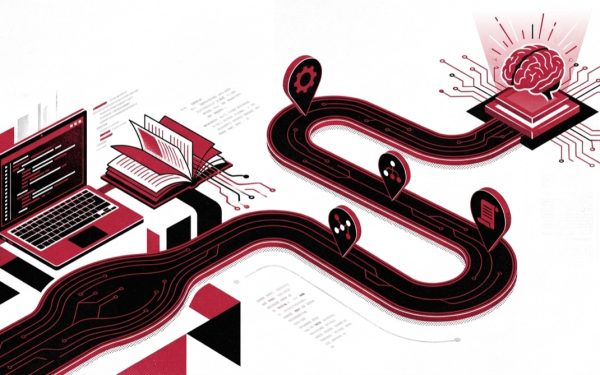
Generative AI is a type of artificial intelligence that creates brand-new content — text, images, audio, video and code — by learning statistical patterns from massive datasets and then predicting what comes next. Tools like ChatGPT (OpenAI), Gemini (Google) and Claude (Anthropic) are all powered by this technology. Instead of merely sorting or labelling existing data the way older AI did, generative AI produces something that did not exist before, in response to a plain-language instruction called a prompt.
- What is generative AI? A plain-English definition
- How text generation works: tokens, prompts & transformers
- How image & video generation works: diffusion explained
- ChatGPT vs Gemini vs Claude: the major models compared
- A short timeline: how we got here
- Real use cases for India
- Limitations, hallucinations & risks
- How to get started safely
- Frequently asked questions
What is generative AI? A plain-English definition
Generative AI (often shortened to gen AI) refers to machine-learning systems that can generate original output rather than just analyse input. The generative AI meaning is best understood by contrast. Traditional, or “discriminative”, AI answers closed questions: Is this email spam? Is this transaction fraud? Is the person in this photo wearing a helmet? It draws a line between categories. Generative AI does the opposite — you give it a starting point and it fills in the rest: Write a cover letter. Draw a logo. Summarise this 40-page contract. Compose a tune.
Under the hood, these systems are large neural networks — mathematical models loosely inspired by the brain — trained on enormous quantities of text, images or audio scraped from books, websites, code repositories and licensed datasets. During training the model adjusts billions of internal numbers (called parameters or weights) until it becomes very good at one deceptively simple task: predicting the next piece of content given everything that came before. Scale that prediction up across a conversation and the result feels like reasoning, writing and creativity.
Generative vs discriminative AI at a glance
| Aspect | Discriminative (traditional) AI | Generative AI |
|---|---|---|
| Core question | “Which category does this belong to?” | “What should come next?” |
| Output | A label, score or yes/no | New text, image, audio, video or code |
| Everyday example | Spam filter, face unlock, credit-risk scoring | ChatGPT reply, AI-generated poster, voice clone |
| How you use it | Feed it data, read its verdict | Write a prompt, read its creation |
| Typical model | Classifier / regression model | Large language model, diffusion model |
How text generation works: tokens, prompts & transformers
Text generators such as ChatGPT, Gemini and Claude are built on large language models (LLMs). Almost all modern LLMs use an architecture called the transformer, introduced by Google researchers in 2017. To understand how they turn a prompt into a paragraph, you need three ideas: tokens, prediction, and the prompt itself.
Step 1 — Your words become tokens
A model does not read whole words. It breaks text into tokens — small chunks that may be a word, part of a word, or a punctuation mark. The sentence “Generative AI is amazing” might become five or six tokens. Every token is converted into a list of numbers (an “embedding”) so the maths can work on it. As a rough rule, one English token is about four characters, and 1,000 tokens is roughly 750 words. Pricing and length limits for most AI tools are measured in tokens, not words.
Step 2 — The model predicts the next token
This is the heart of generative AI. Given the tokens so far, the transformer calculates a probability for every possible next token in its vocabulary, picks one, adds it to the sequence, and repeats — token by token — until the answer is complete. The famous generative pre-trained transformer (the “GPT” in ChatGPT) is named for exactly this: it is generative, pre-trained on huge text corpora, and built on the transformer. The “attention” mechanism inside a transformer lets it weigh which earlier words matter most for the next one, which is how it keeps track of context across long passages.
Step 3 — The prompt steers everything
A prompt is simply the instruction you type. Because the model only continues from what it is given, the quality and clarity of your prompt dramatically change the output — a skill now called prompt engineering. Modern chatbots are also fine-tuned with human feedback (a technique known as RLHF) so they follow instructions, stay helpful, and refuse harmful requests. Many can now also use tools — searching the web, running code, or reading a document you upload — which extends them well beyond their original training data.
How image & video generation works: diffusion explained
Text models predict the next word; image models work very differently. The dominant approach today is the diffusion model, used by tools such as Stable Diffusion, Midjourney, DALL·E and Google’s image and video systems. The idea is surprisingly elegant.
Adding noise, then learning to remove it
During training, the system takes millions of real images and progressively adds random visual “noise” (static) until each picture becomes pure fuzz. It then learns to reverse that process — to predict and strip away the noise step by step. Once trained, you can hand it nothing but random noise plus a text prompt, and it will “denoise” its way to a coherent image that matches your words. A separate model that understands both text and pictures keeps the output aligned with what you asked for.
From images to video
Generative AI video extends the same principles across time. The model must keep objects, lighting and motion consistent from one frame to the next, which is far harder than a single still — so video generators demand much more computing power and usually produce only short clips. By 2026 several systems can generate short, realistic video from a text prompt or an image, and the quality is improving quickly, though long, perfectly consistent footage remains a frontier problem. Audio generation (music, speech and voice cloning) uses related techniques to predict sound waveforms or audio tokens.
ChatGPT vs Gemini vs Claude: the major models compared
Three names dominate the consumer conversation in India and worldwide. It helps to separate the product you chat with from the underlying model family that powers it.
The three big assistants
- ChatGPT (OpenAI) — the app that brought generative AI to the mainstream after its late-2022 launch. It is powered by OpenAI’s GPT family of models and offers free and paid tiers, voice, image generation and tool use.
- Gemini (Google) — Google’s assistant and model family, deeply tied into Search, Android, Workspace (Docs, Gmail) and Pixel devices. Its strength is broad integration across Google’s ecosystem, which is widely used in India.
- Claude (Anthropic) — built by Anthropic with a strong emphasis on safety, long documents and careful, helpful writing. Popular for analysis, coding and long-form drafting.
Other notable players include Meta’s open-weight Llama models, Microsoft Copilot (which uses OpenAI models inside Windows and Office), Mistral, and DeepSeek. India also has a growing homegrown effort under the IndiaAI Mission, including work on models tuned for Indian languages.
| Assistant | Maker | Best known for | Where you’ll meet it |
|---|---|---|---|
| ChatGPT | OpenAI | General-purpose chat, image generation, huge ecosystem of plugins/apps | chatgpt.com, mobile apps, inside many products via API |
| Gemini | Integration with Search, Android, Gmail, Docs; multimodal answers | Google app, Android, Chrome, Workspace | |
| Claude | Anthropic | Long documents, safe and nuanced writing, coding help | claude.ai, mobile apps, via API |
| Copilot | Microsoft (uses OpenAI) | Office documents, Windows, enterprise workflows | Windows, Microsoft 365, Edge |
| Llama | Meta | Open-weight models developers can self-host | Built into apps and run by businesses |
Key terms you’ll hear
Multimodal means a model can handle more than one type of input or output — for example reading an image and answering questions about it, or accepting voice. Context window is how much text (in tokens) a model can consider at once; larger windows let you paste long documents. Open-weight (sometimes loosely called “open source”) means the trained model can be downloaded and run by anyone, as with Llama, versus closed models accessed only through a company’s app or API.
A short timeline: how we got here
Generative AI feels sudden, but it built on decades of research. The pace from research breakthrough to everyday Indian smartphone has been remarkably fast.
Real use cases for India
Generative AI is already part of daily work and study across India. Below are practical generative AI examples, grouped by who benefits.
For students and job-seekers
Explaining tough concepts in simple language, summarising long PDFs and research papers, generating practice questions, improving resumes and cover letters, and translating between English and Indian languages. Used as a study aid — not a shortcut to copy answers — it can be a patient, always-available tutor.
For entrepreneurs and small businesses
Drafting product descriptions, social-media captions and ad copy; replying to customer queries; creating logos, posters and thumbnails; writing and debugging code; and turning a rough idea into a first business plan. For a solo founder or a small Lapaas-style team, gen AI acts like an affordable junior assistant across marketing, design and admin.
For professionals and creators
| Field | How generative AI helps |
|---|---|
| Marketing | Campaign ideas, ad variations, SEO drafts, email sequences, image creatives |
| Software & IT | Writing, explaining and fixing code; generating tests and documentation |
| Content & media | Scripts, blog drafts, thumbnails, voice-overs, short video clips |
| Customer support | Drafting replies, summarising tickets, multilingual chat in Indian languages |
| Education | Lesson plans, simplified explanations, quiz generation, doubt solving |
| Finance & admin | Summarising reports, drafting emails, organising notes (verify all numbers) |
Limitations, hallucinations & risks
For all its power, generative AI has real and well-documented weaknesses. Understanding them is what separates a smart user from a careless one.
Hallucinations: confident but wrong
A hallucination is when a model states something false as if it were true — an invented statistic, a fake citation, a court case that never happened, or a wrong date. This is not the model “lying”; it is a side-effect of how generation works. The system predicts plausible-sounding text, and plausible is not the same as correct. Because it has no built-in fact-checker, it can fill a gap with fluent fiction. Always verify facts, figures, names and quotes from another reliable source before you rely on them — especially for anything legal, medical, financial or academic.
Other key limitations
- Knowledge cut-off: A model’s training data stops at a certain date, so it may not know recent events unless it can search the web.
- Bias: Because models learn from human-created data, they can reproduce social, gender or regional biases present in that data.
- Privacy: Never paste sensitive personal, financial or confidential data into a public chatbot — treat anything you type as potentially stored or reviewed.
- Copyright & originality: Ownership and licensing of AI-generated images, text and music are still being settled in courts and policy worldwide.
- Deepfakes & misinformation: The same tools that make creativity cheap also make convincing fake images, audio and video cheap — a real concern for scams and elections.
- Cost & energy: Training and running large models consumes significant computing power and electricity.
How to get started safely
You do not need to be a programmer to benefit. Here is a sensible first path for an Indian beginner.
- Pick one free tool — ChatGPT, Gemini or Claude all have free tiers. Start with whichever fits your existing accounts.
- Write clear prompts. State the role, the task, the format and any constraints. “Act as a career coach. Rewrite my resume summary for a sales role in 3 bullet points, simple English” beats “fix my resume”.
- Iterate. Treat it as a conversation — ask follow-ups, request a different tone, or ask it to explain its reasoning.
- Verify everything important. Cross-check facts, numbers and quotes before you use them.
- Protect your data. Keep Aadhaar, PAN, bank details, passwords and client secrets out of the chat.
- Disclose where it matters. Be transparent when AI-generated content is used in professional, academic or news contexts.
Frequently asked questions
What is generative AI in simple words?
Generative AI is software that creates new content — text, images, audio, video or code — in response to a plain-language instruction. It learns patterns from huge amounts of data during training and then predicts new content one step at a time. ChatGPT, Gemini and Claude are popular examples.
What is the difference between generative AI and AI?
“AI” is the broad field of making machines do tasks that need intelligence. Generative AI is one branch of it that focuses on creating new content, rather than only classifying or predicting. A spam filter is AI but not generative; ChatGPT is generative AI.
How do ChatGPT, Gemini and Claude actually work?
All three are large language models built on the transformer architecture. They break your prompt into tokens, use an “attention” mechanism to weigh context, and then predict the most likely next token repeatedly until the answer is complete. They are fine-tuned with human feedback to follow instructions and avoid harmful outputs.
What is a token and why does it matter?
A token is a small chunk of text — a word, part of a word or punctuation — that the model processes. Roughly 1,000 tokens equal about 750 English words. Tokens matter because most AI tools measure their length limits and pricing in tokens, not words.
How does AI generate images and video?
Most image and video tools use diffusion models. During training they learn to remove random noise from pictures step by step. To create something new, they start from pure noise plus your text prompt and “denoise” their way to a finished image. Video extends this across many frames, which needs far more computing power.
What are some real examples of generative AI?
Writing emails, essays and code; summarising long documents; translating between Indian languages; generating logos, posters and thumbnails; creating ad copy and social captions; voice-overs and short video clips; and acting as a study tutor or coding assistant.
Is generative AI always accurate?
No. It can “hallucinate” — state false information confidently, including fake statistics, citations or dates. It can also be biased and may not know recent events. Always verify important facts, figures and quotes from a reliable source, and never share sensitive personal or financial data with a public chatbot.
Is generative AI free to use in India?
Yes, the leading assistants — ChatGPT, Gemini and Claude — all offer free tiers that are enough for most everyday tasks, with paid plans adding faster, more capable models and higher usage limits. India also has government-backed efforts under the IndiaAI Mission to build models for Indian languages.