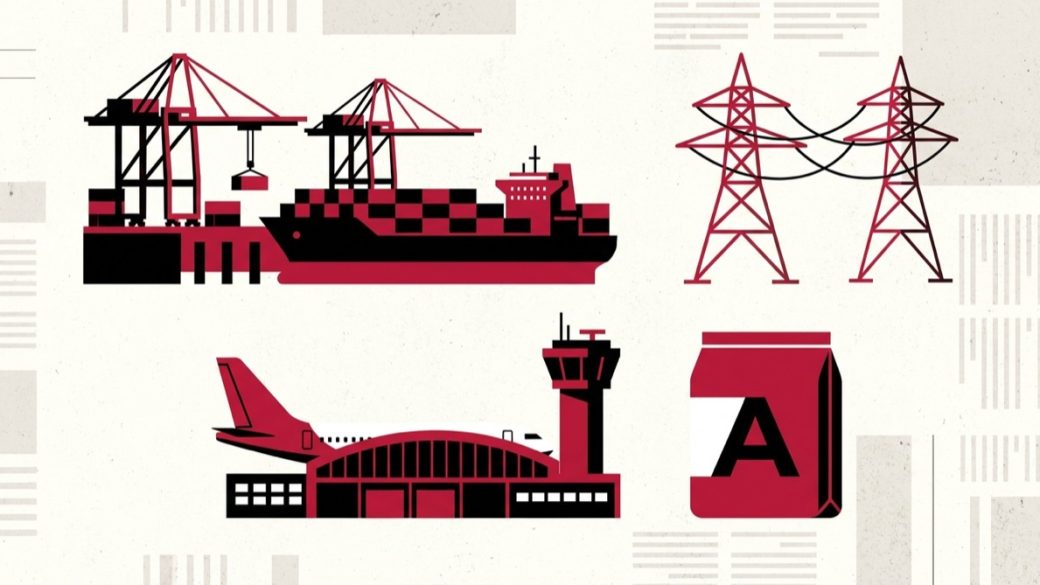
The Adani Group is one of India’s largest private-sector conglomerates, founded by Gautam Adani in 1988 as a commodity-trading firm and now spanning ports, energy, power, airports, cement, edible oils, data centres and green hydrogen. Headquartered in Ahmedabad, Gujarat, it is built around the philosophy of owning critical infrastructure — the roads, ports, wires and pipes through which the Indian economy moves — and has grown into a family of separately listed flagship companies led by Adani Enterprises.
What is the Adani Group?
The Adani Group is a diversified Indian multinational — a conglomerate, meaning a single business house that operates across many unrelated industries through separate companies. Where a focused company might do one thing, a conglomerate spreads across ports, power, airports and consumer goods at once. The Adani Group’s common thread is infrastructure and the movement of energy and goods: it tends to own the asset that everyone else has to use.
The group is privately controlled by the Adani family, with Gautam Adani as chairman. But several of its businesses are publicly listed on India’s stock exchanges (the BSE and NSE), so ordinary investors can own shares in them. The promoter family holds large stakes, while the rest trades in the market. This structure — a tightly held family group sitting on top of many individually listed companies — is typical of India’s big business houses, much like the Tata and Reliance groups.
Gautam Adani and the group’s history
Gautam Adani was born in Ahmedabad in 1962 into a middle-class family. He dropped out of college and moved to Mumbai as a teenager, working briefly in the diamond trade before returning to Gujarat. In 1988, he founded Adani Enterprises (originally Adani Exports) as a commodity-trading business, importing and exporting goods such as agricultural products, plastics and metals.
The turning point came in the 1990s. India’s economy was opening up after the 1991 liberalisation reforms, and the Gujarat government was inviting private players to develop infrastructure. In 1995, Adani won the mandate to develop a port at Mundra on the Gujarat coast. Mundra would go on to become India’s largest commercial port — and the seed of the group’s entire infrastructure empire.
From a single port to a national platform
Over the next two decades, the group expanded outward from Mundra in deliberate steps. It moved from running one port to running many (forming Adani Ports & SEZ), then into power generation, then power transmission and distribution, then renewable energy, gas, airports and cement. Each new business was usually housed in its own company, and several were taken public to raise capital.
The timeline below shows the broad arc of how a trading firm became a multi-sector infrastructure group.
Adani Group companies (the listed flagships)
One of the most common questions people search for is the Adani Group companies list. The group runs dozens of subsidiaries, but the structure is easiest to understand through its main publicly listed flagship companies. Each one is the listed “face” of a business vertical, and several were spun out of the original Adani Enterprises over the years — a strategy the group calls “incubation”.
| Listed company | Ticker (NSE) | What it does |
|---|---|---|
| Adani Enterprises | ADANIENT | The flagship incubator: new businesses (airports, roads, data centres, mining, green hydrogen) are built here before being spun off. |
| Adani Ports & SEZ (APSEZ) | ADANIPORTS | India’s largest private ports and logistics operator, anchored by Mundra. |
| Adani Green Energy | ADANIGREEN | One of India’s biggest renewable-energy companies (solar and wind). |
| Adani Energy Solutions | ADANIENSOL | Power transmission lines and electricity distribution (formerly Adani Transmission). |
| Adani Power | ADANIPOWER | The group’s thermal (coal-based) power generation business. |
| Adani Total Gas | ATGL | City gas distribution (piped cooking gas and CNG), a joint venture with France’s TotalEnergies. |
| Ambuja Cements | AMBUJACEM | A leading cement maker, acquired in 2022; it in turn controls ACC. |
| ACC | ACC | One of India’s oldest cement brands, part of the group via Ambuja. |
| Adani Wilmar (AWL Agri Business) | AWL | Edible oils and packaged foods (the “Fortune” brand); a food JV.* |
*The group has signalled it is reshaping its stake in the food/FMCG joint venture over time; treat ownership of that specific arm as evolving rather than fixed.
A note on “Adani Group net worth” and market value
Searchers often look for the group’s “net worth” or total value. The most meaningful number is the combined market capitalisation of the listed Adani companies — the total stock-market value of all their shares added together. This figure runs into several lakh crore rupees (hundreds of billions of US dollars at the group level in good periods), but it moves a great deal with share prices and should be treated as a broad, rounded indicator rather than a fixed amount. Gautam Adani is consistently ranked among the wealthiest people in India and Asia, though his exact rank also rises and falls with the share prices of these companies.
The core businesses, explained
Behind the tickers are real, physical businesses. Here is what each major vertical actually does and why it matters to the Indian economy.
1. Ports and logistics (APSEZ)
This is the group’s foundation. Adani Ports & SEZ operates a network of ports along India’s western and eastern coasts, handling a very large share of the country’s seaborne cargo. Ports are a classic infrastructure business: high upfront cost, long life, and steady fees charged on every tonne of cargo that passes through. The group has extended this into logistics — warehouses, rail links and a special economic zone (SEZ) at Mundra — to capture more of the journey goods take.
2. Energy: power, renewables and transmission
The energy cluster is the largest part of the group by revenue and ambition, and it has three distinct pieces:
- Adani Power generates electricity from large coal-fired (thermal) plants.
- Adani Green Energy builds solar and wind farms — including some of the world’s largest renewable parks — as India shifts toward clean power.
- Adani Energy Solutions owns the high-voltage transmission lines that carry power across states, plus electricity distribution in Mumbai.
Together these cover generation, transport and delivery of power — the full chain from plant to plug.
3. Airports
Through Adani Airport Holdings (within Adani Enterprises), the group became India’s largest private airport operator in a remarkably short time. It runs several major airports and is the developer behind a large new airport for the Mumbai region. Airports combine aviation fees with retail, parking and real estate — a mix of infrastructure and consumer revenue.
4. Cement
In 2022 the group made a landmark move into cement by acquiring Ambuja Cements and ACC from Switzerland’s Holcim. Overnight, this made Adani the second-largest cement producer in India. Cement is a natural fit because the group is itself a giant consumer of it — for ports, power plants and airports — and because India’s construction boom keeps demand high.
5. Gas, edible oil and new economy bets
Adani Total Gas pipes cooking gas to homes and CNG to vehicles in many Indian cities. Adani Wilmar (now branded AWL Agri Business) sells the well-known “Fortune” edible oils and staples. And inside Adani Enterprises, the group is incubating “new economy” businesses such as data centres, roads and copper — areas it expects to grow over the coming decade.
How the Adani Group grew: the strategy
The group’s rise from a small Gujarat trader to a national giant in roughly three decades is one of the most studied stories in Indian business. A few repeatable moves explain most of it.
Own the “moat” assets
Adani consistently targets assets with high barriers to entry — ports, transmission grids, airports — that are hard for rivals to replicate and that the economy cannot do without. These generate predictable, often regulated or contracted, cash flows over decades.
Incubate, then list
New ventures are first built inside Adani Enterprises, then spun off as separate listed companies once they mature. This unlocks value (each business gets its own market price) and gives each arm its own access to capital.
Grow through both building and buying
The group expands organically (constructing solar parks, new port terminals) and through large acquisitions (Ambuja/ACC in cement, NDTV in media, control of Mumbai’s airport). The table below contrasts the two engines.
| Growth engine | How it works | Examples |
|---|---|---|
| Organic (building) | Constructing new assets from scratch and scaling them | Mundra port expansion, solar and wind parks, new transmission lines |
| Inorganic (acquiring) | Buying existing companies to enter a sector fast | Ambuja Cements & ACC (cement), control of Mumbai airport, NDTV (media) |
Fund growth with heavy capital — and debt
Infrastructure is capital-hungry. The group has historically funded expansion with a mix of equity (selling shares, bringing in global partners such as TotalEnergies) and substantial debt. High leverage has been both an engine of fast growth and the single most debated feature of the group, because heavy borrowing raises the stakes if cash flows or markets wobble. In recent years the group has emphasised reducing its reliance on debt relative to earnings.
The Hindenburg report episode
No factual overview of the Adani Group is complete without the events of early 2023. In January 2023, Hindenburg Research, a US-based short-selling firm, published a report making a series of allegations against the group, including claims related to stock-price manipulation and the use of offshore entities, and questions about debt levels. A short-seller is an investor who profits if a share price falls; Hindenburg disclosed that it held short positions, meaning it stood to gain financially from a decline in Adani shares.
The Adani Group rejected the allegations, calling the report misleading and motivated, and published a detailed rebuttal. Nonetheless, the report triggered a sharp sell-off: the share prices of Adani companies fell heavily in the following weeks, and the group withdrew a large follow-on share sale (FPO) that had just been completed, returning money to investors, citing market volatility.
What happened afterwards
In the period that followed, the group worked to stabilise the situation — prepaying some loans, securing fresh investment from global investors, and reiterating that its businesses remained operationally sound. India’s markets regulator, SEBI, examined matters relating to the allegations, and the Supreme Court of India set up an expert committee and monitored the regulatory process. Over the subsequent months and into 2024–2025, the listed companies recovered a significant part of their value, though the episode remains a defining moment in the group’s history and a frequent reference point in any discussion of it.
Green hydrogen and the road ahead
Looking forward, the group’s headline bet is green energy and green hydrogen. Green hydrogen is hydrogen produced by splitting water using renewable electricity, so it can be made with near-zero carbon emissions; it is seen as a future clean fuel for industries that are hard to electrify, such as steel, fertiliser and shipping. The Adani Group has announced very large, long-horizon investment plans to build an integrated green-hydrogen ecosystem — from manufacturing solar panels and wind turbines to producing the hydrogen itself.
This fits the group’s DNA: pick an asset-heavy area aligned with national priorities (here, India’s energy transition and its target of net-zero emissions by 2070), build at massive scale, and aim to be the lowest-cost producer. Alongside hydrogen, the group continues to expand airports, data centres, roads and cement. The common logic across all of it remains the same one Gautam Adani started with at Mundra in 1995: own the infrastructure the economy can’t function without.
| Theme | What to watch |
|---|---|
| Energy transition | Scale-up of Adani Green’s solar/wind capacity and the green-hydrogen build-out |
| Infrastructure | New airport capacity, ports, roads and data centres under Adani Enterprises |
| Balance sheet | Debt levels relative to earnings, and the mix of equity vs borrowing used to fund growth |
| Governance & disclosure | Regulatory findings, audited results and transparency following the 2023 episode |
Frequently asked questions
Who owns the Adani Group?
The Adani Group is controlled by the Adani family, led by founder and chairman Gautam Adani. While the family (as “promoters”) holds large stakes, several group businesses — such as Adani Enterprises, Adani Ports, Adani Green Energy and Adani Power — are listed on India’s stock exchanges, so public investors also own shares in them.
How many companies are in the Adani Group?
The group runs many dozens of subsidiaries and joint ventures, but it is organised around a handful of major listed flagship companies. The most prominent include Adani Enterprises, Adani Ports & SEZ, Adani Green Energy, Adani Energy Solutions, Adani Power, Adani Total Gas, Ambuja Cements and ACC.
What is the Adani Group’s main business?
There is no single business — it is a diversified conglomerate. Its largest and oldest areas are ports/logistics and energy (power generation, renewables, transmission and gas). It has also become a major player in cement, airports and edible oils, and is investing heavily in green hydrogen and data centres.
When and how did the Adani Group start?
Gautam Adani founded the group in 1988 in Ahmedabad as a commodity-trading firm (Adani Exports, now Adani Enterprises). Its infrastructure journey began in 1995 when it won the mandate to develop Mundra port in Gujarat, which grew into India’s largest commercial port and the base of the wider group.
What was the Hindenburg report about?
In January 2023, the US short-selling firm Hindenburg Research published a report alleging issues such as stock manipulation and concerns over offshore entities and debt at the Adani Group. The group rejected the allegations as misleading. The report triggered a sharp but partly temporary fall in Adani share prices, and the matter was reviewed by India’s regulator SEBI under the Supreme Court’s oversight.
Is the Adani Group a government company?
No. It is a privately controlled, family-led conglomerate whose flagship companies are listed on the stock market. It is not owned by the government, although — like other infrastructure groups — it operates many assets (ports, airports, power lines) under government concessions, licences and regulation.
What is the Adani Group’s net worth?
The most useful measure is the combined stock-market value (market capitalisation) of its listed companies, which runs into several lakh crore rupees but fluctuates significantly with share prices. Treat any single figure as a rounded, point-in-time snapshot rather than a fixed amount.
Disclaimer: This article is for educational purposes only and is not investment/financial advice. Read all scheme/offer documents and consult a SEBI-registered adviser where relevant.