An ESOP (Employee Stock Option Plan) is a scheme that gives an employee the right — but not the obligation — to buy a fixed number of the company’s shares at a pre-agreed price after a waiting period, letting staff own a slice of the business they help build. In India, ESOPs are governed by the Companies Act, 2013 and (for listed firms) SEBI rules, and they carry a distinctive two-stage tax: once as a perquisite when you exercise, and again as capital gains when you sell. This guide explains vesting, the strike price, exercise, liquidity, ESOP taxation in India, buybacks, and how plans differ between startups and MNCs — with a worked example.
What is an ESOP? · The ESOP lifecycle: grant to sale · Key terms: vesting, strike price, exercise · How you actually make money (liquidity) · ESOP taxation in India · A worked example · Startups vs MNCs · How to evaluate an ESOP offer · FAQ
What is an ESOP?
ESOP stands for Employee Stock Option Plan (also written as Employee Stock Ownership Plan). It is a form of equity compensation: instead of — or in addition to — cash salary, a company offers eligible employees the option to purchase its shares at a price fixed today, which they can act on later once they have stayed long enough to “earn” that right.
The word option is the heart of it. An ESOP does not give you shares outright on day one. It gives you a contractual right to buy a set number of shares at a set price in the future. You decide whether to use that right. If the company has grown and the shares are worth more than your fixed buying price, the option is valuable. If the shares are worth less, you can simply walk away and lose nothing but the opportunity.
Why companies grant ESOPs
For an early-stage startup that is short on cash, ESOPs are a way to attract and keep talented people by promising a share of future upside rather than a large salary today. For established companies, they align employees’ interests with shareholders’ — if you own a piece of the company, you have a direct reason to help it grow. ESOPs also improve retention, because options typically vest over several years, giving employees a financial reason to stay.
The legal backbone in India
ESOPs in India are issued under Section 62(1)(b) of the Companies Act, 2013, read with Rule 12 of the Companies (Share Capital and Debentures) Rules, 2014. For listed companies, the scheme must also comply with the SEBI (Share Based Employee Benefits and Sweat Equity) Regulations, 2021, commonly called the SEBI SBEB Regulations. A private company must pass a special resolution of shareholders to approve its plan; a listed company’s plan must additionally be administered by a compensation/nomination and remuneration committee. The terms in your individual grant letter sit on top of this framework.
The ESOP lifecycle: from grant to sale
Every ESOP moves through the same five stages. Understanding this journey is the single most useful thing you can do before signing an offer that includes options.
1. Grant. The company awards you a specific number of options at a fixed strike price (also called the exercise price). This is recorded in a grant letter. Nothing is taxed and you own nothing yet — you simply hold a promise.
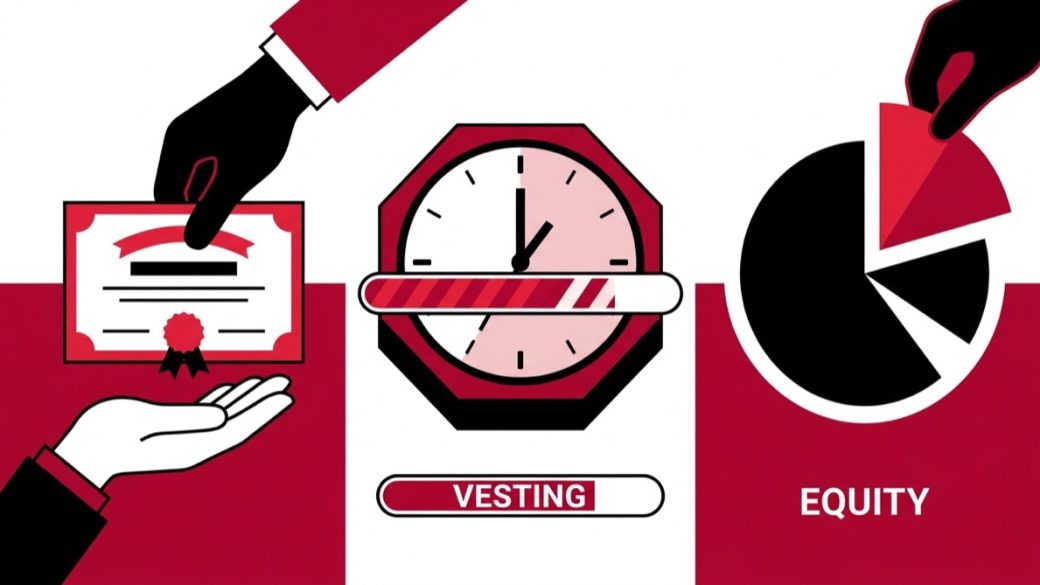
2. Vesting. Your right to those options is “earned” gradually, usually over four years. Until an option vests, you cannot act on it.
3. Exercise. Once options vest, you can exercise them — pay the strike price and convert each option into an actual share. This is the first taxable moment in India.
4. Holding. After exercise you are a shareholder. You hold the shares and wait for a chance to sell.
5. Sale / liquidity event. You sell the shares — in a buyback, a secondary sale to investors, an acquisition, or on the stock exchange after an IPO — and convert your paper gain into real money. This is the second taxable moment.
Key terms: vesting, strike price and exercise
Vesting and the cliff
Vesting is the schedule by which you earn the right to your options. The most common Indian pattern is a four-year vest with a one-year cliff. The “cliff” means nothing vests for the first 12 months; if you leave before completing one year, you forfeit everything. After the cliff, a chunk vests at once and the rest typically vests monthly or quarterly over the remaining period.
Indian law sets a floor here: under the Companies Act rules and SEBI’s SBEB Regulations, there must be a minimum gap of one year between the grant of options and their vesting. Companies are free to stretch vesting longer, but they cannot vest options in under a year.
Strike price (exercise price)
The strike price is the fixed amount you pay per share when you exercise, set at the time of grant. In a startup it is often the share’s fair value at grant, or sometimes a nominal “face value” (for example ₹1 or ₹10 per share). The lower your strike price relative to the eventual sale price, the bigger your gain. Companies must determine this price following a fair-valuation approach; for listed firms the SEBI rules and accounting standards govern how options are valued and expensed.
Exercise
To exercise is to actually use your vested options: you pay the strike price and receive shares. Exercising costs real money — the strike price multiplied by the number of options, plus tax on the perquisite (explained below). This is why some employees delay exercising until a liquidity event is near. Note that vested options usually come with an exercise window after you leave the company: if you don’t exercise within that window (often 90 days, though many Indian startups now offer longer), the vested options can lapse.
| Term | What it means | Why it matters to you |
|---|---|---|
| Grant | Award of a set number of options at a fixed strike price | Your starting point; sets how many shares and at what price |
| Vesting | Earning the right to your options over time | You must stay long enough; unvested options are forfeited if you leave |
| Cliff | Initial period (often 1 year) before any options vest | Leave before the cliff and you get nothing |
| Strike / exercise price | Price you pay per share to convert an option | Lower strike = larger gain on sale |
| Exercise | Paying the strike price to turn options into shares | First tax event; requires cash up front |
| Vesting window / post-exit window | Time after leaving in which you must exercise vested options | Miss it and vested options can lapse |
| Liquidity event | Buyback, secondary sale, acquisition or IPO that lets you sell | When paper value becomes cash |
How you actually make money: the liquidity question
The hardest truth about ESOPs is that vested, exercised shares in a private company are still illiquid — you cannot sell them on a stock exchange because the company is not listed. You need a liquidity event to turn shares into cash. There are four common routes in India:
- Buyback: the company (or its founders/investors) repurchases employees’ shares, usually during a funding round. This is the most common way Indian startup employees realise value before an IPO.
- Secondary sale: you sell your shares directly to an incoming investor or a fund, separate from the company raising fresh capital.
- Acquisition / M&A: another company buys yours, and shareholders — including ESOP holders — are paid out as part of the deal.
- IPO: the company lists on the stock exchange. After any lock-in period, you can sell your shares on the open market like any other shareholder.
ESOP taxation in India
This is where ESOPs trip people up, so go slowly. In India, ESOPs are taxed at two separate points, and confusing them is the single most common mistake.
Tax event 1 — at exercise (taxed as salary perquisite)
When you exercise, the difference between the fair market value (FMV) of the share on the exercise date and the strike price you paid is treated as a perquisite — a benefit from employment. It is added to your salary income and taxed at your applicable income-tax slab. Your employer deducts TDS on this amount. Note that this tax is due even though you have not sold anything and have no cash in hand yet — a real cash-flow pinch for many employees.
Tax event 2 — at sale (taxed as capital gains)
When you later sell the shares, any gain over the FMV that was used at exercise is a capital gain. The rate depends on how long you held the shares after exercise and on whether the company is listed:
- Listed shares (sold on an Indian exchange with STT paid): treated as long-term if held more than 12 months, otherwise short-term.
- Unlisted shares (e.g. a private-company buyback): treated as long-term if held more than 24 months, otherwise short-term.
Short-term and long-term gains are taxed at different rates, and rates have changed in recent Finance Acts — so confirm the current rate and any indexation/exemption rules for your situation when you actually sell, ideally with a chartered accountant.
The startup deferral relief
To ease the cash-flow problem at exercise, the government introduced a deferral for employees of eligible startups recognised by the Department for Promotion of Industry and Internal Trade (DPIIT) and holding a certificate under Section 80-IAC of the Income-tax Act. Under Section 192(1C), such employees can defer paying the perquisite tax at exercise — the TDS/payment is pushed to the earliest of: (a) five years from the end of the relevant financial year, (b) the date you sell the shares, or (c) the date you leave the company. This only applies to a narrow set of DPIIT-recognised eligible startups, not to all startups or to MNCs.
| Tax event 1: Exercise | Tax event 2: Sale | |
|---|---|---|
| When it happens | You convert options into shares | You sell the shares for cash |
| Head of income | Salary (perquisite) | Capital gains |
| What is taxed | FMV at exercise − strike price | Sale price − FMV at exercise |
| Rate | Your income-tax slab | Short-/long-term capital gains rate |
| Who collects | Employer deducts TDS | You report and pay when filing |
| Possible relief | Deferral for DPIIT-recognised eligible startups (Sec 192(1C)) | Long-term treatment after the holding period |
A worked example
Numbers make this concrete. The figures below are illustrative only — chosen for round-number clarity, not as a real share price or tax computation.
Step 1 — Cost to exercise: 1,000 × ₹10 = ₹10,000 paid to the company to convert her options into shares.
Step 2 — Perquisite at exercise (taxed as salary): (FMV ₹100 − strike ₹10) × 1,000 = ₹90,000. This ₹90,000 is added to Riya’s salary for that year and taxed at her slab; her employer deducts TDS on it.
Step 3 — Capital gain at sale: (sale ₹300 − FMV at exercise ₹100) × 1,000 = ₹2,00,000. This is taxed as a capital gain — short- or long-term depending on her holding period and whether the shares are listed.
Crucially, the ₹100 FMV at exercise is the dividing line: everything below it (down to her ₹10 strike) was taxed as salary, and everything above it was taxed as capital gains. She is not taxed twice on the same rupee.
ESOPs at startups vs MNCs
The mechanics are the same, but the experience of holding ESOPs at an early-stage Indian startup is very different from holding them at a large listed multinational.
| Dimension | Early-stage startup | Large MNC / listed company |
|---|---|---|
| Share type | Unlisted, privately held | Often listed on a stock exchange |
| Liquidity | Depends on buybacks, secondaries or a future IPO | Sellable on the market after any lock-in |
| Risk & upside | High risk, potentially very high upside | Lower risk, steadier but smaller upside |
| Valuation visibility | FMV set periodically by a valuer; can be opaque | Transparent live market price |
| Instrument variety | Usually plain stock options (ESOPs) | May also use RSUs, ESPPs and SARs |
| Tax deferral | Sec 192(1C) deferral if DPIIT-recognised eligible startup | Generally not eligible for the startup deferral |
| Holding for long-term gains | More than 24 months (unlisted) | More than 12 months (listed, STT paid) |
Cousins of the ESOP you may meet
At larger or international employers you may be offered variants rather than plain options:
- RSUs (Restricted Stock Units): a promise of actual shares on vesting, with no strike price to pay. Common at big tech firms.
- ESPP (Employee Stock Purchase Plan): lets you buy company shares at a discount, often via salary deductions.
- SARs (Stock Appreciation Rights): pay you the increase in share value in cash or shares, without you having to buy anything.
- Sweat equity: shares issued for non-cash contributions such as know-how or IP; in India these are governed alongside ESOPs under the Companies Act and SEBI SBEB rules.
How to evaluate an ESOP offer
When a job offer includes ESOPs, the headline number (“options worth ₹50 lakh!”) is the least reliable part. Ask these questions before you assign any value to the grant:
- How many options, and what total shares outstanding? Your percentage ownership matters more than the raw count. Ask what fully-diluted percentage of the company your grant represents.
- What is the strike price, and the latest FMV / preferred-share price? This tells you the built-in gain today.
- What is the vesting schedule and cliff? Confirm the years, the cliff, and the vesting frequency.
- What happens if I leave? Check the post-exit exercise window and whether the company allows cashless exercise.
- Is there a path to liquidity? Has the company run buybacks before? Is an IPO realistic, and on what timeline?
- What are the tax implications for me specifically? Especially whether the startup is DPIIT-recognised for the Section 192(1C) deferral.
Frequently asked questions about ESOPs
What is the full form of ESOP, and what does it mean?
ESOP stands for Employee Stock Option Plan (sometimes Employee Stock Ownership Plan). It is a scheme that gives an employee the right to buy a fixed number of the company’s shares at a pre-agreed price after a vesting period, allowing staff to own a share of the business.
How does an ESOP work in India?
Your employer grants you options at a fixed strike price. They vest over time (typically four years with a one-year cliff). Once vested, you can exercise them — pay the strike price to receive actual shares. You then hold the shares until a liquidity event (buyback, secondary, acquisition or IPO) lets you sell them for cash. ESOPs are issued under Section 62(1)(b) of the Companies Act, 2013, and listed companies also follow SEBI’s SBEB Regulations, 2021.
Are ESOPs taxable in India?
Yes, at two points. First, at exercise, the difference between the share’s fair market value and your strike price is taxed as a salary perquisite at your income-tax slab (with TDS). Second, at sale, the gain over the FMV used at exercise is taxed as a capital gain (short- or long-term, depending on your holding period and whether the shares are listed).
What happens to my ESOPs when I leave the company or quit?
Unvested options are usually forfeited when you leave. Vested options can typically be exercised within a limited post-exit window — often 90 days, though many Indian startups now offer longer. If you don’t exercise within that window, the vested options can lapse, so check your grant letter carefully before resigning.
What happens to ESOPs when the company is sold or acquired?
It depends on the deal and your plan’s terms. Vested shares are usually paid out at the acquisition price. Unvested options may be cancelled, cashed out, accelerated, or converted into options of the acquiring company. Some plans include “acceleration” clauses that vest options early on a change of control.
What is the difference between ESOPs and RSUs?
With an ESOP you receive options and must pay a strike price to convert them into shares. With an RSU (Restricted Stock Unit) you are promised actual shares that you receive on vesting with nothing to pay. RSUs are common at large tech and multinational firms; plain ESOPs are typical at early-stage Indian startups.
Can ESOP tax be deferred for startup employees?
Yes, in a limited case. Under Section 192(1C) of the Income-tax Act, employees of DPIIT-recognised eligible startups holding an 80-IAC certificate can defer the perquisite tax at exercise to the earliest of five years from the end of the relevant financial year, the date they sell the shares, or the date they leave the company. This relief does not apply to all startups or to MNCs.
Disclaimer: This article is for educational purposes only and is not investment/financial advice. Read all scheme/offer documents and consult a SEBI-registered adviser where relevant.