Reliance Industries Limited (RIL) is India’s largest private-sector company by revenue and market value, chaired by Mukesh Ambani. What began in the 1960s as a small textile and polyester trading venture founded by Dhirubhai Ambani has grown into a sprawling conglomerate spanning four core engines: digital services (Jio), Reliance Retail, the legacy oil-to-chemicals (O2C) business, and a fast-growing new-energy arm. This guide explains what Reliance does, how it got here, who owns it, and where it is headed.
What is Reliance Industries? ·
History: Dhirubhai to Mukesh Ambani ·
The key business segments ·
Jio & digital services ·
Reliance Retail ·
Oil-to-Chemicals (O2C) ·
New energy & green push ·
Ownership & leadership ·
Strategy & what’s next ·
FAQ
What is Reliance Industries?
Reliance Industries Limited, usually shortened to RIL or simply “Reliance,” is a diversified Indian conglomerate headquartered in Mumbai. Its shares trade on both the National Stock Exchange (NSE) and the Bombay Stock Exchange (BSE) under the ticker RELIANCE, and it has consistently ranked among the most valuable listed companies in India, generally hovering around the ₹20 lakh crore mark in market capitalisation depending on the day’s price.
A conglomerate is a single corporate group that owns businesses across unrelated industries. Reliance is the textbook Indian example: on any given day the same parent company is refining crude oil, selling broadband and mobile data to hundreds of millions of subscribers, running supermarkets and fashion stores, and building solar-manufacturing capacity. The group employs several hundred thousand people directly and supports a much larger ecosystem of partners, retailers and gig workers.
For new readers, the simplest mental model is this: Reliance has one foot in “old economy” heavy industry (energy and chemicals) and one foot in “new economy” consumer technology and retail. Most large Indian companies specialise in one or the other; Reliance’s distinctive feature is that it operates at very large scale in both at the same time, and uses the steady cash from the older businesses to bankroll the newer ones. That is why its quarterly results are followed closely as a barometer not just of one company, but of Indian consumption, energy and digital trends together.
History: from Dhirubhai Ambani to Mukesh Ambani
The Reliance story is one of the most studied case studies in Indian business. It is essentially the journey from a one-room trading office to a household name in nearly every Indian city and village.
The Dhirubhai Ambani era (1960s–2002)
Reliance was founded by Dhirubhai Ambani, who returned to India after working in Aden (in present-day Yemen) and started out trading yarn and spices. In the 1960s he moved into textiles, and the brand “Vimal” became widely recognised. Dhirubhai is credited with two things that shaped Indian capitalism: building large-scale, backward-integrated manufacturing (textiles to polyester to petrochemicals to refining), and popularising equity investing among ordinary Indian households through Reliance’s public share issues. The phrase “backward integration” simply means owning each earlier step of your own supply chain — so rather than buying the raw material for fabric from someone else, Reliance progressively built the polyester, then the petrochemicals, then the refining that fed it. Reliance’s annual general meetings, held in large stadiums to accommodate tens of thousands of small shareholders, became part of Indian business folklore. By the time of his death in 2002, Reliance had grown into one of India’s biggest industrial groups with a giant refinery complex at Jamnagar, Gujarat.
The split and the Mukesh Ambani era (2002–present)
Dhirubhai did not leave a will, and the group was divided between his two sons. Mukesh Ambani retained Reliance Industries, with its core refining, petrochemicals and oil-and-gas businesses, while his brother Anil Ambani took telecom, power and financial-services ventures (a separate “Reliance ADA Group” that is not part of RIL). Under Mukesh Ambani’s leadership, RIL expanded the Jamnagar refinery into one of the world’s largest, and then made two transformational bets: retail (from the mid-2000s) and telecom, with the launch of Jio in 2016. The Jio launch, with aggressively priced 4G data, is widely regarded as a turning point for India’s internet adoption.
The key business segments at a glance
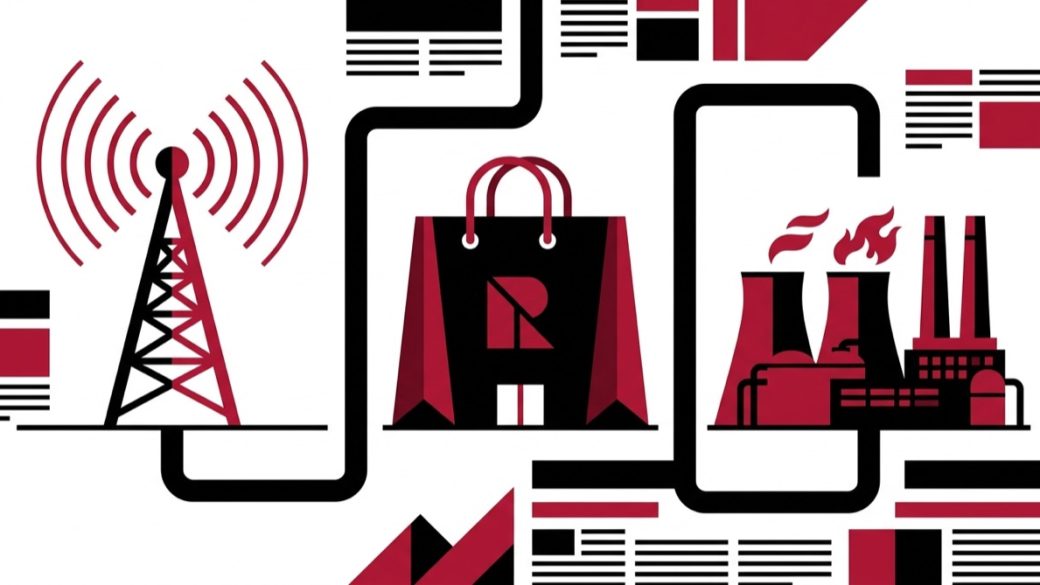
Reliance reports its results across a few broad segments. The simplest way to understand the company today is as four engines plus a media and entertainment arm. The table below summarises what each does and which brands you may already use.
| Segment | What it does | Well-known brands / units |
|---|---|---|
| Digital services (Jio) | Mobile data & voice, home broadband, enterprise connectivity, digital apps | Jio, JioFiber, JioMart (digital), JioCinema |
| Reliance Retail | Organised retail across grocery, fashion, electronics and more | Reliance Fresh, Smart Bazaar, Reliance Digital, Trends, AJIO |
| Oil-to-Chemicals (O2C) | Refining crude oil and producing petrochemicals; fuel retail | Jamnagar refinery, Jio-bp fuel stations (JV) |
| Oil & Gas (E&P) | Exploration and production of domestic natural gas | KG-D6 basin (east coast) |
| New energy | Solar, batteries, green hydrogen and related manufacturing (being built out) | Dhirubhai Ambani Green Energy Giga Complex |
| Media & entertainment | Television, streaming and news | Network18; JioStar (media JV with Disney’s India business) |
What does “O2C” mean? Oil-to-Chemicals is Reliance’s term for its integrated chain that turns crude oil into fuels (like petrol and diesel) and into petrochemical building blocks (like polymers and polyester) used to make plastics, packaging and fabrics. It is the group’s oldest cash engine, and the cash it throws off has historically funded Reliance’s expansion into newer businesses.
Jio & digital services
Jio is arguably the business that changed Reliance’s identity. Launched commercially in 2016 under Reliance Jio Infocomm, it offered low-cost 4G data and free voice calls, triggering a price war that dramatically lowered the cost of mobile internet in India. Jio rapidly became one of the largest telecom operators in the country by subscriber base and has since rolled out 5G and fixed broadband (JioFiber and JioAirFiber).
The telecom and digital assets sit under a holding company, Jio Platforms. In 2020, Jio Platforms attracted a wave of high-profile global investors — including technology and private-equity majors — who bought minority stakes, validating its valuation and giving Reliance significant capital to reduce debt. A separately listed entity, Jio Financial Services (JFS), was demerged from RIL in 2023 to house financial-services and lending ambitions; it trades independently on the exchanges.
Why Jio matters strategically
Beyond connectivity, Jio gives Reliance a direct digital relationship with a very large user base. That underpins ambitions in digital commerce, payments, content and, increasingly, artificial intelligence and cloud services. Management has publicly framed AI and connectivity as central to Jio’s next phase. A potential Jio IPO (a stock-market listing of the digital business) is one of the most anticipated events on Dalal Street, though investors should rely only on official company announcements for any timeline or pricing.
Reliance Retail
Reliance Retail is India’s largest retailer by revenue and store count, operating thousands of stores across formats. If you have shopped at Reliance Fresh or Smart Bazaar for groceries, at Reliance Digital for electronics, at Trends for apparel, or ordered fashion on AJIO, you have used a Reliance Retail business. The company also distributes a range of international brands in India and has built private labels and a fast-moving consumer goods (FMCG) portfolio.
Like Jio Platforms, the retail holding company (Reliance Retail Ventures) raised capital from global investors, reflecting expectations about the long runway for organised retail in a market still dominated by small shops (“kirana” stores). A future listing of Reliance Retail is widely speculated about, but again, only official filings should be treated as confirmation.
Oil-to-Chemicals (O2C) and oil & gas
The O2C segment is where Reliance came from and remains a major cash generator. At its heart is the Jamnagar complex in Gujarat — among the largest refining hubs in the world — which converts crude oil into transport fuels and petrochemical feedstocks for export and domestic use. On the retail-fuel side, Reliance runs petrol pumps through Jio-bp, a joint venture with the global energy company bp.
Separately, the oil & gas (exploration & production) business produces natural gas from domestic fields, most notably in the KG-D6 block off India’s east coast. This matters for India’s energy security because domestically produced gas reduces reliance on imports and helps the country manage its large energy import bill.
O2C earnings are inherently cyclical: they rise and fall with global crude prices, refining margins (the spread between the cost of crude and the price of refined products), and petrochemical demand. When global refining margins are wide, the segment can be very profitable; when they compress, profits fall even if the plants run at full capacity. That cyclicality is one reason Reliance has pushed so hard into steadier, consumption-led businesses and into clean energy — diversifying the group’s earnings away from the swings of the commodity cycle. It is also why the company describes the segment as a “cash engine” whose returns are recycled into faster-growing arms.
New energy & the green push
Reliance has committed to a large, multi-year investment in clean energy, anchored by the Dhirubhai Ambani Green Energy Giga Complex in Jamnagar. The plan spans several “giga-factories” intended to manufacture, rather than merely import, the building blocks of the energy transition.
| New-energy pillar | What it aims to do |
|---|---|
| Solar (PV modules) | Manufacture solar photovoltaic modules and components end-to-end in India |
| Battery storage | Build battery cells and storage systems to make renewable power usable around the clock |
| Green hydrogen | Produce hydrogen using renewable electricity (electrolysers) as a clean industrial fuel |
| Power electronics & fuel cells | Make the supporting hardware that ties the clean-energy chain together |
The strategic logic is to repeat the Jamnagar playbook — large scale and deep integration — but for clean energy, and to align with India’s national targets for renewable capacity and net-zero emissions. As with any long-gestation industrial programme, timelines and capacities evolve, so treat company guidance as the source of truth.
Ownership & leadership
Reliance is a publicly listed company, so anyone can buy its shares. However, the Ambani family (the “promoter group”) holds a large controlling stake — typically around the high-40s percent range — with the remainder held by domestic and foreign institutional investors, mutual funds and millions of retail shareholders. (“Promoter” is the Indian regulatory term for a company’s founding owners who control it.)
Mukesh Ambani is the Chairman and Managing Director and is consistently ranked among the wealthiest individuals in Asia. In recent years the next generation has formally entered leadership: his children — Akash Ambani, Isha Ambani and Anant Ambani — have taken board and leadership roles associated with the digital/Jio, retail, and new-energy businesses respectively, in what is widely seen as a long-term succession plan.
Strategy & what comes next
Three themes define Reliance’s current strategy, and they are useful lenses for anyone tracking the company’s news flow.
1. Consumer + digital as the growth core
Jio and Reliance Retail are positioned as the long-term growth drivers, monetising India’s rising incomes, smartphone penetration and shift to organised retail. Watch for updates on subscriber additions, average revenue per user (ARPU) in telecom, store expansion, and any moves on potential listings of these units.
2. New energy as the next big bet
The green-energy giga-complex is a multi-year capital programme. Progress on solar manufacturing, battery cells and green hydrogen will determine whether new energy becomes a genuine third pillar alongside O2C and consumer.
3. Deleveraging and disciplined capital
After heavy investment cycles, Reliance has emphasised strengthening its balance sheet, partly through stake sales in Jio Platforms and Reliance Retail. Investors typically track net debt, capital expenditure and free cash flow to judge financial health.
| What investors & readers usually track | Why it matters |
|---|---|
| Jio ARPU & subscribers | Shows pricing power and the health of the digital engine |
| Reliance Retail revenue & store count | Gauges momentum in the consumer business |
| Refining & petrochemical margins | Drives the cyclical O2C profits |
| New-energy milestones | Signals progress on the future growth pillar |
| Net debt & capex | Indicates balance-sheet strength and investment intensity |
| Any IPO announcements (Jio/Retail) | Potential value-unlocking events — trust official filings only |
Frequently asked questions
What does Reliance Industries do?
Reliance Industries is a diversified conglomerate. Its main businesses are digital services and telecom (Jio), organised retail (Reliance Retail), oil-to-chemicals or O2C (refining crude oil and making petrochemicals), domestic oil & gas exploration, and a growing new-energy arm (solar, batteries and green hydrogen). It also has media and entertainment interests.
Who owns Reliance Industries?
It is a publicly listed company, so its shares are owned by a mix of the founding Ambani family (the “promoter group”, typically holding a controlling stake of around the high-40s percent), large institutional investors and mutual funds, and millions of individual retail shareholders. Mukesh Ambani leads the company as Chairman and Managing Director.
Who founded Reliance and what is its history?
Reliance was founded by Dhirubhai Ambani, who began with yarn and textiles trading in the 1960s and built the “Vimal” brand before expanding into polyester, petrochemicals and refining. After his death in 2002 the group was split between his sons; Mukesh Ambani kept Reliance Industries and later launched Jio (2016) and scaled up Reliance Retail.
What are the main subsidiaries and companies under Reliance?
Key units include Reliance Jio Infocomm and its holding company Jio Platforms (digital/telecom), Reliance Retail Ventures (retail), the O2C and oil-and-gas operations, the new-energy business, and Network18/JioStar in media. Jio Financial Services was demerged into a separately listed company in 2023.
Is Reliance Industries the biggest company in India?
Reliance is consistently among the very largest Indian companies by revenue and is frequently the most valuable private-sector company by market capitalisation, competing for the top spot with firms such as Tata Consultancy Services and HDFC Bank. Its exact rank changes with daily share prices, so check current market data for the latest position.
When is the Jio IPO?
A stock-market listing (IPO) of the Jio digital business has been widely speculated about and is among the most anticipated potential listings in India. As of mid-2026 you should rely only on official Reliance announcements and stock-exchange filings for any confirmed date, pricing or structure, rather than on rumours.
What is the difference between Reliance Industries and the Anil Ambani group?
They are separate. After the 2002 family split, Mukesh Ambani took Reliance Industries (refining, petrochemicals, and later Jio and Retail), while Anil Ambani took telecom, power and financial-services ventures under a different group (“Reliance ADA Group”). The two are independent companies despite sharing the Reliance name and family heritage.
Disclaimer: This article is for educational purposes only and is not investment/financial advice. Read all scheme/offer documents and consult a SEBI-registered adviser where relevant.