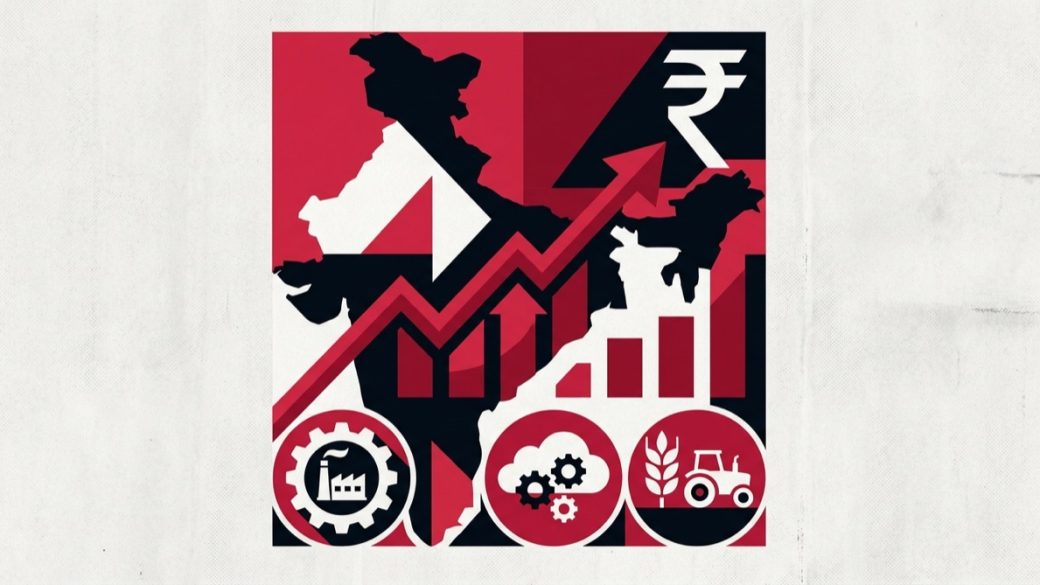
The Indian economy is the world’s fifth-largest by nominal GDP and one of the fastest-growing major economies on the planet. It is a mixed, services-led economy that combines a vast agricultural base, a growing manufacturing sector, a world-class IT and digital-services industry, and one of the biggest consumer markets in the world. This guide explains how India’s economy is sized and structured, the sectors that drive it, the key indicators you should track, and the forces that will shape its next decade.
How big is the Indian economy?
When people ask “how big is the Indian economy,” they are usually asking about Gross Domestic Product (GDP) — the total market value of all goods and services a country produces in a year. By this measure, India ranks among the top five economies in the world by nominal GDP, having moved past the United Kingdom in recent years to become the fifth-largest. The economy is in the multi-trillion-dollar range and a long-standing national goal has been to cross the $5-trillion mark and then climb toward becoming the world’s third-largest economy.
There are two common ways to size an economy, and they tell very different stories:
Nominal GDP vs PPP GDP
Nominal GDP converts output at market exchange rates (rupees to US dollars). On this basis India is the fifth-largest economy. Purchasing Power Parity (PPP) adjusts for how much a dollar actually buys in each country — and because prices in India are lower, India’s PPP-based economy is even larger, ranking as the world’s third-largest. Both views are correct; they simply answer different questions.
Why per-capita income is the number to watch
A large total economy spread across roughly 1.4 billion people means average income per person is modest by global standards. India is classified by the World Bank as a lower-middle-income, developing economy. The central economic challenge is not just to grow the overall pie, but to raise income per person fast enough to lift hundreds of millions of people toward middle-class living standards.
The structure: three sectors that power India
Every economy is divided into three broad sectors. Understanding the balance between them is the single best way to understand how an economy actually works.
1. Agriculture (the primary sector)
Agriculture and allied activities — farming, dairy, fisheries, forestry — contribute a relatively small and slowly shrinking share of GDP, but they still employ the largest portion of India’s workforce. This mismatch (a large share of jobs producing a smaller share of output) is one of the defining features of the Indian economy. Monsoon rainfall, crop prices, and rural demand make agriculture politically and economically critical, even as its GDP weight declines.
2. Industry (the secondary sector)
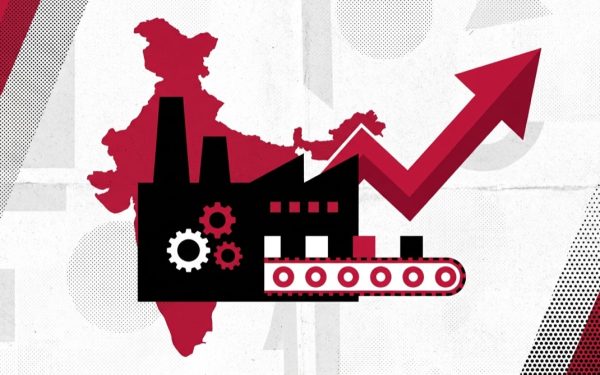
Industry covers manufacturing, mining, electricity, and construction. India is actively trying to expand this sector through initiatives like Make in India and Production Linked Incentive (PLI) schemes, aiming to raise manufacturing’s share of GDP and create large numbers of formal jobs. Construction and infrastructure spending are major growth engines within this segment.
3. Services (the tertiary sector)
Services are the powerhouse of the modern Indian economy, contributing more than half of GDP. This sector spans information technology (IT) and software, business-process management, banking and financial services, telecom, trade, hospitality, and the fast-growing digital economy. India’s IT and software-export industry is globally competitive and a key source of foreign-exchange earnings.
India’s services strength is unusual for an economy at its income level. Most countries grow rich first through a large manufacturing phase and only later become services-heavy. India, by contrast, leapfrogged into services — especially software, global capability centres, and digital platforms — relatively early. This gives it a competitive edge in high-value, knowledge-based work, but it also means manufacturing has not yet absorbed as many workers as in other fast-growing economies, which is why expanding industry remains a national priority.
| Sector | What it includes | Share of GDP | Share of jobs |
|---|---|---|---|
| Agriculture (primary) | Farming, dairy, fishing, forestry | Smallest of the three | Largest single employer |
| Industry (secondary) | Manufacturing, mining, power, construction | Roughly a quarter | Growing share |
| Services (tertiary) | IT, finance, telecom, trade, tourism | More than half | Large and rising |
Key economic indicators explained
To read the health of any economy like an analyst, you track a handful of core indicators. Here are the ones that matter most for India and what each one tells you.
GDP growth rate
This is the headline number — the percentage by which real (inflation-adjusted) output grows year over year. India has consistently been one of the fastest-growing major economies, which is why it attracts so much global investor attention. A rising growth rate signals expanding production, jobs, and incomes. Analysts distinguish between real GDP growth (after stripping out inflation, the truest measure of expansion) and nominal GDP growth (which includes price rises). When you read that “the economy grew by X%,” it almost always refers to real growth.
Inflation (CPI and WPI)
Inflation measures how fast prices rise. India watches two main gauges: the Consumer Price Index (CPI), which tracks retail prices paid by households, and the Wholesale Price Index (WPI), which tracks prices at the wholesale level. The Reserve Bank of India (RBI) targets CPI inflation around a defined band and uses interest rates to keep it in check. Food and fuel prices are the biggest swing factors.
Fiscal deficit
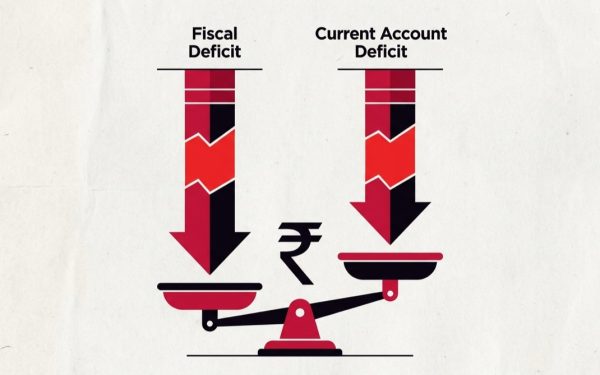
The fiscal deficit is the gap between what the government spends and what it earns (excluding borrowings), expressed as a percentage of GDP. A controlled deficit shows fiscal discipline; a large one can fuel inflation and raise borrowing costs. The government sets a deficit target in the annual Union Budget.
Current account and trade balance
The current account deficit (CAD) captures whether India imports more than it exports (including services and remittances). India typically runs a goods-trade deficit — partly because it imports large volumes of crude oil — but this is cushioned by strong services exports and remittances from Indians working abroad.
Foreign exchange reserves
Forex reserves are the foreign currency, gold, and reserve assets held by the RBI. Healthy reserves act as a shock absorber, helping stabilise the rupee and cover imports during global turbulence. India holds one of the largest reserve stockpiles in the world.
| Indicator | What it measures | Who tracks/controls it | Healthy signal |
|---|---|---|---|
| GDP growth rate | Speed of economic expansion | MoSPI / NSO | Higher, sustained growth |
| CPI inflation | Retail price rises | RBI (targets it) | Within the target band |
| Fiscal deficit | Govt spending vs income | Ministry of Finance | Falling toward target |
| Current account deficit | External trade balance | RBI | Small and financed easily |
| Forex reserves | External buffer | RBI | Large and stable |
Growth story and what drives it
India’s rise from a slow-growing economy in the late twentieth century to a leading global growth engine is rooted in the 1991 economic reforms, which opened the economy to private enterprise, foreign investment, and global trade (a process called liberalisation). Several durable forces now power its growth.
Demographic dividend
India has one of the youngest populations among large economies. A large, young working-age population can drive output and consumption for decades — provided enough quality jobs and skills are created. This “demographic dividend” is one of India’s biggest structural advantages.
Domestic consumption
Unlike export-dependent economies, India’s growth is powered substantially by its own domestic demand. A vast and rising consumer base makes the economy more resilient to global slowdowns and is a magnet for companies worldwide.
The digital and services engine
India’s digital public infrastructure — including the Unified Payments Interface (UPI) for instant payments and the Aadhaar digital-identity system — has formalised commerce, expanded financial inclusion, and enabled a thriving startup and fintech ecosystem. Combined with a globally competitive IT-services industry, this is a powerful, distinctly Indian growth driver.
Investment and infrastructure
Sustained public spending on roads, railways, ports, airports, and energy — alongside rising private investment — boosts productivity across the whole economy. Better logistics lower the cost of moving goods, cheaper and more reliable power supports factories, and faster connectivity links smaller towns into national supply chains. Manufacturing pushes such as Make in India and PLI schemes aim to deepen this further by encouraging companies to build products in India rather than import them.
Exports and global integration
India is steadily expanding its role in global trade. While it has long been a leader in services exports — particularly software and IT-enabled services — there is a major push to grow merchandise exports in areas like electronics, pharmaceuticals, automobiles, and engineering goods. As global companies look to diversify supply chains beyond a single country, India is positioning itself as an attractive alternative manufacturing and sourcing base, a trend often described as the “China-plus-one” strategy.
The government’s role and major reforms
India runs a mixed economy — markets and private enterprise drive most activity, while the government plays a major role in regulation, public goods, welfare, and strategic sectors. Several institutions and reforms shape the economy.
The key institutions
- Ministry of Finance — presents the annual Union Budget, setting taxation and spending (fiscal policy).
- Reserve Bank of India (RBI) — the central bank, which manages inflation, interest rates, the rupee, and the banking system (monetary policy).
- NITI Aayog — the government’s policy think tank, guiding long-term planning.
- SEBI — regulates the stock markets; GST Council — governs the unified Goods and Services Tax.
Landmark reforms
Beyond 1991 liberalisation, two reforms reshaped modern India: the Goods and Services Tax (GST), which replaced a tangle of state and central taxes with one national indirect tax, creating a unified market; and the Insolvency and Bankruptcy Code (IBC), which streamlined how stressed companies are resolved. Schemes like Make in India, Digital India, and PLI aim to expand manufacturing and the digital economy.
Risks and challenges ahead
India’s outlook is strong, but real challenges remain. A balanced view of the economy must weigh them honestly.
Jobs and the informal economy
Creating enough quality, formal-sector jobs for millions of young people entering the workforce each year is India’s biggest economic test. A large share of employment is still informal, with limited security and benefits.
Inequality and uneven development
Growth has not been evenly shared across regions, between urban and rural areas, or across income groups. Lifting per-capita income and broadening prosperity is essential for inclusive growth.
External and energy dependence
India imports a large share of its crude oil and many high-end electronics and components. Global oil-price spikes, supply-chain shocks, and a volatile rupee-versus-dollar exchange rate can pressure inflation and the current account.
Skilling, climate, and infrastructure gaps
Bridging the skills gap so the demographic dividend is fully realised, adapting to climate risks (including monsoon variability that affects agriculture), and continuing to close infrastructure gaps are all critical to sustaining high growth.
| Strength | Corresponding challenge |
|---|---|
| Large young workforce | Generating enough quality jobs |
| Fast overall GDP growth | Raising per-capita income and reducing inequality |
| Strong services & digital economy | Deepening manufacturing and exports |
| Big domestic market | Energy & import dependence, external shocks |
The road to a developed India
India’s stated long-term ambition is to become a developed economy — often framed as the “Viksit Bharat” (Developed India) vision — and to rank among the world’s top three economies by nominal GDP. Getting there depends on sustaining high growth over a long period, expanding manufacturing and exports, deepening skills and human capital, continuing reforms, and ensuring growth lifts incomes broadly rather than narrowly.
The mathematics of this goal are demanding but achievable. To move from lower-middle-income to high-income status, an economy needs to grow real output at a strong pace for many consecutive years while keeping inflation, deficits, and external balances under control. Few large economies have managed this transition smoothly, so consistency matters more than any single record year. The encouraging news is that India’s growth drivers — demographics, domestic demand, digital infrastructure, and rising investment — are structural rather than temporary, which gives the long-run trajectory genuine momentum.
For everyday readers, students, and investors, the practical message is simple: India is a large, fast-growing, services-led mixed economy with powerful structural tailwinds and well-understood challenges. Watch the five core indicators — GDP growth, inflation, fiscal deficit, current account, and forex reserves — and you will be able to read the economy’s direction with confidence, no matter what the headlines say.
Frequently asked questions
Is India a developed or developing economy?
India is classified as a developing economy — specifically a lower-middle-income country by the World Bank. Although its total GDP is among the largest in the world, its per-capita income is still modest, which is why it is not yet a developed economy. Becoming developed is a stated long-term national goal.
What type of economy does India have?
India has a mixed economy. Private enterprise and free markets drive most activity, while the government plays a significant role through regulation, public services, welfare programmes, and a presence in strategic sectors.
Which is the largest sector of the Indian economy?
The services (tertiary) sector is the largest, contributing more than half of GDP. It includes IT and software, finance, telecom, trade, and tourism. Agriculture contributes the least to GDP but still employs the most people.
What rank is India’s economy in the world?
India is the 5th-largest economy by nominal GDP and the 3rd-largest by purchasing power parity (PPP). Its long-term goal is to rise into the top three by nominal GDP as well.
What is the difference between nominal GDP and PPP?
Nominal GDP measures output at current market exchange rates. PPP (purchasing power parity) adjusts for differences in the cost of living, showing how much output actually buys. India ranks higher on PPP because prices are lower domestically.
What are the main indicators used to measure India’s economy?
The core indicators are the GDP growth rate, inflation (CPI and WPI), the fiscal deficit, the current account deficit, and foreign exchange reserves. Together they show how fast the economy is growing and how stable it is.
Why is India’s economy growing so fast?
Key drivers include a large young workforce (the demographic dividend), strong domestic consumption, a booming digital and services economy supported by infrastructure like UPI, and rising investment and infrastructure spending — all built on the foundation of the 1991 economic reforms.
Disclaimer: This article is for educational purposes only and is not investment/financial advice. Read all scheme/offer documents and consult a SEBI-registered adviser where relevant.