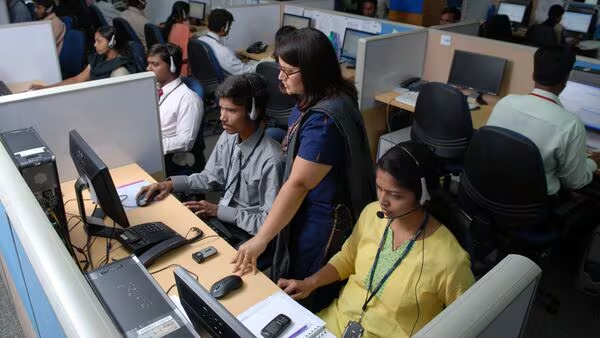
In a clear sign that global technology heavyweights are leaning heavily into India’s tech ecosystem, the FAAMNG group of companies (Meta, Amazon, Apple, Microsoft, Netflix, and Google) has added approximately 13,600 employees in India so far in 2026.
Data released by specialized staffing firm Xpheno indicates that despite an intense backdrop of mass tech layoffs and rigid cost-cutting measures in western offices, Big Tech hiring inside India actually grew by 6% year-on-year, up from the 12,800 workers onboarded during the same period last year.
1. The Strategy: Precision Roles Over General Headcount
While the net employee addition is positive, the data reveals that the era of massive, volume-driven generalist recruitment is largely over. Silicon Valley has fundamentally filtered its hiring lens through a strict outcome-based model:
- The Skills Pivot: Hiring is heavily concentrated within deep-tech and high-impact operational layers. Demand for standard backend developers and basic IT support roles has noticeably slowed down, while recruitment for Generative AI engineers, Cloud Architects, Cybersecurity analysts, and Data Engineers has surged by 25% to 30%.
- The Global Capability Center (GCC) Magnet: A significant portion of this headcount is being absorbed directly into Global Capability Centers based out of tier-1 hubs like Bengaluru and Hyderabad. Meta, Amazon, and Microsoft are actively utilizing their Indian centers to build and deploy complex, foundational product architectures rather than simple operational backups.
[Old Big Tech Playbook] ──► Mass Campus Placement ──► Volume General Headcount (Slowing Down)
                                                                 │
                                                                 ▼ (2026 Precision Paradigm)
[New Big Tech Playbook] ──► Core AI, Cloud & Cyber ──► 13,600 India Hires (+6% YoY Growth)
2. The Micro Pressures Sucking Jobs to India
According to recruitment consultancies like TeamLease Digital, the structural decision to scale up technical teams in India while keeping US headcount flat or shrinking is being accelerated by two specific macro pressures:
- The US Visa Squeeze and Costs: Escalating administrative costs, heightened regulatory friction around H-1B visas, and proposed protectionist labor legislation in the United States have made traditional cross-border human resource relocation vastly more expensive.
- The Macro Growth Outlook: TeamLease metrics project that by the conclusion of December 2026, total Big Tech and GCC hiring across India could potentially scale by 16% to 20% overall. This is bolstered by a booming domestic internet economy and massive long-term data infrastructure commitments—headlined by Amazon’s landmark $48 billion investment blueprint for the country.
3. The Indian Tech Workforce Outlook (H1 2026)
The surge in high-tier FAAMNG talent acquisition maps clean structural alignments across the broader Indian white-collar landscape:
| Hiring Metric Layer | Active Market Status & Trend |
| Top Tech Hiring Hub | Bengaluru remains the absolute capital, commanding an 84% overall hiring intent, closely powered by an 81% intent footprint within specialized IT domains. |
| The Shift in Entry Requirements | For incoming tech freshers, employers are increasingly prioritizing verified internships, cloud certifications, and live portfolio builds over legacy academic degrees. |
| Emerging Tier-2 Corridors | Metros like Thane, Pune, and Kochi are experiencing severe mid-to-senior talent capture as satellite GCC operations set up lean teams outside core hubs. |
While traditional IT outsourcing and services enterprises are navigating a slower transition due to clients tightening their discretionary spending budgets, the FAAMNG ecosystem’s steady 13,600-strong expansion proves that India is no longer just an offshore back-office—it is a central development environment for core enterprise AI.
For a deeper look into how localized global operations are transforming the tech landscape, you can watch this analysis on the Indian GCC Growth Boom vs IT Services Hiring. This video breaks down how multinational companies are shifting deep-tech workloads directly to their in-house Indian centers rather than outsourcing them.