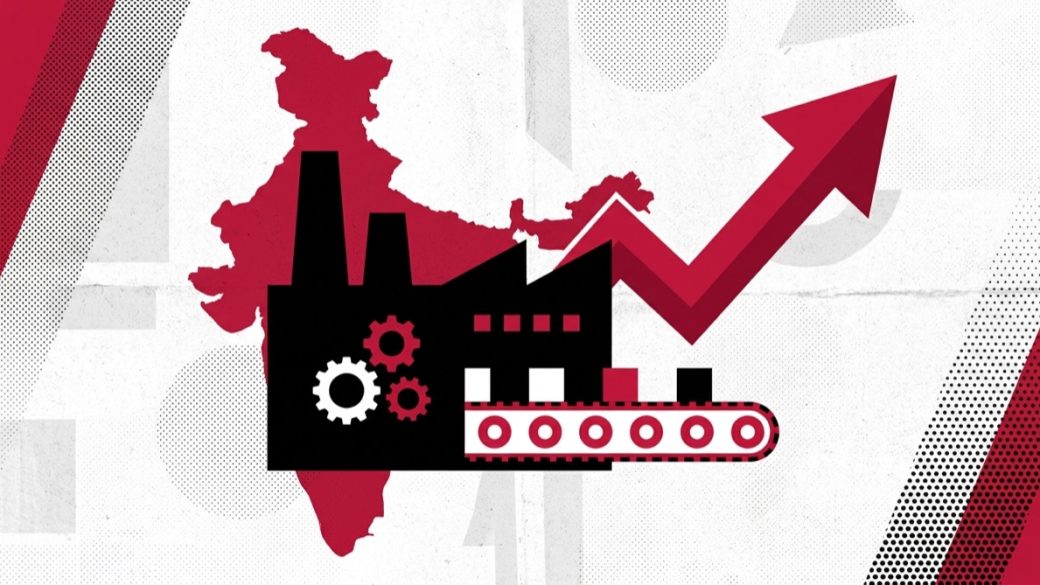
Make in India is the Government of India’s flagship initiative, launched on 25 September 2014, to turn India into a global manufacturing and design hub by encouraging companies to manufacture their products in India. Its modern engine is the set of Production Linked Incentive (PLI) schemes — cash incentives paid to companies on the additional goods they produce and sell from Indian factories. Together they aim to raise manufacturing’s share of the economy, cut import dependence, and create jobs across sectors from electronics and pharmaceuticals to automobiles and solar.
- What is Make in India?
- Goals and the four pillars
- PLI schemes explained: how the money works
- The 14 PLI sectors at a glance
- Electronics & semiconductors: the flagship story
- Results so far: what has actually changed
- Criticisms and open questions
- How businesses can participate
- Frequently asked questions
What is Make in India?
Make in India is a national programme designed to encourage both domestic and foreign companies to manufacture and assemble their products inside India. It was launched by Prime Minister Narendra Modi on 25 September 2014, with a now-famous lion logo built out of cogwheels — a symbol meant to combine India’s strength with the machinery of industry.
The thinking behind it was simple. For decades, India’s growth story was led by services — software, IT, finance and business process outsourcing — while manufacturing remained a relatively small share of the economy compared with East Asian peers like China, Vietnam and South Korea. Manufacturing matters because it creates large numbers of jobs for people without advanced degrees, builds industrial know-how, and reduces reliance on imported goods. Make in India set out to change the balance.
It is important to understand that “Make in India” is an umbrella brand, not a single law or a single subsidy. It coordinates many separate policies: easing rules for doing business, liberalising foreign investment, building infrastructure and industrial corridors, and — most importantly in recent years — offering direct financial incentives through the PLI schemes. The initiative is steered by the Department for Promotion of Industry and Internal Trade (DPIIT), which sits under the Ministry of Commerce and Industry.
Goals and the four pillars
When it was launched, Make in India set out an ambitious vision: to raise the share of manufacturing in India’s economy and to make the country a credible alternative to other Asian manufacturing destinations. The original aspiration was to lift manufacturing’s contribution to gross domestic product (GDP) meaningfully and to create a large number of manufacturing jobs over time.
The initiative rested on four broad pillars that the government repeatedly emphasised:
1. New processes
Treating “ease of doing business” as a core reform — simplifying licences, approvals and compliance so that setting up and running a factory becomes faster and less bureaucratic.
2. New infrastructure
Building industrial corridors, smart cities, and modern logistics so that goods can move cheaply and factories have reliable power, land and connectivity. Later schemes such as the National Logistics Policy and the PM Gati Shakti master plan reinforced this pillar.
3. New sectors
Opening more sectors to foreign direct investment (FDI) — including defence, insurance, railways and more — so that global capital and technology could flow into Indian manufacturing.
4. New mindset
Shifting the government’s role from a regulator that controls industry to a facilitator that partners with it.
PLI schemes explained: how the money works
The Production Linked Incentive scheme is the part of Make in India that most directly puts government money behind manufacturing. The full form of PLI is Production Linked Incentive. The idea, introduced from 2020 onwards, is straightforward but powerful: instead of giving companies upfront grants or tax holidays regardless of output, the government pays a cash incentive that is linked to how much extra a company actually produces and sells from its Indian factories.
In practice, a typical PLI scheme works like this:
- A base year is fixed. The company’s existing production or sales in a base year is recorded as the starting point.
- Targets and thresholds are set. The company commits to a minimum level of investment and a minimum amount of incremental (additional) production over the scheme period, usually around five years.
- Incentives are paid on the increase. For each year the company qualifies, it receives an incentive — commonly a percentage of the incremental sales of eligible goods made in India. Rates vary by sector and often taper down over the scheme’s life.
- It is performance-based. No extra production, no incentive. This is the crucial difference from older subsidy models — the company must deliver results to get paid.
This design is meant to reward genuine scale-up, attract serious manufacturers (including global ones shifting supply chains), and limit the risk of money being spent without output. The schemes are run by the relevant line ministries — for example, electronics PLI is administered by the Ministry of Electronics and Information Technology (MeitY), while others sit with ministries such as Pharmaceuticals, Textiles, Heavy Industries and Food Processing.
| Element of a typical PLI scheme | What it means |
|---|---|
| Base year | The reference year against which extra (“incremental”) production is measured |
| Eligibility threshold | Minimum committed investment and/or production a company must meet to qualify |
| Incentive basis | Usually a percentage of incremental sales of eligible India-made goods |
| Scheme tenure | Commonly around five years, with rates that may taper over time |
| Trigger for payout | Audited proof of investment and incremental sales — paid in arrears, not upfront |
| Administering body | The relevant line ministry (e.g. MeitY for electronics) |
The 14 PLI sectors at a glance
The government rolled out PLI schemes across 14 key sectors, with a combined outlay of roughly ₹1.97 lakh crore (about ₹1,970 billion) announced over a five-year horizon. The sectors were chosen for their potential to create jobs, reduce imports, build strategic capability, or capture global supply chains shifting out of other countries.
| Sector | Why it was selected |
|---|---|
| Large-scale electronics manufacturing (mobile phones) | Capture global handset assembly; cut electronics imports |
| IT hardware (laptops, tablets, servers) | Reduce dependence on imported computing devices |
| Pharmaceuticals (drugs & formulations) | Strengthen India’s “pharmacy of the world” position |
| Bulk drugs / key starting materials (APIs) | Reduce reliance on imported active ingredients |
| Medical devices | Build domestic capacity in a high-import segment |
| Telecom & networking products | Secure critical communications equipment |
| Automobiles & auto components | Promote advanced and clean-mobility manufacturing |
| Advanced chemistry cell (ACC) battery storage | Enable EV and energy-storage ecosystems |
| Solar PV modules (high-efficiency) | Build a domestic clean-energy supply chain |
| Textiles (man-made fibre & technical textiles) | Move up the value chain in a major employer |
| Food processing | Add value to agriculture and create rural jobs |
| White goods (air conditioners & LED lights) | Localise components and reduce imports |
| Speciality steel | Build high-grade, value-added steel capacity |
| Drones & drone components | Nurture an emerging strategic technology |
Each scheme has its own eligibility rules, investment thresholds, incentive rates and timelines, notified separately by the responsible ministry. Some sectors have seen heavy uptake and oversubscription; others have been slower, and the government has periodically reviewed, extended or restructured individual schemes based on performance.
Electronics & semiconductors: the flagship story
If Make in India has a poster child, it is electronics — specifically smartphones. The PLI scheme for large-scale electronics manufacturing, launched in 2020, offered incentives to companies that ramped up mobile-phone production in India. Global contract manufacturers and brands responded, and India went from assembling a modest share of the phones it consumed to becoming a major mobile-phone producer that also exports handsets.
The iPhone effect
Apple’s manufacturing partners expanded iPhone assembly in India significantly under this scheme, and “iPhone make in India” became one of the most visible symbols of the policy. India is now an established assembly base for Apple’s contract manufacturers, and smartphones — led by high-value models — have become one of the country’s notable export categories. Samsung, which already ran a large facility in Noida, and a range of Indian and Chinese-brand manufacturers also scaled domestic production.
Why “assembly” is not the same as “deep manufacturing”
An honest assessment notes a key nuance: much of the early electronics success has been assembly — importing components and putting them together in India — rather than making the high-value parts (chips, displays, advanced components) domestically. Raising the local “value addition” is the next, harder challenge, and it is exactly where the semiconductor push comes in.
The semiconductor mission
To build genuinely deep capability, the government launched a dedicated Semicon India programme (the India Semiconductor Mission) with a large financial outlay to support semiconductor fabrication plants (fabs), display fabs, assembly and testing (ATMP/OSAT) facilities, and chip design. While this sits under MeitY rather than the PLI umbrella in a strict sense, it is part of the same strategic goal: to move India up the electronics value chain and reduce dependence on imported chips. Several large assembly, testing and packaging projects and at least one major fab have been approved and are at various stages of construction. Building a full chip-fabrication ecosystem is a multi-year, capital-intensive effort, so results here are measured over years, not months.
Results so far: what has actually changed
More than a decade after launch, Make in India and the PLI schemes have produced real, visible changes — alongside genuine debate about how far they have gone. Sticking to what can be stated responsibly:
- Electronics and smartphones: India transformed from a country that imported most of its phones into one that assembles the large majority of phones sold domestically and exports a meaningful and growing volume. This is the clearest success.
- Ease of doing business: India improved substantially in global ease-of-doing-business rankings during the 2014–2020 period (before the underlying index was discontinued), reflecting genuine reform in areas like company registration, construction permits and electricity connections.
- Foreign direct investment: India attracted large FDI inflows over the period, helped by liberalisation of sectoral caps. (FDI is influenced by many global factors, so it cannot be attributed to Make in India alone.)
- New ecosystems: Schemes for solar modules, batteries, drones and pharmaceuticals have begun to build domestic supply chains that barely existed before, even if some are still maturing.
- Diversification of global supply chains: As multinationals adopted “China plus one” strategies, India positioned itself as one of the alternatives — competing with Vietnam, Mexico and others.
Criticisms and open questions
A balanced guide must cover the critiques, which come from economists across the spectrum:
Manufacturing’s share of GDP has been slow to rise
Despite the initiative, manufacturing’s share of India’s economy has not climbed as fast as the early ambitions implied. Lifting it meaningfully has proved harder than expected, and some critics argue the original targets were always optimistic.
Assembly versus value addition
As noted, a chunk of headline success — especially in electronics — reflects assembly of imported parts. Critics argue this can keep import bills high (for components) even as exports of finished goods rise, and that the real prize is deeper domestic value addition.
Uneven uptake and disbursement
PLI uptake has varied widely by sector. Some schemes were oversubscribed and performed well; others saw slow investment, missed targets, or slower-than-planned payout of incentives because of administrative and qualification hurdles. The government has revisited several schemes as a result.
Concentration and the role of large players
Because PLI rewards scale, benefits can concentrate among large companies that can hit big investment and production thresholds, raising questions about how much micro, small and medium enterprises (MSMEs) gain.
Jobs versus capital intensity
Modern manufacturing is increasingly automated, so a given rise in output may create fewer jobs than similar growth would have a generation ago — complicating the employment goals.
| The promise | The reality (balanced view) |
|---|---|
| India as a global manufacturing hub | Strong gains in electronics assembly; broad-based hub status still developing |
| Sharp rise in manufacturing’s GDP share | Progress slower than the original ambition |
| Self-reliance and lower imports | Mixed — finished-goods imports down in places, component imports still significant |
| Large-scale job creation | Jobs created, but automation limits the multiplier |
| Deep, high-value manufacturing | Early stage; the semiconductor mission is the key bet |
How businesses can participate
For founders, manufacturers and investors, Make in India is less a single application form and more a landscape of schemes to navigate. A practical starting framework:
- Identify the relevant scheme. Check whether your product fits one of the 14 PLI sectors, or related programmes (Semicon India, state-level industrial incentives, cluster schemes). Each is notified by a specific ministry with its own guidelines.
- Check eligibility and thresholds. PLI schemes typically require minimum investment and incremental production commitments. These are often designed for medium-to-large players, though some sectors have smaller thresholds.
- Use the official portals. The Make in India website (makeinindia.com) and DPIIT, along with the National Single Window System and individual ministry portals, are the authoritative sources for current schemes, application windows and rules.
- Layer in state incentives. Many Indian states offer their own capital subsidies, land, power tariffs and single-window clearances on top of central schemes. Location choice can materially affect the economics.
- Plan for compliance. Incentives are disbursed only after audited proof of investment and incremental sales, so robust documentation is essential.
Because scheme details, rates and windows change over time, always verify the latest notifications on official government sources before making investment decisions.
Frequently asked questions
What is the full form of PLI scheme?
PLI stands for Production Linked Incentive. It is a scheme under which the government pays companies a cash incentive linked to the increase in goods they manufacture and sell from their factories in India, over a fixed base year and scheme period.
When was Make in India launched?
Make in India was launched on 25 September 2014 by Prime Minister Narendra Modi. The PLI schemes that now power it were introduced later, from 2020 onwards.
Which ministry runs Make in India and the PLI schemes?
The overall Make in India initiative is coordinated by the Department for Promotion of Industry and Internal Trade (DPIIT), under the Ministry of Commerce and Industry. Individual PLI schemes are run by the relevant line ministry — for example, electronics PLI is administered by the Ministry of Electronics and Information Technology (MeitY), and others by ministries such as Pharmaceuticals, Textiles and Heavy Industries.
How many sectors are covered by the PLI scheme?
PLI schemes were announced for 14 key sectors, including mobile/electronics manufacturing, IT hardware, pharmaceuticals, bulk drugs, medical devices, telecom, automobiles, batteries, solar modules, textiles, food processing, white goods, speciality steel and drones, with a combined outlay of roughly ₹1.97 lakh crore.
How is PLI different from older subsidies?
Traditional subsidies often gave money upfront or as tax breaks regardless of output. PLI is performance-based — a company only receives the incentive after it actually invests and produces more than a defined baseline. No extra production means no incentive.
Is the iPhone really “made in India”?
Apple’s contract manufacturers assemble a large and growing number of iPhones in India, and India has become a significant export base for them. However, much of this is currently assembly of components that are still largely imported; deepening local component and chip manufacturing is the goal of the broader semiconductor mission.
Has Make in India been a success?
It has had clear successes — especially the surge in domestic electronics and smartphone manufacturing and exports — alongside areas where progress has been slower, such as raising manufacturing’s overall share of GDP and building deep, high-value supply chains. It is best viewed as a long-term structural initiative that is still unfolding.
Disclaimer: This article is for educational purposes only and is not investment/financial advice. Government scheme details, incentive rates and eligibility change over time — read all official scheme documents and consult a SEBI-registered adviser or qualified professional where relevant before making business or investment decisions.