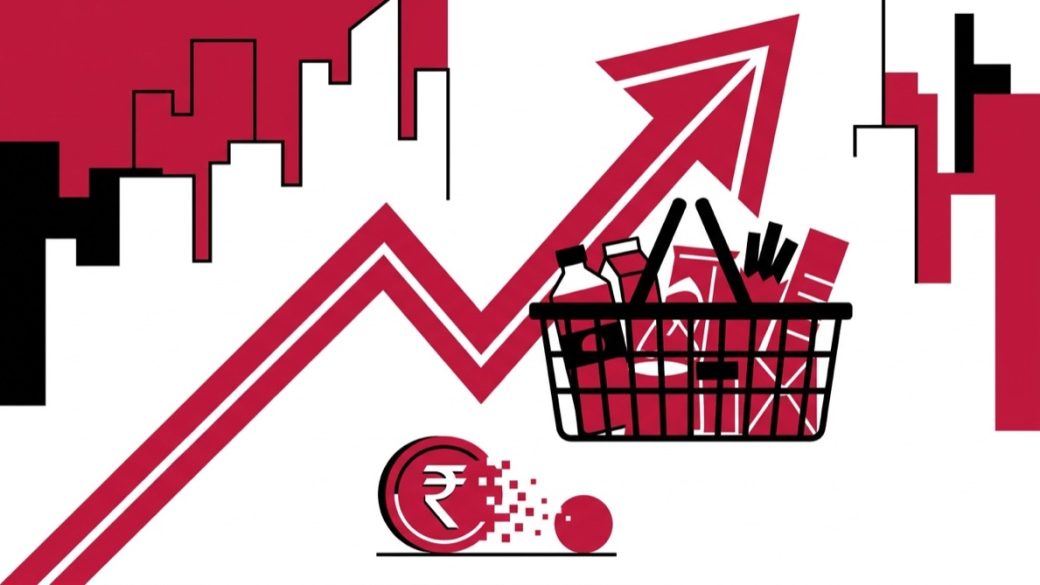
Inflation in India is the rate at which the general level of prices for goods and services rises over time, steadily reducing what each rupee can buy. It is measured mainly through two index families — the Consumer Price Index (CPI), which tracks retail prices paid by households, and the Wholesale Price Index (WPI), which tracks bulk transaction prices. The Reserve Bank of India (RBI) is legally tasked with keeping retail (CPI) inflation at 4%, within a tolerance band of 2% to 6%, and it does this primarily by adjusting its key interest rate, the repo rate.
What inflation actually means ·
CPI vs WPI: India’s two price gauges ·
How inflation is measured in India ·
Types of inflation ·
What causes inflation in India ·
Who wins and who loses ·
The RBI’s 4% ±2% target ·
How the repo rate controls inflation ·
Deflation, disinflation & stagflation ·
FAQ
What inflation actually means
Ask any household in India what inflation is, and the answer is usually instant: prices go up. That instinct is correct. Inflation is a sustained, broad-based rise in the general price level of an economy. The key words are “sustained” and “broad-based.” A one-off jump in tomato prices after a bad monsoon is not inflation by itself; inflation is when the overall basket of things people buy — food, fuel, rent, transport, school fees, clothing, medicines — gets more expensive on average, month after month.
The flip side of rising prices is falling purchasing power. If prices rise 6% in a year and your income stays flat, you have effectively become poorer: the same salary now buys 6% less. This is why inflation is sometimes called a “silent tax.” Nobody sends you a bill, but your money quietly buys less than it did before.
A small, steady, predictable amount of inflation is generally considered healthy for a growing economy like India’s. It encourages spending and investment rather than hoarding cash and keeps the economy a safe distance from the more dangerous condition of falling prices. The problem is not inflation itself, but inflation that is too high, too volatile, or unpredictable.
Headline vs core inflation
You will often hear two versions of the number. Headline inflation is the all-in figure covering every item in the index, including food and fuel. Core inflation strips out food and fuel, which tend to be volatile and driven by weather or global crude prices that domestic policy cannot easily influence. Core inflation gives policymakers a cleaner read on underlying, demand-driven price pressure. In India, where food is a very large share of the average household budget, the gap between headline and core inflation can be wide, and both are watched closely.
CPI vs WPI: India’s two price gauges
India does not have a single “inflation number.” It has several, but two dominate the conversation: the Consumer Price Index (CPI) and the Wholesale Price Index (WPI). They measure different things, are compiled by different agencies, and can tell very different stories at the same point in time.
The CPI captures prices at the retail level — what a household actually pays at the shop or online. It is the headline measure that affects ordinary people most directly, and crucially, it is the index the RBI is legally required to target. The WPI captures prices at the wholesale or bulk level — transactions between businesses, before goods reach the final consumer. The WPI does not include services at all, while the CPI does.
Why does the difference matter? Because the two can move in opposite directions for months. WPI is heavily weighted towards manufactured goods and commodities, so it reacts quickly to swings in global metal, crude, and input prices. CPI is weighted towards food and services that households consume. It is entirely possible for wholesale (WPI) inflation to be near zero or even negative while retail (CPI) inflation is uncomfortably high — or the reverse. Because the RBI’s legal mandate is framed around CPI, the retail number is what ultimately drives interest-rate decisions.
| Feature | CPI (Consumer Price Index) | WPI (Wholesale Price Index) |
|---|---|---|
| What it measures | Retail prices paid by consumers | Bulk / wholesale transaction prices |
| Covers services? | Yes (rent, education, health, transport) | No — goods only |
| Biggest weight | Food & beverages | Manufactured products |
| Compiled by | National Statistical Office (NSO), under MoSPI | Office of the Economic Adviser, DPIIT (Ministry of Commerce) |
| Used by RBI for target? | Yes — this is the official target index | No — watched as a supplementary indicator |
| Who feels it most | Households and salaried consumers | Producers, traders, businesses |
How inflation is measured in India
Both indices work on the same underlying idea: pick a representative “basket” of goods and services, assign each item a weight based on how much people (or businesses) actually spend on it, track the prices over time, and compare the basket’s total cost today against its cost in a fixed reference year, called the base year. The percentage change in that basket’s cost over twelve months is the year-on-year inflation rate.
The basket and the base year
The base year is the benchmark against which all later prices are compared; its index value is set to 100. As consumption patterns evolve, the base year and the basket are periodically revised so the index keeps reflecting how people genuinely spend. The CPI used for the RBI’s target is the all-India Combined CPI (rural plus urban). The WPI is built around manufactured products, primary articles (such as food and minerals), and fuel and power.
Why your personal inflation feels higher
A common complaint is that “official inflation is 5% but my expenses went up far more.” Both can be true. The index reflects an average household’s basket. If you spend a larger-than-average share on the items rising fastest — say, school fees, rent in a metro, or healthcare — your personal inflation will outpace the headline number. The official figure is a national average, not a measure of any single family’s experience.
Types of inflation
Economists classify inflation in two useful ways: by what is driving it, and by how fast prices are rising. Understanding the driver matters, because the right policy response depends on the cause.
By cause
- Demand-pull inflation — “too much money chasing too few goods.” When demand in the economy outruns the supply of goods and services, prices get bid up. Strong wage growth, easy credit, or heavy government spending can all stoke demand-pull pressure.
- Cost-push inflation — rising input costs push prices higher even when demand is flat. A spike in crude oil, costlier imported components, higher minimum support prices, or a weaker rupee that makes imports dearer are classic cost-push triggers in India.
- Built-in (wage-price) inflation — a self-reinforcing loop where workers demand higher wages to cope with rising prices, and firms then raise prices to cover higher wage bills, which prompts fresh wage demands.
By speed
| Category | Roughly what it looks like | Character |
|---|---|---|
| Creeping / mild | Low single digits, steady | Generally healthy for a growing economy |
| Walking / moderate | Mid-to-high single digits | A warning sign; erodes savings noticeably |
| Galloping | Sustained double digits | Damaging; distorts spending and investment |
| Hyperinflation | Extreme, runaway price rises | Currency collapse; very rare, not India’s experience |
India’s challenge has historically been keeping inflation in the creeping-to-walking range and preventing food or fuel shocks from tipping it higher. Hyperinflation — the kind seen in some failed economies — has never been India’s story.
What causes inflation in India
Indian inflation has some distinctive drivers that set it apart from advanced economies. Because food carries a heavy weight in the CPI, India’s inflation is unusually sensitive to agriculture and weather.
Food and the monsoon
The monsoon is arguably India’s most important inflation variable. A poor or uneven monsoon hits crop output, and food prices — vegetables, pulses, cereals, edible oils — can spike quickly. Because food is such a large slice of the consumer basket, a food shock alone can lift headline CPI sharply. Supply-chain bottlenecks, storage and transport gaps, and seasonal cycles add further volatility.
Fuel, crude oil and the rupee
India imports the bulk of the crude oil it consumes, so global oil prices feed directly into domestic fuel, transport, and freight costs — and indirectly into the price of almost everything that has to be moved. A weaker rupee compounds this: when the rupee depreciates against the dollar, imported oil, electronics, and industrial inputs all cost more in rupee terms, a textbook cost-push effect.
Demand, money supply and government spending
On the demand side, rapid credit growth, rising incomes, and large government expenditure can push aggregate demand ahead of supply. When the money circulating in the economy grows faster than the output of goods and services, the general price level tends to rise. This is the demand-pull channel that monetary policy is designed to manage.
Who wins and who loses from inflation
Inflation is not equally bad for everyone. It quietly redistributes wealth, and knowing which side of the ledger you are on helps you plan.
Who is hurt
- Savers holding cash: money sitting idle, or earning interest below the inflation rate, loses real value every year.
- Fixed-income earners: pensioners and anyone on a flat income see their real purchasing power shrink.
- Lenders (in real terms): they get repaid in rupees that buy less than the rupees they lent.
- The poor and lower-income households: they spend a larger share of income on food and fuel, the very items that often rise fastest.
Who can benefit
- Borrowers with fixed-rate loans: they repay a fixed amount with money that is worth less over time.
- Owners of real assets: property, gold, and equities can hold or grow their value when prices rise, acting as a partial hedge.
- The government as a borrower: moderate inflation can ease the real burden of existing rupee-denominated debt.
The RBI’s 4% ±2% inflation target
Until the mid-2010s, the RBI pursued multiple objectives without a single, legally fixed inflation goal. That changed with the adoption of a flexible inflation targeting (FIT) framework. The Reserve Bank of India Act was amended to give the central bank an explicit, statutory mandate: maintain price stability while keeping in mind the objective of growth.
Under this framework, the Government of India, in consultation with the RBI, sets a numerical target. The target is 4% CPI inflation, with a tolerance band of plus or minus 2 percentage points — in other words, the comfort zone runs from 2% at the lower bound to 6% at the upper bound. The midpoint of 4% is the actual aim; the band simply acknowledges that inflation will fluctuate and that temporary deviations are normal.
Two features make this framework “flexible.” First, the band recognises that hitting exactly 4% every month is impossible, so short-term deviations are expected. Second, the law builds in accountability: if average inflation stays outside the 2%–6% band for three consecutive quarters, the RBI is deemed to have failed the target and must formally explain to the government why it missed, what it is doing about it, and how long it expects recovery to take.
Who actually sets the rate: the MPC
Interest-rate decisions are not made by the Governor alone. They are taken by the Monetary Policy Committee (MPC), a six-member body comprising three RBI officials and three external experts appointed by the government. The MPC meets several times a year, reviews the inflation and growth outlook, and votes on the policy rate. Decisions are by majority, with the Governor holding a casting vote in the event of a tie. This committee-based structure is designed to make rate-setting transparent and less dependent on any single individual.
How the repo rate controls inflation
The RBI’s single most powerful tool for steering inflation is the repo rate — the interest rate at which commercial banks borrow short-term funds from the RBI against government securities. Think of it as the wholesale price of money in the banking system. When the RBI moves the repo rate, it sets off a chain reaction that ripples through the entire economy.
Tightening vs easing
When inflation runs hot, the RBI tightens by raising the repo rate. Borrowing becomes costlier for banks, who pass on higher rates to consumers and businesses. Home, car, and business loan EMIs rise; new borrowing slows; consumers and companies spend and invest less. As aggregate demand cools, the upward pressure on prices eases. When the bigger worry is weak growth, the RBI does the opposite — it eases by cutting the repo rate to make credit cheaper, encourage borrowing, and revive demand.
An important caveat: monetary policy works with a lag. A rate change can take several quarters to fully filter through to prices, and it is far better at taming demand-driven inflation than at fixing a food or oil supply shock. That is why the RBI focuses on the trend and the outlook, not a single month’s reading.
The RBI’s wider toolkit
| Tool | What it is | Effect on inflation |
|---|---|---|
| Repo rate | Rate banks pay to borrow from the RBI | Higher rate cools demand and prices |
| Reverse repo / SDF | Rate the RBI pays banks to park surplus funds | Drains excess liquidity from the system |
| Cash Reserve Ratio (CRR) | Share of deposits banks must keep with the RBI | Higher CRR leaves banks less to lend |
| Statutory Liquidity Ratio (SLR) | Share of deposits held in approved securities | Influences how much banks can lend |
| Open market operations | RBI buying/selling government bonds | Adjusts money supply and liquidity |
Crucially, the RBI cannot fight inflation alone. Food-driven and supply-side inflation often needs the government’s help — releasing buffer stocks, adjusting import duties, or curbing exports of scarce commodities. Monetary policy (the RBI) and fiscal policy (the government) work best in tandem.
Deflation, disinflation and stagflation
Inflation has several close cousins that are frequently confused. Getting the terms right matters, because they call for very different responses.
Disinflation vs deflation
Disinflation is a slowdown in the rate of inflation — prices are still rising, just less quickly. Going from 6% to 4% is disinflation, and it is usually a sign that policy is working. Deflation is different and far more dangerous: it is an outright fall in the general price level, a negative inflation rate. Deflation may sound appealing — cheaper everything — but it can be toxic. If people expect prices to keep falling, they delay purchases, demand drops, businesses cut output and jobs, and the economy can spiral downward. India has generally faced the challenge of high inflation rather than deflation.
Stagflation: the worst of both worlds
Stagflation is the rare and painful combination of stagnant growth (high unemployment, weak output) occurring at the same time as high inflation. It is a policy nightmare because the usual cures conflict: raising interest rates to fight inflation would further choke an already-weak economy, while cutting rates to revive growth would pour fuel on inflation. Stagflation is typically triggered by a severe supply shock — a sudden surge in oil prices being the textbook example.
| Term | What’s happening to prices | What’s happening to growth |
|---|---|---|
| Inflation | Rising | Usually growing |
| Disinflation | Still rising, but more slowly | Typically stable |
| Deflation | Falling outright (negative) | Often weak or contracting |
| Stagflation | Rising fast | Stagnant or shrinking |
Frequently asked questions
What is the current inflation rate in India?
India’s official retail inflation is measured by year-on-year CPI and is released monthly by the National Statistical Office (MoSPI). Because the figure changes every month with food and fuel prices, the most reliable way to get the latest reading is to check the newest MoSPI CPI release or the RBI’s monetary policy statements. As a framework, the RBI aims to keep CPI inflation around 4%, within a 2%–6% tolerance band.
What is the difference between CPI and WPI in India?
CPI (Consumer Price Index) measures retail prices that households pay and includes both goods and services, with food carrying a large weight. WPI (Wholesale Price Index) measures bulk transaction prices between businesses and covers goods only, with manufacturing carrying a large weight. The RBI’s inflation target is based on CPI, not WPI, so retail inflation is what ultimately drives interest-rate decisions.
How does the RBI control inflation in India?
The RBI’s main tool is the repo rate — the rate at which banks borrow from it. To cool high inflation, the RBI raises the repo rate, which pushes up loan and EMI costs, slows borrowing and spending, and eases demand-driven price pressure. It also uses the cash reserve ratio, open market operations, and liquidity tools. Rate decisions are taken by the six-member Monetary Policy Committee (MPC).
What are the main types of inflation?
By cause, the three main types are demand-pull inflation (demand outruns supply), cost-push inflation (rising input costs such as oil or imports), and built-in or wage-price inflation (a wage-and-price feedback loop). By speed, inflation is classified as creeping (mild), walking (moderate), galloping (high double digits), and hyperinflation (extreme runaway prices).
What is the RBI’s inflation target?
Under India’s flexible inflation targeting framework, the target is 4% CPI inflation with a tolerance band of plus or minus 2 percentage points — a comfort zone of 2% to 6%. If average inflation stays outside that band for three consecutive quarters, the RBI must formally explain the miss to the government and outline its remedial plan.
What causes inflation in India specifically?
India’s biggest inflation drivers are food prices (heavily influenced by the monsoon and crop output, since food is a large part of the CPI basket), fuel and crude oil (India imports most of its oil), the rupee’s exchange rate (a weaker rupee makes imports costlier), and demand-side factors such as credit growth, rising incomes, and government spending.
What is the difference between inflation, deflation and stagflation?
Inflation is a sustained rise in prices. Deflation is the opposite — an outright fall in the general price level — which can be dangerous because it discourages spending. Stagflation is the rare, painful mix of high inflation alongside stagnant growth and high unemployment, usually triggered by a major supply shock such as an oil-price surge.
Disclaimer: This article is for educational purposes only and is not investment/financial advice. Read all scheme/offer documents and consult a SEBI-registered adviser where relevant.