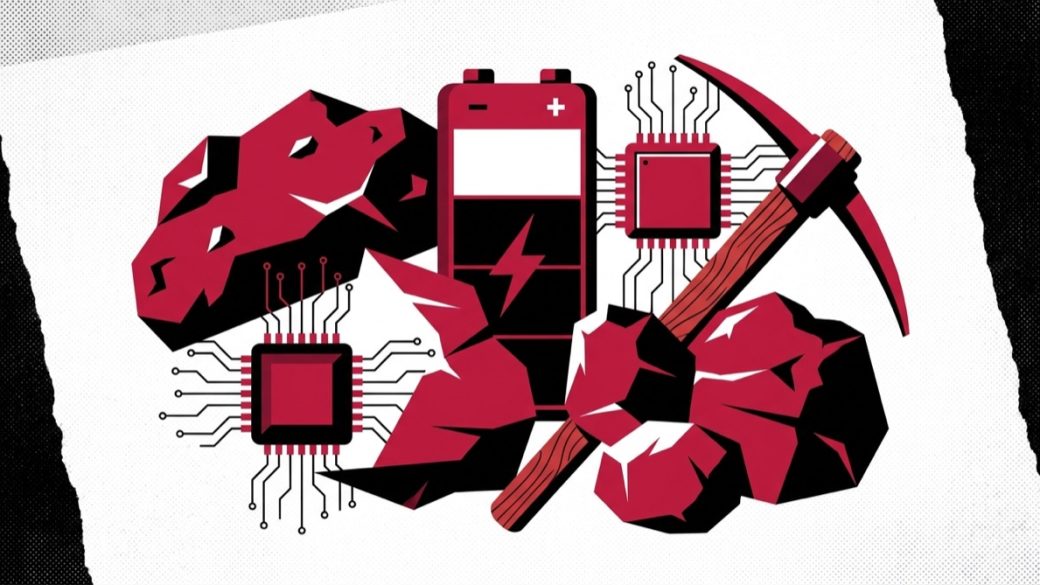
Critical minerals are the metals and elements — such as lithium, cobalt, nickel, graphite and rare earths — that are essential for electric vehicles, semiconductors, clean energy and defence equipment, but whose supply is at high risk because production is concentrated in a few countries. India identified 30 such minerals in 2023 and, in January 2025, approved the National Critical Mineral Mission to secure its supply chains, reduce import dependence and build a domestic value chain from mining to recycling.
What are critical minerals?
Why they matter for EVs, chips & defence
India’s list of 30 critical minerals
China’s dominance over supply
The National Critical Mineral Mission
India’s reserves & import dependence
What it means for Indian industry
Challenges ahead
FAQ
What are critical minerals?
A critical mineral is any mineral or element that is both economically essential — meaning a modern economy cannot function or grow without it — and supply-vulnerable, meaning there is a real risk that supply could be disrupted. “Criticality” is therefore not a fixed property of an element; it depends on a country’s industrial needs and how exposed it is to import shocks. A mineral that is critical for India (because we import almost all of it) may be less critical for a country that mines it domestically.
Governments around the world maintain their own lists. The United States tracks a list through the U.S. Geological Survey, the European Union publishes a “Critical Raw Materials” list, and India released its own list of 30 critical minerals in 2023. These lists overlap heavily on the headline names — lithium, cobalt, nickel, graphite and the rare earth elements — because the same technologies (batteries, magnets, chips) drive demand everywhere.
How is “criticality” decided?
India’s list was prepared by an expert committee set up by the Ministry of Mines. The committee assessed each mineral on two broad axes that most countries use:
- Economic importance — how central the mineral is to high-growth sectors such as clean energy, electronics, electric mobility and defence.
- Supply risk — how concentrated global production is, how dependent India is on imports, and how easily supply could be cut off by geopolitics, export controls or a single dominant supplier.
The two-axis approach explains why bulk metals such as iron and ordinary steel are not on the list (India produces plenty domestically), while a metal used in small quantities — like a rare earth element in a magnet — can be highly critical because almost none of it is mined or refined here.
Why critical minerals matter for EVs, chips and defence
The reason critical minerals have shot to the top of the policy agenda is that the technologies defining the 21st-century economy are extraordinarily mineral-intensive. The energy transition, in particular, swaps a fuel-based system (oil, coal, gas) for a materials-based one (batteries, magnets, wiring). You buy the minerals once and use the device for years — but you must secure those minerals first.
Electric vehicles and batteries
A lithium-ion battery — the heart of every electric car, scooter and grid storage unit — depends on a handful of these minerals. The cathode uses lithium, and depending on the chemistry, cobalt, nickel and manganese. The anode uses graphite. The motor in most EVs uses permanent magnets made with rare earth elements such as neodymium and dysprosium. With India targeting a large share of electric two-wheelers and four-wheelers and building gigafactories under the Production Linked Incentive (PLI) scheme for advanced chemistry cells, demand for these inputs is set to climb sharply.
Semiconductors and electronics
Chips and electronics rely on minerals such as silicon, gallium, germanium, tantalum and indium. Many of these are used in tiny quantities but have no easy substitute, and several are produced overwhelmingly by one country. As India builds semiconductor fabrication and assembly under the India Semiconductor Mission, secure access to these inputs becomes a strategic necessity, not just a commercial one.
Defence, space and clean energy
Rare earth magnets are used in precision-guided weapons, fighter-jet components, submarines, radar and satellites. Titanium and tungsten are vital for aerospace and hard alloys. Clean-energy hardware is equally hungry: wind turbines use rare earth magnets, solar panels use silicon and silver, and the entire grid runs on copper. A disruption in any of these can stall manufacturing lines and defence programmes alike — which is exactly why supply security has become a national-security question.
India’s list of 30 critical minerals
In June 2023, the Ministry of Mines released India’s first official list of 30 critical minerals, prepared by a seven-member expert committee. This list of critical minerals now anchors policy — it guides which minerals get priority in exploration, auctions, customs-duty relief and overseas acquisition. The strategic and critical minerals on the list span battery metals, rare earths, electronics materials and high-tech alloys.
| Category | Examples on India’s list | Main uses |
|---|---|---|
| Battery & energy-storage metals | Lithium, Cobalt, Nickel, Graphite | EV and grid batteries, electronics |
| Rare earth elements (REE) | The rare earth group (incl. neodymium, dysprosium) | Permanent magnets for motors, wind turbines, defence |
| Semiconductor & electronics | Silicon, Gallium, Germanium, Indium, Tantalum | Chips, LEDs, fibre optics, capacitors |
| Aerospace & hard alloys | Titanium, Tungsten, Vanadium, Beryllium, Rhenium | Jet engines, armour, cutting tools, alloys |
| Platinum-group & specialty | Platinum-group elements, Tellurium, Selenium, Niobium, Zirconium, Hafnium | Catalysts, solar, nuclear, electronics |
| Other strategic minerals | Copper, Molybdenum, Antimony, Cadmium, Phosphorus, Potash, Tin, Bismuth, Glauconite | Wiring, fertilisers, alloys, batteries |
Note: The official list contains 30 minerals (with the rare earth elements counted as groups). The grouping above is illustrative, to show the technology areas each mineral serves; it is not the government’s exact categorisation.
Why the list keeps evolving
Criticality is dynamic. A new battery chemistry can suddenly make a once-ignored metal essential; a fresh domestic discovery can lower a mineral’s “supply risk” score and take it off the priority list. Governments therefore review these lists periodically. India’s expert committee recommended that the list be revisited regularly so that policy keeps pace with technology and geopolitics — so expect the 30-mineral list to be updated in future years.
China’s dominance over critical mineral supply
The single most important fact about critical minerals is this: the problem is less about mining and more about processing. Many of these minerals are mined in several countries — cobalt in the Democratic Republic of Congo, lithium in Australia and South America — but the refining and processing that turns raw ore into battery-grade or magnet-grade material is heavily concentrated in China.
China spent decades building this midstream capacity. As a result, it dominates the global processing of several critical minerals and, in particular, controls the overwhelming majority of the world’s rare earth processing and permanent-magnet manufacturing. This concentration gives any dominant supplier real leverage: in recent years China has tightened export controls on minerals and processing technologies such as gallium, germanium and certain rare earth items, sending a clear signal to import-dependent economies — India included — that supply can be used as a strategic tool.
Why this matters for India: Even if India finds and mines lithium or rare earths at home, it would still need refining and magnet-making capacity to capture value. Building that midstream — the conversion plants and magnet factories — is one of the hardest and most important parts of the challenge.
The National Critical Mineral Mission (NCMM)
To respond to this strategic gap, the Union Cabinet approved the National Critical Mineral Mission in January 2025, with a total outlay of about ₹16,300 crore in government spending plus an expected contribution from public-sector enterprises. The mission spans the entire value chain — from exploration and mining at home to acquiring assets abroad, building processing capacity, and recycling. It runs over a multi-year period (covering roughly 2024–25 to 2030–31).
What the mission aims to do
The NCMM brings several earlier efforts under one umbrella with clear goals:
- Boost domestic exploration — fund a large number of exploration projects by the Geological Survey of India (GSI) and other agencies to find new deposits within India and its offshore areas.
- Speed up mining & auctions — build on the 2023 law change that lets the central government auction blocks for several critical and deep-seated minerals, removing them from the slower state-level process.
- Secure assets abroad — expand overseas acquisition of mines and offtake deals through the state-backed joint venture KABIL (Khanij Bidesh India Ltd) in resource-rich countries.
- Build processing & recycling — incentivise refining capacity and the recovery of critical minerals from electronic waste and spent batteries (the “urban mine”).
- Create a stockpile & ease imports — explore strategic stockpiling and reduce customs duties on key critical minerals so that industry can import inputs more cheaply while domestic capacity is built.
The legal groundwork: the 2023 MMDR amendment
The mission builds on an important 2023 amendment to the Mines and Minerals (Development and Regulation) Act. Before that change, private companies were effectively barred from exploring or mining several atomic and strategic minerals such as lithium and beryllium. The amendment removed six minerals from the restricted “atomic minerals” list and empowered the central government to auction blocks for a set of critical and deep-seated minerals. This opened the door for private investment and faster, centrally run auctions — several tranches of critical-mineral blocks have since been put up for bidding.
| Pillar | Lead agency / vehicle | Goal |
|---|---|---|
| Exploration | Geological Survey of India, Mineral Exploration Corp. | Discover new domestic deposits |
| Auctions & mining | Ministry of Mines (central auctions) | Bring blocks to production faster |
| Overseas assets | KABIL (NALCO + HCL + MECL JV) | Lithium, cobalt & other offtake abroad |
| Processing & recycling | Industry via incentives | Build refining and e-waste recovery |
| Trade & stockpile | Ministry of Finance / Mines | Duty cuts, strategic reserves |
India’s reserves and import dependence
India’s position is one of high import dependence. The country imports all or nearly all of several key critical minerals — including most of its lithium, cobalt, nickel and rare earth requirements — making the supply chain vulnerable to global price swings and export controls. Reducing this dependence is the central economic rationale behind the mission.
What India does and doesn’t have
The picture is mixed. India is not resource-poor across the board, but its proven, processable reserves of the most in-demand battery and magnet minerals are limited:
- Lithium: The GSI reported the discovery of lithium resources in the Reasi district of Jammu & Kashmir, and exploration is ongoing elsewhere. However, a “resource” is an early-stage estimate, not a proven, mineable reserve — turning it into production requires years of further study, environmental clearances and the right processing technology for the local ore.
- Rare earths: India holds notable reserves of monazite (a rare-earth-bearing mineral) in its coastal beach sands, handled largely by the public-sector IREL. But India processes only a small fraction into the separated, magnet-grade oxides that industry actually needs.
- Other minerals: India has meaningful resources of some minerals on the list, but for the headline battery metals it remains heavily reliant on imports for now.
What it means for Indian industry
For Indian businesses, the critical-minerals push is both an opportunity and a risk to manage. Secure, affordable inputs are the difference between a competitive “Make in India” EV or electronics sector and one that is perpetually exposed to import shocks.
For EV and battery makers
Cheaper, more reliable access to lithium, cobalt, nickel and graphite — helped by customs-duty cuts and, eventually, domestic processing — lowers cell costs and de-risks gigafactory investments made under the advanced chemistry cell PLI scheme. Battery recycling also becomes a genuine business line as volumes of end-of-life batteries grow.
For electronics and semiconductor firms
Companies investing under the India Semiconductor Mission gain from more secure access to electronics minerals such as gallium, germanium and tantalum. A domestic supply or strategic stockpile reduces the chance that an export control abroad halts a fab or assembly line at home.
For mining, engineering and recycling companies
The 2023 law change and the mission’s auctions open a new private-sector frontier in exploration, mining and — most valuably — mineral processing and recycling. There is also scope for engineering and chemicals firms to build the refining and magnet-making capacity that India currently lacks.
| Stakeholder | Opportunity | Risk to watch |
|---|---|---|
| EV / battery makers | Lower input costs, recycling revenue | Continued import reliance in the near term |
| Electronics / chip firms | More secure inputs, stockpile cushion | Foreign export controls on key minerals |
| Mining & processing | New blocks, refining & recycling business | Long lead times, clearances, price swings |
| Investors | A new strategic-materials theme | Hype around early-stage “discoveries” |
Challenges ahead
The mission is ambitious, but the road is long. Several hard problems stand between India and genuine supply security:
- Long lead times: A new mine can take many years from discovery to production. Even with faster auctions, the payoff is gradual.
- The processing gap: Mining is the easier half. Building competitive refining and magnet-manufacturing — the stages China dominates — needs technology, capital and skilled labour that India is still developing.
- Geopolitical competition: Every major economy is chasing the same minerals and the same overseas assets at once, pushing up prices and competition for deals.
- Environment and community: Mining and processing carry real ecological and social costs. Clearances, water use and local consent must be handled carefully and transparently.
- Price volatility: Critical-mineral prices can swing wildly, which can make a domestic project look attractive one year and uneconomic the next.
The realistic view is that India is building resilience — not aiming for overnight self-sufficiency. A diversified strategy of domestic exploration, overseas partnerships (including with friendly producer nations), recycling and selective stockpiling is how most experts expect the country to reduce, rather than fully eliminate, its dependence over the coming decade.
Frequently asked questions
What are critical minerals in simple terms?
Critical minerals are metals and elements — like lithium, cobalt, nickel, graphite and rare earths — that are essential for modern technology (EV batteries, semiconductors, clean energy and defence) but whose supply is at high risk because production is concentrated in a few countries. “Critical” means both economically important and supply-vulnerable.
How many critical minerals are on India’s list?
India’s official list, released by the Ministry of Mines in 2023, contains 30 critical minerals. It includes battery metals (lithium, cobalt, nickel, graphite), the rare earth elements, electronics minerals (gallium, germanium, indium, tantalum) and high-tech alloy metals (titanium, tungsten, vanadium and others). The list is meant to be reviewed and updated periodically.
What is the National Critical Mineral Mission?
The National Critical Mineral Mission (NCMM) is a Government of India programme approved in January 2025 with an outlay of about ₹16,300 crore (plus expected PSU investment). It aims to secure India’s critical-mineral supply across the whole value chain — domestic exploration, mining, overseas acquisition, processing and recycling — and to cut import dependence over a multi-year period running to around 2030–31.
Why does China dominate critical minerals?
China spent decades building the midstream — the refining and processing that turns raw ore into battery-grade and magnet-grade materials. While mining is spread across many countries, China controls a large share of global processing and the overwhelming majority of rare earth processing and permanent-magnet manufacturing. This lets it use export controls as strategic leverage over import-dependent countries.
Does India have lithium reserves?
India has reported lithium resources — notably a find in the Reasi district of Jammu & Kashmir — and exploration is ongoing. However, these are early-stage resources, not yet proven, mineable reserves. Turning them into production requires years of further drilling, feasibility studies, environmental clearances and suitable processing technology, so India still imports most of its lithium for now.
Why are critical minerals important for electric vehicles?
Every lithium-ion battery needs lithium, often with cobalt, nickel and manganese in the cathode and graphite in the anode. EV motors also use permanent magnets made from rare earth elements such as neodymium and dysprosium. Without a secure supply of these minerals, India cannot scale up EV and battery manufacturing affordably.
What is KABIL?
KABIL (Khanij Bidesh India Ltd) is a state-backed joint venture of three public-sector companies — NALCO, Hindustan Copper and Mineral Exploration Corporation. Its job is to identify and acquire critical-mineral assets such as lithium and cobalt in resource-rich countries abroad, securing offtake for Indian industry. It is a key vehicle within the National Critical Mineral Mission.
Disclaimer: This article is for educational purposes only and is not investment or financial advice. Government schemes, mineral lists and outlays may be updated over time; verify current details with official sources such as the Ministry of Mines. Read all scheme documents and consult a SEBI-registered adviser before making any investment decisions related to this theme.