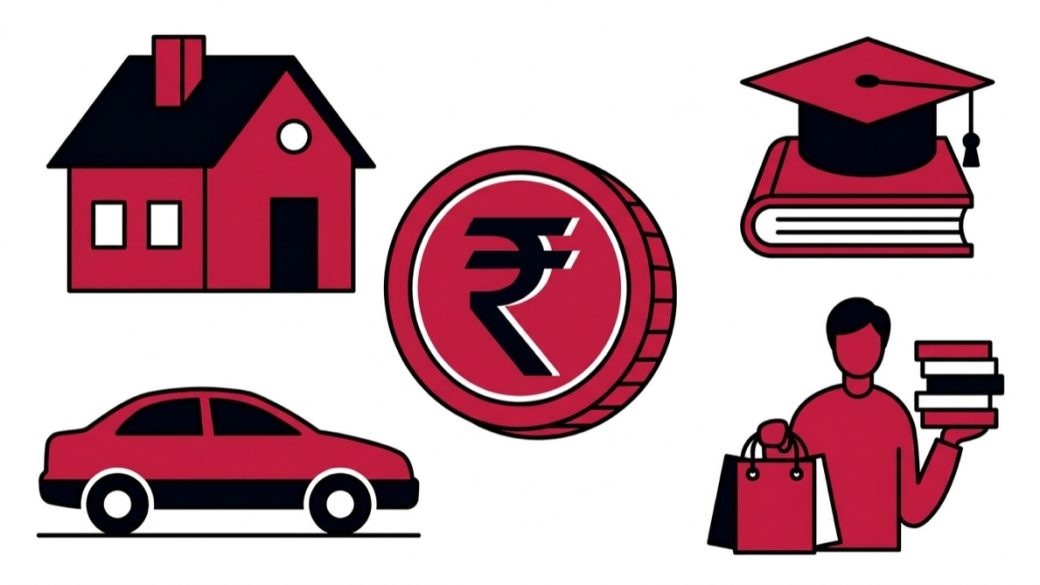
The main types of loans in India fall into two families: secured loans (backed by an asset, such as a home loan, car loan, gold loan or loan against property) and unsecured loans (no collateral, such as a personal loan, education loan or most business loans). Within these, the loans most Indians use are personal loans, home loans, car/vehicle loans, education loans, gold loans and business loans — each with its own interest rate, tenure, eligibility and documentation.
How a loan actually works ·
Secured vs unsecured loans ·
The main types of loans in India ·
Fixed vs floating interest ·
EMI basics & the real cost ·
Eligibility & documents ·
How to choose the right loan ·
Common mistakes to avoid ·
FAQ
Borrowing is woven into Indian life — a home loan to buy a flat, an education loan for a child’s degree abroad, a personal loan for a wedding, a gold loan in an emergency, or a working-capital loan to keep a small business running. Yet most borrowers sign loan agreements without fully understanding what kind of loan they are taking, how the interest is calculated, or whether a cheaper option existed. This guide explains every major loan type available to Indian borrowers in 2026, in plain language, so you can borrow with your eyes open.
How a loan actually works
A loan is a sum of money you borrow from a lender — a bank, a Non-Banking Financial Company (NBFC), or a digital lending app — that you agree to repay over time with interest. Three numbers define almost every loan:
- Principal — the amount you borrow.
- Interest rate — the price of borrowing, expressed as a percentage per year (per annum, or “p.a.”).
- Tenure — the period over which you repay, usually in months or years.
You typically repay through an EMI (Equated Monthly Instalment) — a fixed monthly payment that covers both interest and a slice of principal. Beyond the headline rate, lenders also charge a processing fee (often 0.5%–3% of the loan), and may levy prepayment or foreclosure charges, late-payment penalties and documentation fees. Always look at the APR (Annual Percentage Rate), which bundles interest plus fees, rather than just the advertised interest rate.
Secured vs unsecured loans
The single most important distinction is whether a loan is secured or unsecured. This one factor drives the interest rate, the size you can borrow, the speed of approval and the risk you carry.
Secured loans
A secured loan is backed by collateral — an asset you pledge, such as a house, a car, gold or fixed deposits. Because the lender can recover its money by selling the asset if you default, secured loans carry lower interest rates, allow larger amounts and run for longer tenures. The trade-off: you can lose the pledged asset if you stop paying. Home loans, car loans, gold loans and loans against property (LAP) are all secured.
Unsecured loans
An unsecured loan has no collateral. The lender relies entirely on your creditworthiness — your income, repayment history and CIBIL score. Because the lender’s risk is higher, unsecured loans carry higher interest rates, smaller limits and shorter tenures, but are faster to get and put no specific asset at stake. Personal loans, most education loans and many small-business loans are unsecured. Note that defaulting still seriously damages your credit score and can lead to legal recovery.
The main types of loans in India
Here are the loan categories Indian borrowers use most, what they are for, and how they typically behave. Interest rates move with the RBI repo rate and your credit profile, so treat the ranges below as broad, indicative bands for 2026 rather than fixed quotes — always confirm the live rate with the lender.
1. Personal loan
An unsecured, all-purpose loan you can use for a wedding, medical bill, travel, home renovation or debt consolidation. No collateral and no restriction on end-use (except illegal activity). It is the fastest loan to get — often disbursed within hours digitally — but among the most expensive, with rates commonly in the low-to-high teens per annum. Tenures usually run one to five years, occasionally up to seven.
2. Home loan (housing loan)
A secured loan to buy, build or renovate a house or flat, where the property itself is the collateral. Home loans offer the lowest interest rates of any retail loan (because they are secured and long-term) and the longest tenures — up to 30 years. Lenders typically finance up to 75%–90% of the property value (the rest is your down payment, called the margin). Home loans can also bring tax benefits under the Income Tax Act on both principal and interest, subject to the rules of the tax regime you choose. Sub-types include plot/land loans, home-construction loans, home-improvement loans and balance-transfer (refinance) loans.
3. Car / vehicle loan
A secured loan to buy a new or used car, two-wheeler or commercial vehicle, with the vehicle itself hypothecated to the lender until you finish repaying. Rates sit between home-loan and personal-loan levels, and tenures usually range from one to seven years. New-car loans can finance up to roughly 85%–100% of the on-road price; used-vehicle loans finance a smaller share and carry higher rates because the asset depreciates.
4. Education loan
A loan to fund higher studies in India or abroad — tuition, living costs, books and travel. Smaller loans are often unsecured; larger ones (typically above a few lakh, especially for foreign study) usually require collateral and a co-applicant, generally a parent. A defining feature is the moratorium (repayment holiday): you usually do not pay EMIs during the course plus a grace period of six months to one year after finishing, though interest may accrue during that time. Education loans also offer a tax deduction on the interest paid under Section 80E for a limited number of years.
5. Gold loan
A secured loan where you pledge gold jewellery or coins and borrow against their value. Gold loans are popular for emergencies because they are fast (often same-day), need minimal documentation and do not depend heavily on your credit score. The amount is capped by the loan-to-value (LTV) ratio set by the RBI — you can borrow only a regulated fraction of the gold’s market value. Tenures are usually short, and many gold loans come with flexible repayment (bullet or interest-only options). Miss payments and the lender can auction your gold.
6. Business loan
Finance for a company or self-employed professional — to buy equipment, fund working capital, or expand. Business loans can be unsecured (term loans, based on turnover and financials) or secured (against property, machinery or receivables). Common forms include working-capital loans, term loans, machinery loans, invoice/bill discounting and overdraft/cash-credit facilities. Government-backed credit guarantee schemes for micro and small enterprises help many small businesses borrow without collateral.
7. Loan against property (LAP) and other secured loans
A LAP lets you mortgage a residential or commercial property you already own and borrow a large sum at a relatively low rate for any purpose — business, education or a major expense. Other secured options include a loan against fixed deposits, a loan against shares or mutual funds, and a loan against insurance policies. These suit borrowers who own assets and want a lower rate than an unsecured loan would offer.
| Loan type | Secured / unsecured | Typical tenure | Best for | Watch out for |
|---|---|---|---|---|
| Personal loan | Unsecured | 1–5 years | Any urgent, short-term need | High interest; processing fees |
| Home loan | Secured (property) | Up to 30 years | Buying or building a home | Down payment; floating-rate rises |
| Car / vehicle loan | Secured (vehicle) | 1–7 years | New or used vehicle | Depreciation; used-car rates |
| Education loan | Unsecured or secured | 5–15 years | Higher studies, India or abroad | Interest during moratorium |
| Gold loan | Secured (gold) | 3 months–3 years | Fast emergency cash | LTV cap; auction risk |
| Business loan | Either | 1–10 years | Working capital, expansion | Cash-flow stress; collateral |
| Loan against property | Secured (property) | Up to 15–20 years | Large sum, lower rate | Asset at risk; long commitment |
Fixed vs floating interest rates
Every loan charges interest in one of two ways, and the choice affects how much you ultimately pay.
Fixed interest rate
The rate stays the same for the whole tenure (or for a fixed initial period). Your EMI never changes, which makes budgeting predictable and protects you if market rates rise. The downside: fixed rates usually start higher, and you do not benefit if rates fall.
Floating interest rate
The rate moves with a benchmark — most retail floating loans in India are now linked to an external benchmark such as the RBI repo rate (the EBLR system). When the repo rate falls, your rate and EMI (or tenure) drop; when it rises, they climb. Floating rates usually start lower and are common for home loans. For floating-rate loans to individuals, lenders generally cannot charge foreclosure or prepayment penalties — a real advantage if you plan to prepay.
EMI basics and the real cost of a loan
Your EMI is calculated from three inputs — principal (P), the monthly interest rate (r) and the number of months (n) — using the standard formula:
EMI = P × r × (1 + r)n ÷ [ (1 + r)n − 1 ]
Here r is the annual rate divided by 12 and expressed as a decimal (for example, 12% p.a. becomes 0.12/12 = 0.01 per month). You do not need to compute this by hand — every lender and aggregator offers a free online EMI calculator. What matters is understanding two things the calculator reveals:
- Early EMIs are mostly interest. In the first years, a large share of each EMI goes to interest and only a small part reduces principal. This is why prepaying early in the tenure saves far more interest than prepaying later.
- A longer tenure means a smaller EMI but more total interest. Stretching a loan reduces the monthly burden but increases what you ultimately pay. Shorten the tenure where you can afford the EMI.
| Scenario | Loan amount | Rate (p.a.) | Tenure | Effect |
|---|---|---|---|---|
| Shorter tenure | Same principal | Same rate | Fewer years | Higher EMI, lower total interest |
| Longer tenure | Same principal | Same rate | More years | Lower EMI, higher total interest |
| Part-prepayment early | Principal reduced | Same rate | Reduced | Large interest saving |
Rule of thumb: Lenders generally prefer your total EMIs (across all loans) to stay within about 40%–50% of your monthly income — the Fixed-Obligation-to-Income Ratio (FOIR). Borrow within that limit so a single bad month does not push you into default.
Eligibility and documents
Lenders assess two things: your ability to repay (income and existing obligations) and your willingness to repay (credit history). The common eligibility factors are:
- Age — typically 21 to 60 for salaried borrowers (up to 65–70 for some self-employed and home-loan borrowers).
- Income — a stable, sufficient income; a higher income supports a larger loan.
- Credit score — your CIBIL (or other bureau) score, ideally above 750, signals reliable repayment and earns better rates.
- Employment / business stability — minimum work experience or years in business.
- Existing EMIs — current obligations reduce how much more you can borrow.
Documents usually required
- Identity & address (KYC): Aadhaar, PAN, passport, voter ID or driving licence.
- Income proof: salary slips and Form 16 (salaried); ITRs, bank statements and financials (self-employed).
- Bank statements: usually the last 3–6 months.
- Asset / collateral papers: property title documents for home loans/LAP, the proforma invoice for a vehicle loan, or the admission letter and fee structure for an education loan.
How to choose the right loan
With the categories clear, choosing well comes down to a short checklist:
- Match the loan to the purpose. A home needs a home loan, a degree needs an education loan. Use a personal loan only when no cheaper, purpose-specific loan fits.
- Prefer secured over unsecured when you can. If you own an asset and the need is large, a secured loan (home loan, LAP, gold loan) will almost always be cheaper than a personal loan.
- Compare the APR, not just the interest rate. Add processing fees, insurance bundled into the loan and prepayment charges. A “lower rate” loan with heavy fees can cost more.
- Check your credit score first. You can view it free once a year from each bureau. Fix errors and clear small dues before applying — a higher score earns a lower rate.
- Choose the right tenure. Pick the shortest tenure whose EMI you can comfortably afford to minimise total interest.
- Read the fine print. Note the foreclosure/prepayment terms, whether the rate is fixed or floating, and any penalty clauses, before you sign.
- Borrow from a regulated lender. Use RBI-regulated banks, NBFCs or their authorised digital lending partners; avoid unregistered apps that promise instant money.
Common mistakes borrowers make
- Borrowing the maximum offered. The sanctioned limit is what the lender will give, not what you can comfortably repay. Borrow only what you need.
- Ignoring the credit score. A weak score quietly costs you a higher rate for the entire tenure; a strong one is the cheapest way to save money on a loan.
- Choosing the longest tenure by default. A small EMI feels easy but can double the interest you pay over the life of the loan.
- Missing EMIs. Even one missed payment dents your credit score and triggers penalties; on secured loans it can eventually cost you the asset.
- Falling for unregulated lending apps. Predatory apps charge brutal rates and harass borrowers. Stick to RBI-regulated lenders and check the lender’s name on the loan agreement.
- Skipping the loan agreement. Hidden fees, rate-reset clauses and penalties live in the fine print. Read it before signing.
Frequently asked questions
What are the main types of loans?
The main types are split into secured loans (backed by collateral) and unsecured loans (no collateral). The most common in India are personal loans, home loans, car/vehicle loans, education loans, gold loans, business loans and loans against property. Secured loans are cheaper and larger; unsecured loans are faster but cost more.
What is the difference between a secured and an unsecured loan?
A secured loan is backed by an asset you pledge — a house, car or gold — so it carries a lower interest rate, a larger limit and a longer tenure, but the lender can seize the asset if you default. An unsecured loan has no collateral and relies on your income and credit score, so it is quicker but charges a higher rate and offers smaller amounts.
Which type of loan has the lowest interest rate in India?
Home loans typically carry the lowest interest rates among retail loans because they are secured by the property and run for long tenures. Loans against property, fixed deposits and gold also tend to be cheaper than unsecured options. Personal loans usually carry the highest rates because they have no collateral.
What is a good CIBIL score to get a loan?
A CIBIL (or other credit bureau) score of 750 and above is generally considered good and improves both your chances of approval and the rate you are offered. Scores below 700 can lead to higher rates, smaller limits or rejection. You can check your score free once a year from each bureau and fix any errors before applying.
How is the EMI on a loan calculated?
The EMI depends on the principal, the monthly interest rate and the tenure, using the formula EMI = P × r × (1+r)^n / [(1+r)^n − 1], where r is the annual rate divided by 12. In practice you can use any free online EMI calculator. Remember that a longer tenure lowers the EMI but raises the total interest you pay.
Is a personal loan or a gold loan better for an emergency?
Both are fast, but a gold loan is usually cheaper because it is secured by your gold, and it depends less on your credit score. A personal loan needs no asset but charges a higher rate. If you own gold and need cash quickly, a gold loan is often the lower-cost option, provided you can repay before the lender’s auction terms apply.
Can I prepay or foreclose a loan early?
Yes. For floating-rate loans taken by individuals, regulators generally bar lenders from charging foreclosure or prepayment penalties, so you can repay early and save interest. Fixed-rate loans may carry a prepayment charge. Always check the foreclosure clause in your loan agreement, and prepay early in the tenure when most of your EMI is still going to interest.
Disclaimer: This article is for educational purposes only and is not investment/financial advice. Read all scheme/offer documents and consult a SEBI-registered adviser where relevant.