UPI (Unified Payments Interface) is India’s real-time mobile payment system, built by the National Payments Corporation of India (NPCI), that lets you send money instantly between any two bank accounts using just a UPI ID, mobile number, or QR code — for free, 24×7, without sharing your bank details. Launched in 2016, UPI has become the backbone of everyday money movement in India, processing more than 18 billion transactions every month and powering apps like PhonePe, Google Pay, Paytm and BHIM.
What Is UPI? Full Form and Meaning
UPI stands for Unified Payments Interface. It is a system that connects multiple bank accounts into a single mobile application, merging several banking features — sending money, receiving money, and merchant payments — into one seamless interface. The word “unified” is the key idea: instead of every bank and every app speaking a different language, UPI gives them one common standard so money can flow between any of them instantly.
Before UPI, transferring money digitally in India meant using NEFT, RTGS or IMPS — and to do so you had to add the recipient as a “beneficiary,” entering their full account number, IFSC code and bank name, then waiting for activation. UPI removed that friction entirely. Today you can pay a street vendor, split a dinner bill, or send rent to a landlord in seconds, using nothing more than a phone number or a scanned QR code.
Crucially, UPI is an interoperable rail. You can keep your account at the State Bank of India, pay using Google Pay, and the shopkeeper can receive the money in their HDFC account through Paytm — and it all just works. That interoperability is what separates UPI from a closed wallet.
Who Runs UPI? NPCI, Banks and Apps
UPI is operated by the National Payments Corporation of India (NPCI), a not-for-profit “umbrella organisation” for retail payments set up in 2008 by the Reserve Bank of India (RBI) and the Indian Banks’ Association. NPCI also runs other familiar systems such as IMPS, RuPay cards, FASTag (the NETC network) and the BHIM app. UPI itself was launched by NPCI in April 2016.
Understanding who does what helps explain why UPI is so reliable and so cheap for users. There are four main players in every UPI transaction.
The bank’s two roles: PSP and remitter/beneficiary
In UPI jargon, the app you use is backed by a Payment Service Provider (PSP) bank — the bank that holds the UPI licence and gives the app permission to operate on the network. Your own bank, where your savings account sits, is the remitter bank when you pay and the beneficiary bank when you receive. NPCI sits in the middle as the “switch,” routing the instruction and settling the money between the two banks. Because this is shared public infrastructure regulated by the RBI, person-to-person UPI payments are free for ordinary users.
How UPI Works: Step by Step
From the moment you tap “Pay” to the moment the receiver gets a confirmation, a remarkable amount happens — usually in under five seconds. Here is the simplified journey of a single payment.
Behind the scenes
When you confirm a payment, your app sends a request to its PSP bank, which forwards it to NPCI. NPCI identifies the receiver’s bank from the UPI ID and asks your bank to debit your account. Your bank verifies your UPI PIN, debits the amount, and NPCI instructs the receiver’s bank to credit it. Both sides get an instant SMS or in-app confirmation, while the actual inter-bank settlement happens in the background. This is why a UPI transfer feels instant even though several institutions are involved.
Push vs pull payments
UPI supports two directions. A “push” payment is when you actively send money — scanning a QR or entering a UPI ID. A “pull” or collect request is when someone requests money from you and you approve it. A genuine warning here: fraudsters abuse collect requests, so you should never approve a “collect” or enter your UPI PIN to receive money. You only ever need your PIN to pay, never to get paid.
UPI ID (VPA) and UPI PIN Explained
Two terms confuse most new users: the UPI ID and the UPI PIN. They do completely different jobs.
What is a UPI ID (VPA)?
A UPI ID, formally called a Virtual Payment Address (VPA), is your unique payment “handle” — something like yourname@oksbi or 9876543210@ybl. The part before the @ identifies you; the part after the @ identifies the PSP/bank handling the payment (for example @oksbi for SBI via Google Pay, @ybl for Yes Bank powering PhonePe, @paytm for Paytm). The whole point of a VPA is privacy: you can receive money without ever revealing your account number or IFSC code.
What is a UPI PIN?
A UPI PIN is a 4- or 6-digit secret code you set when you link your bank account. It is your authorisation — the digital equivalent of your ATM PIN — and it is required to approve every outgoing payment. It is part of UPI’s two-factor security (your phone/SIM is the first factor, the PIN is the second). You should memorise it, never write it down where others can see it, and never share it with anyone, including people claiming to be from your bank, an app, or “customer care.”
| Feature | UPI ID (VPA) | UPI PIN |
|---|---|---|
| What it is | Your public payment address, e.g. name@oksbi | Your secret 4–6 digit authorisation code |
| Purpose | Lets others send money to you | Lets you approve money going out |
| Can you share it? | Yes — it is meant to be shared | Never — sharing it can drain your account |
| Needed to receive money? | Yes | No (never enter PIN to receive) |
| Needed to send money? | Recipient’s ID, yes | Yes, always |
Types of UPI Payments
UPI is not just one feature. Over the years NPCI has layered several payment modes on top of the core rail, each solving a different real-world need.
- P2P (person-to-person): Sending money to friends and family via UPI ID or mobile number.
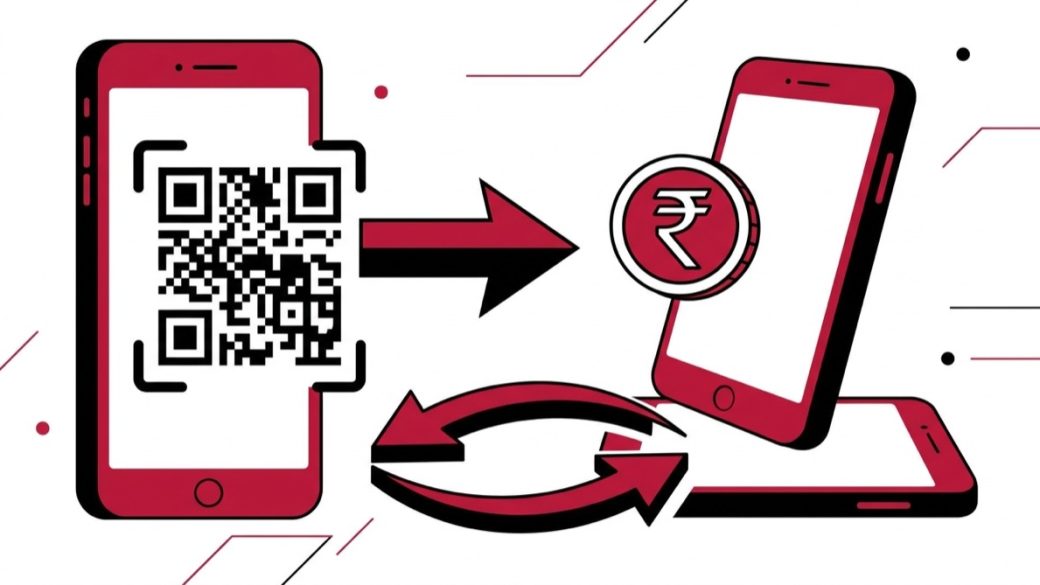
- P2M (person-to-merchant): Paying shops and businesses, usually by scanning a static or dynamic QR code.
- Scan & Pay (QR): The dominant mode in India — one QR sticker lets a vendor accept money from any UPI app.
- Collect request: A “pull” where a biller or person requests payment that you approve in your app.
- UPI AutoPay: Recurring mandates for subscriptions, SIPs, EMIs and utility bills — you authorise once, and approved payments recur automatically.
- UPI Lite & Lite X: An on-device wallet for fast small-value and even offline payments (covered below).
- Credit on UPI: Paying via a RuPay credit card or a pre-sanctioned bank credit line linked to UPI.
UPI Transaction Limits in 2026
UPI has limits set by NPCI and the RBI, partly to control risk and fraud. The standard ceiling for most everyday person-to-person and merchant payments is ₹1 lakh per transaction, with banks also applying their own daily caps (commonly ₹1 lakh and around 10–20 transactions per day across apps). However, regulators have steadily raised limits for specific high-value, lower-risk categories so that UPI can be used beyond small payments.
| Category | Indicative per-transaction limit |
|---|---|
| Standard P2P / general payments | Up to ₹1 lakh |
| Capital markets, insurance, foreign inward remittance | Up to ₹2 lakh |
| Hospitals & educational institutions | Up to ₹5 lakh |
| Verified merchants / tax payments (select categories) | Up to ₹5 lakh |
| UPI Lite single payment | Up to ₹1,000 |
| UPI 123Pay (feature phones) | Up to ₹10,000 |
UPI Lite, Credit on UPI, 123Pay and Other Innovations
UPI keeps evolving. These newer features are the ones Indian users are adopting fastest in 2026.
UPI Lite and UPI Lite X
UPI Lite is an “on-device wallet” for small payments. You load a small balance into it from your bank account, and then small payments (single payments up to ₹1,000) go through instantly without entering a UPI PIN and without hitting your main bank statement for every tiny transaction. This makes paying for tea, auto rides and groceries faster and reduces clutter. UPI Lite X goes a step further with offline payments using NFC — useful in metros, basements, flights or areas with poor connectivity, where you can pay device-to-device without an internet connection.
Credit cards and credit lines on UPI
Historically UPI moved money from your bank account. Now you can also link a RuPay credit card to UPI and pay by scanning a normal UPI QR — spending on credit while the merchant still receives a regular UPI payment. The RBI has also enabled “credit line on UPI,” where a bank pre-sanctions a small credit line that you can draw on through UPI, effectively a built-in mini-loan or “buy now, pay later” rail. Note that merchant transactions on credit cards via UPI can attract interchange fees for larger amounts, though small payments are typically exempt.
UPI 123Pay and UPI Circle
UPI 123Pay brings UPI to feature phones (non-smartphones) through IVR calls, missed-call billing, sound-based tech and apps — important for financial inclusion in rural India where smartphones are not universal. UPI Circle is a delegated-payments feature that lets a primary user (say a parent) allow a trusted secondary user (a child, elderly parent or domestic help) to make UPI payments from their account, either with per-transaction approval or within a set spending limit.
UPI Security, Fraud and How to Stay Safe
UPI itself is built on strong, RBI-mandated security: every payment uses two-factor authentication (your registered device/SIM plus your UPI PIN), data is encrypted, and your bank account number is never exposed to the person you pay. The PIN never travels to the merchant or the app in plain form. In that sense, the rails are secure.
The real risk is social engineering — fraudsters tricking you into authorising a payment yourself. “Fake UPI payment” scams are among the most searched UPI topics in India for a reason. The single most important rule bears repeating: you never need your UPI PIN to receive money. If anyone asks you to enter your PIN, scan a QR, or approve a “collect request” in order to get money, it is a scam.
Common UPI scams to watch for
| Scam type | How it works | How to stay safe |
|---|---|---|
| Collect-request fraud | You get a “request money” notification framed as a refund or prize; approving it sends YOUR money out. | Decline unknown collect requests. PIN = paying, never receiving. |
| Fake “customer care” | A caller posing as bank/app support asks for your PIN, OTP, or to install screen-sharing apps. | Banks never ask for PIN/OTP. Never install AnyDesk/TeamViewer on a stranger’s say-so. |
| QR-code scam | You are told to “scan this QR to receive payment.” Scanning + PIN sends money away. | You never scan a QR to receive money — only to pay. |
| Fake payment screenshot | A “buyer” shows a forged success screenshot but no money actually arrives. | Confirm credit in your own bank SMS/app before handing over goods. |
| Overpayment / refund trick | Scammer claims they “accidentally” paid extra and asks you to send it back. | Verify in your account first; refund only via the same app’s history. |
UPI Goes Global
One of the biggest stories of 2025–26 is UPI’s expansion beyond India. NPCI’s international arm, NPCI International Payments Limited (NIPL), has been signing partnerships to let Indians pay abroad with UPI and, in some cases, to let foreign systems connect to UPI. UPI acceptance and linkages have been rolled out or announced across markets including the UAE, Singapore (linked with PayNow), Sri Lanka, Mauritius, Nepal, Bhutan, France and others, with more in the pipeline. For Indian travellers, this increasingly means scanning a local QR abroad and paying straight from an Indian bank account.
This matters strategically: India is positioning UPI as a model of “Digital Public Infrastructure” that other countries can learn from or plug into, much as it has done with Aadhaar-based identity. UPI has become one of India’s most visible technology exports.
Why UPI Matters for India
UPI has done more than make payments convenient. It has deepened financial inclusion by giving small vendors, gig workers and rural users a free, instant way to accept and send digital money without expensive card machines. It has accelerated the shift away from cash, improved transparency, and created a thriving fintech ecosystem on top of it — from lending and wealth apps to insurance and payroll. For students and young entrepreneurs, UPI is often the first and most-used financial tool they ever touch, and understanding how it works is now basic financial literacy in India.
Frequently Asked Questions About UPI
What is the full form of UPI?
UPI stands for Unified Payments Interface. It is a real-time payment system operated by NPCI that lets you instantly transfer money between bank accounts using a mobile app.
What is a UPI ID with an example?
A UPI ID (or VPA, Virtual Payment Address) is your unique payment handle, for example rohit@oksbi or 9876543210@ybl. You share it to receive money without revealing your bank account number. The text after the @ shows which bank or app is handling the payment.
Is UPI free to use?
For ordinary users, person-to-person and most everyday merchant UPI payments are free — there is no charge to send or receive money. Some specific cases, such as larger merchant transactions paid via a credit card or prepaid wallet on UPI, can involve interchange fees borne by the merchant, not the customer.
What is the UPI transaction limit?
The standard limit for most UPI payments is ₹1 lakh per transaction, though banks set their own daily caps. NPCI has raised limits for specific categories — up to ₹2 lakh for capital markets and insurance, and up to ₹5 lakh for hospitals and educational institutions. New UPI IDs often have a lower limit for the first 24 hours.
What is UPI Lite?
UPI Lite is an on-device wallet for small payments. You preload a small balance, then make small payments (up to ₹1,000 each) instantly without entering your UPI PIN. UPI Lite X adds offline payments via NFC, so you can pay even without an internet connection.
Do I need a UPI PIN to receive money?
No. You only ever need your UPI PIN to send money. If anyone asks you to enter your PIN, scan a QR, or approve a request to receive money, it is a scam — never do it.
Can I use UPI without a smartphone or internet?
Yes. UPI 123Pay lets feature-phone users pay through IVR calls, missed calls, and sound-based methods, while UPI Lite X enables offline NFC payments on smartphones. Both extend UPI to situations where a full app and live internet are not available.
Disclaimer: This article is for educational purposes only and is not investment/financial advice. UPI limits, charges and features are set by NPCI, the RBI and individual banks and can change; always check the latest rules and your own bank’s and app’s terms. Read all scheme/offer documents and consult a SEBI-registered adviser where relevant.