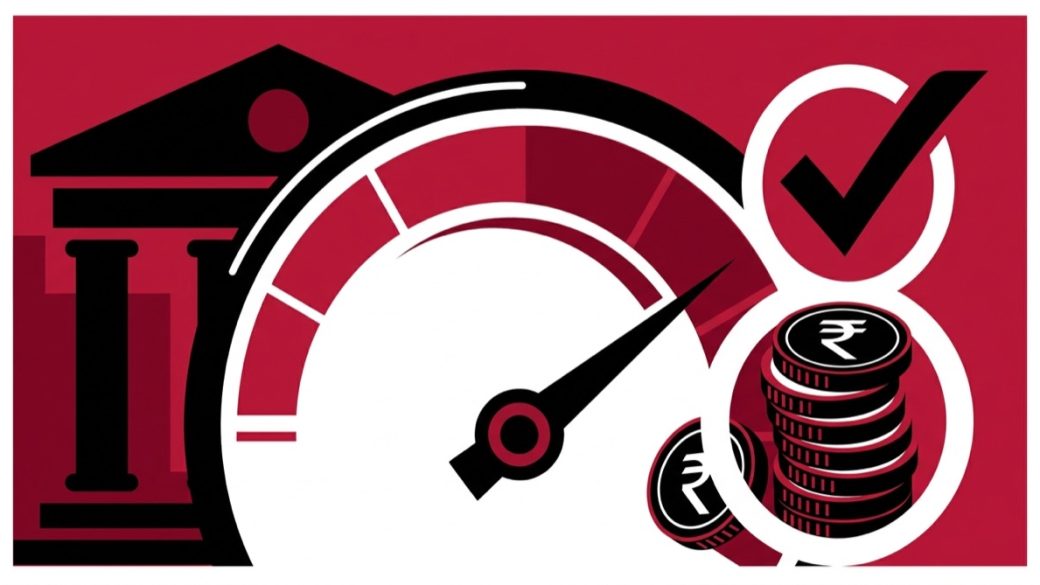
A CIBIL score is a three-digit number between 300 and 900 that sums up how reliably you have repaid loans and credit-card dues. In India, 750 and above is treated as a “good” CIBIL score and gets you faster loan approvals and lower interest rates. You can check your CIBIL score free once a year on CIBIL’s website (and more often through most banks and money apps), and you can improve it by paying every EMI and card bill on time, keeping credit-card usage low, and fixing errors in your credit report.
- What is a CIBIL score (and a credit score)?
- CIBIL vs the other 3 credit bureaus in India
- CIBIL score range: what counts as good?
- How your CIBIL score is calculated
- How to check your CIBIL score free
- How to improve your CIBIL score
- Common mistakes that hurt your score
- Reading your credit report & fixing errors
- Frequently asked questions
What is a CIBIL score (and a credit score)?
A credit score is a number that lenders use to judge how likely you are to repay money you borrow. The most widely quoted credit score in India is the CIBIL score, produced by TransUnion CIBIL — the country’s oldest credit information company. Because banks and NBFCs (non-banking finance companies) quote it so often, “CIBIL score” has effectively become shorthand for “credit score” in everyday Indian conversation, even though it is just one of four bureau scores.
Your score is built from your credit history: the loans and credit cards you hold, how much you owe, and — most importantly — whether you have paid on time. Every time you swipe a credit card, take a personal loan, or even act as a loan guarantor, that activity is reported to the bureaus by your lender and folded into your record.
The score ranges from 300 to 900. A higher number signals lower risk to the lender, which usually translates into easier approvals, larger sanctioned amounts and cheaper interest. A low number — or “NA/NH”, meaning no history — makes lenders cautious.
Why your CIBIL score matters in 2026
A good score is now about far more than getting a loan approved. In practice it affects:
- Interest rate. Many banks offer “risk-based pricing”, so a 780 borrower can pay a noticeably lower rate on a home or personal loan than a 680 borrower.
- Loan and card eligibility. Premium credit cards and high-value loans often have a minimum score cut-off.
- Speed. A clean, high score can mean instant or pre-approved offers instead of lengthy manual review.
- Limits and top-ups. Existing customers with strong scores get higher card limits and easier loan top-ups.
CIBIL vs the other 3 credit bureaus in India
This is the single biggest point of confusion for Indian borrowers. India has four RBI-licensed credit bureaus (officially “credit information companies”), and each produces its own score. CIBIL is the most talked-about, but a lender may pull your score from any of them:
Because each bureau receives data from lenders at slightly different times and uses its own model, your CIBIL, Experian, Equifax and CRIF High Mark scores will usually differ by a few points (sometimes more). None is “fake” — they are simply different snapshots. When people say “my CIBIL is 760 but the app shows 742”, this is usually why: the app is showing a different bureau.
| Bureau | Score it produces | Scale | Free full report |
|---|---|---|---|
| TransUnion CIBIL | CIBIL Score | 300–900 | 1 per year (plus RBI free annual report) |
| Experian | Experian Credit Score | 300–900 | 1 per year (plus RBI free annual report) |
| Equifax | Equifax Credit Score | 300–900 | 1 per year (plus RBI free annual report) |
| CRIF High Mark | CRIF Score | 300–900 | 1 per year (plus RBI free annual report) |
CIBIL score range: what counts as good?
The CIBIL score sits on a band from 300 to 900. Lenders broadly group it into the tiers below. There is no single legally fixed cut-off — each bank sets its own policy — but the market consensus in India is that 750+ is the sweet spot, and most prime lenders are comfortable from around 750 upward.
| Score band | Rating | What it usually means for you |
|---|---|---|
| 800–900 | Excellent | Top-tier. Best interest rates, premium cards, pre-approved offers, strong negotiating power. |
| 750–799 | Very good | The “good CIBIL score” most articles mean. Smooth approvals on home, car and personal loans. |
| 700–749 | Good | Generally approved, but rate may be slightly higher; premium products not guaranteed. |
| 650–699 | Fair | Approvals possible but tougher; expect higher rates, lower limits or extra documentation. |
| 300–649 | Poor | High chance of rejection from prime lenders; rebuilding needed before applying. |
| NA / NH | No history | “Not Applicable / No History” — you are new to credit. Lenders have nothing to assess yet. |
What is a good CIBIL score for a home loan or personal loan?
For big-ticket secured loans such as a home loan, lenders are especially strict because the amount and tenure are large; a score of 750 or above puts you in a strong position to negotiate the rate. For a personal loan or credit card, which are unsecured, the score matters even more — many issuers look for 750+, though some will approve from the low 700s at a higher rate. For a car loan, because the vehicle acts as security, approvals are often a little easier than for unsecured credit, but 750+ still gets you the cheapest financing.
How your CIBIL score is calculated
CIBIL does not publish an exact formula, but it has explained the broad factors and their relative weight. Understanding these five drivers is the key to improving your score, because you can act on each one directly.
1. Payment history (the biggest factor)
This is your track record of paying on time. Late payments, defaults, “settled” accounts and write-offs all pull your score down sharply — and a single 30-day delay can cost meaningful points. Consistent, on-time repayment is the most powerful lever you have.
2. Credit utilisation ratio
This is the share of your total credit-card limit that you actually use. If your cards have a combined limit of Rs 2 lakh and you carry Rs 1.4 lakh, your utilisation is 70% — which looks risky. As a rule of thumb, keeping utilisation under 30% is good for your score.
3. Length of credit history
The longer your accounts have been active and well-managed, the better. This is why closing your oldest credit card can sometimes lower your score — it shortens your average account age.
4. Credit mix
A healthy blend of secured loans (home, auto, gold) and unsecured credit (credit cards, personal loans), all handled responsibly, is viewed positively. Relying only on unsecured borrowing is seen as slightly riskier.
5. New credit and hard enquiries
Every time you formally apply for a loan or card, the lender makes a hard enquiry on your report. Several applications in a short window signal “credit hunger” and can dent your score. Checking your own score is a soft enquiry and never hurts it.
How to check your CIBIL score free
You have several legitimate, free ways to see your score in India. Be wary of any site that demands payment just to “unlock” a number you are entitled to see for free.
Free ways to check your CIBIL score by PAN
- CIBIL’s official website — you can register and get one free CIBIL score and report per year. CIBIL also sells paid subscriptions for more frequent monitoring, but the annual check is free.
- Your bank or NBFC — many banks (and lending apps) now show a free credit score inside their net-banking or mobile app dashboard, refreshed monthly.
- Trusted money apps & aggregators — several regulated fintech and loan-marketplace apps offer a free score check (often pulling from CIBIL or another bureau). Read the fine print so you know which bureau’s score you are seeing.
- The RBI free annual report — separate from the score, you can claim one full credit report free each year from every bureau under RBI rules.
| Source | What you get | How often it’s free |
|---|---|---|
| CIBIL official site | CIBIL score + report | Once per year free; more via paid plan |
| Your bank / NBFC app | Credit score (varies by bureau) | Often monthly, free for customers |
| Money / loan apps | Score + basic insights | Usually free, periodic refresh |
| RBI mandated report | Full detailed credit report | One per bureau, per calendar year |
How to improve your CIBIL score
Improving a CIBIL score is not a quick hack — it is the result of consistent habits over months. The good news is that the biggest levers are firmly in your control. Here is what actually moves the needle.
Pay every EMI and card bill on time
Because payment history is the largest factor, this is non-negotiable. Set up auto-debit or standing instructions for at least the minimum due so you never miss a date. Even better, pay the full credit-card statement, not just the minimum — paying only the minimum keeps you in expensive debt and high utilisation.
Keep credit utilisation below 30%
If you regularly spend close to your card limit, either spread spending across cards or request a limit increase (then keep spending the same), which lowers your utilisation ratio. Paying the bill before the statement date can also reduce the balance that gets reported.
Don’t close your oldest cards
Keeping a long-standing, well-managed card open preserves your credit history length and your total available limit. If a card has no annual fee, there is often little reason to close it.
Apply for new credit sparingly
Space out loan and card applications, and avoid applying to many lenders at once. If you are rate-shopping, do your research first and apply selectively rather than submitting many formal applications that each trigger a hard enquiry.
Build a healthy credit mix
Over time, responsibly handling a blend of secured and unsecured credit is viewed positively. If you only have credit cards, a small, comfortably affordable secured loan (such as a consumer-durable or vehicle loan you can repay easily) can diversify your profile — but never borrow purely to “build score”.
Review your report and dispute errors
Mistakes happen: a closed loan still shown as active, a payment wrongly marked late, or even someone else’s account on your file due to a name or PAN mismatch. Each error can drag your score down, so check your report and raise disputes promptly (covered in the next section).
Common mistakes that hurt your CIBIL score
Many people damage their score without realising it. Watch out for these traps:
- Paying only the minimum due on credit cards, month after month — this signals stress and keeps utilisation high.
- “Settling” a loan instead of fully repaying it. A settlement is recorded on your report and is viewed far less favourably than “closed/paid in full”.
- Co-signing or guaranteeing a loan that the borrower then mishandles — defaults can reflect on your report.
- Ignoring small dues such as a forgotten card annual fee, which can quietly turn into a reported default.
- Applying everywhere at once for cards or loans, creating a cluster of hard enquiries.
- Never checking your report, so errors and fraud go unnoticed for years.
Reading your credit report & fixing errors
Your score is just a number; the credit report behind it is where the detail lives. Knowing how to read it helps you spot what is dragging the number down.
What’s inside a CIBIL report
| Section | What it shows |
|---|---|
| Personal information | Name, date of birth, PAN, contact details (no political/lifestyle data) |
| Account information | Every loan and card, balances, and a month-by-month payment record |
| Enquiry information | Recent applications where lenders pulled your report (hard enquiries) |
| Score | Your current three-digit CIBIL score (300–900) |
How to dispute an error
If you spot a mistake — a wrong “late” mark, a loan you never took, an account that is actually closed — you can raise a dispute directly with the bureau (CIBIL, Experian, Equifax or CRIF High Mark, depending on whose report it is). The bureau then takes it up with the lender that reported the data. Steps in brief:
- Download your full report and note the exact account or entry that is wrong.
- Raise an online dispute on the bureau’s website, selecting the specific field in error.
- The bureau forwards it to the concerned lender for verification.
- If the lender confirms the correction, the bureau updates your report — and your score is recalculated accordingly.
Keep records of your dispute reference number and any confirmation. Correcting a genuine error is one of the fastest legitimate ways to recover lost points.
Frequently asked questions
What is a good CIBIL score in India?
A CIBIL score of 750 or above is generally considered good and is preferred by most lenders for the best interest rates and quickest approvals. Scores from 700–749 are decent and often approved, while 800–900 is excellent. Below 650 is considered poor and usually needs rebuilding before applying for new credit.
How can I check my CIBIL score for free?
You can check it free in several ways: register on CIBIL’s official website for one free score and report per year; use your bank’s or a regulated money app’s dashboard, which often shows a free score monthly; and claim your RBI-mandated free full credit report once a year from each of the four bureaus. You will typically need your PAN and a mobile OTP to verify identity.
Does checking my own CIBIL score reduce it?
No. Checking your own score is a soft enquiry and has no effect on your score, no matter how often you do it. Only hard enquiries — created when a lender pulls your report because you applied for a loan or card — can lower your score, and only if there are many in a short period.
How long does it take to improve a CIBIL score?
There is no overnight fix. Because the score reflects months of behaviour, most people see meaningful improvement over several months to a year of paying on time and keeping credit-card utilisation low. Correcting a genuine error on your report can produce a faster jump once the bureau updates the record.
What is the difference between CIBIL and a credit score?
“Credit score” is the general term for any bureau’s score; “CIBIL score” is the specific score from TransUnion CIBIL, one of India’s four RBI-licensed bureaus. Because CIBIL is the most widely quoted, people often use “CIBIL score” to mean “credit score” — but Experian, Equifax and CRIF High Mark also issue their own 300–900 scores.
What CIBIL score is needed for a home loan or personal loan?
For a home loan, lenders typically prefer 750+ for the best rates, given the large amount and long tenure. For a personal loan (unsecured), many issuers also look for 750+, though some approve from the low 700s at a higher rate. A car loan, being secured by the vehicle, is often a little easier, but 750+ still gets you the cheapest financing.
Why is my CIBIL score different across apps?
Different apps and banks pull from different bureaus (CIBIL, Experian, Equifax or CRIF High Mark), and each bureau updates its data on its own schedule and uses its own model. So a few points of difference between sources is normal — none of them is “wrong”; they are simply different snapshots of the same credit behaviour.
Disclaimer: This article is for educational purposes only and is not investment/financial advice. Read all scheme/offer documents and consult a SEBI-registered adviser where relevant.