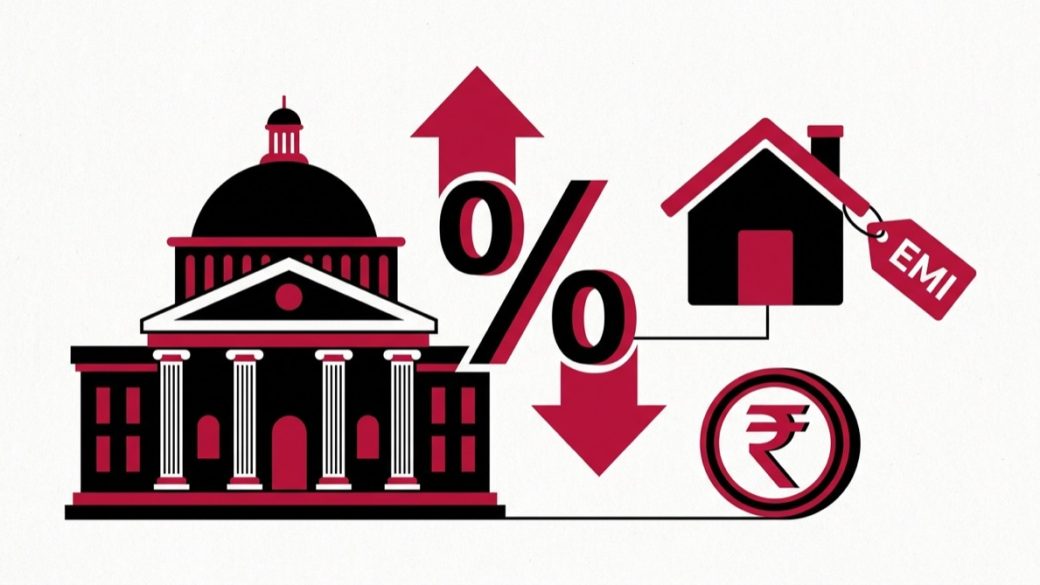
The repo rate is the interest rate at which the Reserve Bank of India (RBI) lends short-term money to commercial banks against government securities. It is the RBI’s most important policy tool: when the repo rate rises, borrowing becomes costlier and loan EMIs tend to go up; when it falls, loans get cheaper. The rate is fixed every two months by the RBI’s six-member Monetary Policy Committee (MPC), whose primary job is to keep retail inflation near a legally mandated target of 4% (within a 2%–6% band).
- What is the repo rate?
- How the repo rate actually works
- Who sets the repo rate? The MPC explained
- Repo rate vs reverse repo rate (and other RBI rates)
- How the repo rate reaches your EMI
- Repo rate and your home, car & personal loan EMIs
- A short history of India’s repo rate
- Repo rate, inflation & the wider economy
- What borrowers and savers should do
- Frequently asked questions
What is the repo rate?
The word “repo” is short for repurchase agreement. When commercial banks fall short of funds, they borrow from the RBI for a very short period — usually overnight — by selling government securities (like treasury bills and dated G-secs) to the central bank, with an agreement to buy them back the next day at a slightly higher price. That difference in price is effectively the interest, and the rate at which this happens is the repo rate (also called the policy repo rate).
Think of the RBI as the “bank for banks.” Just as you pay interest on a loan from your bank, banks pay interest to the RBI when they borrow from it. Because almost every other interest rate in the economy — from your home loan to your fixed deposit — is built on top of this base cost of money, the repo rate sits at the very centre of India’s interest-rate system.
What is a “basis point”?
You will constantly see repo-rate changes described in basis points (bps). One basis point equals one-hundredth of a percentage point, so 100 bps = 1%. When the RBI “hikes the repo rate by 50 bps,” it has raised it by 0.50 percentage points. Central banks use basis points to avoid confusion between a percentage of a rate and a percentage-point change.
How the repo rate actually works
The repo rate is one half of the RBI’s Liquidity Adjustment Facility (LAF) — the daily mechanism through which the central bank manages how much cash (liquidity) is sloshing around the banking system.
- Repo (injecting money): When banks need cash, they borrow from the RBI at the repo rate, putting government bonds up as collateral. This injects liquidity into the system.
- Reverse repo (absorbing money): When banks have surplus cash, they can park it with the RBI and earn interest. This absorbs liquidity. (More on this below.)
By raising or lowering the repo rate, the RBI nudges the entire cost of money up or down. A higher repo rate makes it more expensive for banks to access funds, so they raise the rates they charge customers — cooling demand for loans and, eventually, spending and inflation. A lower repo rate does the opposite: it makes credit cheaper to encourage borrowing, investment and growth.
Who sets the repo rate? The MPC explained
The repo rate is not decided by one person. Since 2016, India has used a Monetary Policy Committee (MPC) — a statutory, six-member body created under amendments to the RBI Act, 1934. The MPC is the institution legally responsible for fixing the policy repo rate to achieve the inflation target set by the government.
Who is on the MPC?
The committee has six members:
- Three from the RBI — the RBI Governor (who chairs it), a Deputy Governor in charge of monetary policy, and one officer nominated by the RBI.
- Three external members — economists and experts appointed by the central government, typically for a four-year term.
Each member has one vote, and decisions are taken by majority. If there is a tie, the Governor has a second, casting vote. The MPC normally meets six times a year (roughly once every two months), and the minutes — including how each member voted and why — are published, making the process unusually transparent.
What the MPC is actually trying to do
Under India’s flexible inflation targeting framework, the government has tasked the RBI with keeping Consumer Price Index (CPI) inflation at 4%, with a tolerance band of plus or minus 2% — i.e. between 2% and 6%. The repo rate is the main lever the MPC pulls to stay near that target while also supporting growth. If inflation is running hot, the MPC tends to raise rates; if inflation is comfortably low and growth is weak, it can cut them.
Repo rate vs reverse repo rate (and other RBI rates)
One of the most common points of confusion is the difference between the repo rate and the reverse repo rate. The simplest way to remember it: repo is when the RBI lends to banks; reverse repo is when banks lend to the RBI.
| Term | Direction of money | Who pays interest | What it does |
|---|---|---|---|
| Repo rate | RBI → Banks | Banks pay RBI | Banks borrow cash; injects liquidity |
| Reverse repo rate | Banks → RBI | RBI pays banks | Banks park surplus cash; absorbs liquidity |
The reverse repo rate is always lower than the repo rate — otherwise banks could borrow and re-deposit for a risk-free profit. Together, these two form a corridor within which the overnight market interest rate moves.
The wider “rate corridor”
Beyond repo and reverse repo, the RBI uses a few related tools you will see in news coverage:
| Rate / tool | What it is |
|---|---|
| Standing Deposit Facility (SDF) | Introduced in 2022, it lets banks park surplus funds with the RBI without collateral. It now effectively sets the floor of the rate corridor, just below the repo rate. |
| Marginal Standing Facility (MSF) | An emergency window where banks can borrow from the RBI above their normal limit, at a rate slightly higher than the repo rate. It forms the ceiling of the corridor. |
| Bank Rate | A longer-term lending rate at which the RBI lends to banks; today it is usually aligned with the MSF rate. |
| CRR (Cash Reserve Ratio) | The share of deposits banks must keep with the RBI as cash, earning no interest. Raising it reduces the money banks can lend. |
| SLR (Statutory Liquidity Ratio) | The minimum share of deposits banks must hold in safe assets like government bonds, gold or cash. |
The repo rate and reverse repo/SDF control the price of money; CRR and SLR control the quantity of money banks can lend. Together they make up the RBI’s monetary-policy toolkit.
How the repo rate reaches your EMI
A repo-rate change does not magically appear on your loan statement. It travels through the banking system in a process economists call monetary policy transmission. Historically, this transmission was slow and incomplete — banks were quick to raise lending rates but slow to pass on cuts. To fix that, the RBI pushed banks toward external benchmark-linked lending rates.
From MCLR to the repo-linked era
For years, banks priced loans off an internal benchmark called the MCLR (Marginal Cost of Funds-based Lending Rate), which they controlled and adjusted slowly. From October 2019, the RBI required banks to link most new floating-rate retail and small-business loans to an external benchmark — and most chose the repo rate itself. This created the RLLR (Repo-Linked Lending Rate).
If your home loan is on the RLLR/EBLR system, your rate is essentially:
So when the RBI changes the repo rate, repo-linked loans are usually reset within a quarter — making cuts and hikes reach borrowers much faster than under the old MCLR regime.
Why MCLR borrowers still wait
If your loan is still on the older MCLR or base-rate system, transmission is slower and tied to a reset clause (often six or twelve months). This is one reason many borrowers switch to a repo-linked loan — though it cuts both ways: you benefit faster from cuts, but also feel hikes sooner.
Repo rate and your home, car & personal loan EMIs
This is the part most readers care about. For a floating-rate, repo-linked loan, a change in the repo rate flows almost directly into your interest rate. When that happens, banks usually keep your EMI the same and adjust the loan tenure (the number of months you pay), or they keep the tenure the same and change the EMI. For large, long loans like home loans, even a small rate move has a surprisingly big effect over time.
An illustrative example
The table below is a simplified illustration of how a 0.50% (50 bps) rate change affects the EMI on a fresh 20-year home loan, holding tenure fixed. These are rounded, hypothetical figures for understanding the direction and scale of the impact — not a quote for any specific loan.
| Loan amount | Rate before | Rate after (+0.50%) | Approx. EMI before | Approx. EMI after | Extra per month |
|---|---|---|---|---|---|
| ₹30 lakh | 8.50% | 9.00% | ₹26,000 | ₹27,000 | ~₹1,000 |
| ₹50 lakh | 8.50% | 9.00% | ₹43,400 | ₹45,000 | ~₹1,600 |
| ₹75 lakh | 8.50% | 9.00% | ₹65,100 | ₹67,500 | ~₹2,400 |
Over a 20-year tenure, that monthly difference compounds into lakhs of rupees in extra interest — which is why borrowers track repo-rate decisions so closely.
What it means by loan type
- Home loans: Almost always floating and repo-linked today, so the most directly affected. A rate change typically reaches you within a quarter.
- Car & personal loans: Often at fixed rates, so existing loans usually do not change — but new loans get priced on the prevailing rate environment.
- Credit cards: Carry their own high, largely fixed rates and are not directly tied to the repo rate.
- Fixed deposits & savings: When the repo rate rises, banks often raise FD rates too — good news for savers and senior citizens. When it falls, deposit returns tend to soften.
A short history of India’s repo rate
The repo rate has swung widely over the past two decades, tracking India’s battles with inflation, global shocks and growth slowdowns. Some broad phases are worth knowing:
| Period | Direction | What was happening |
|---|---|---|
| 2008–2009 | Sharp cuts | The RBI slashed rates aggressively to cushion the economy during the global financial crisis. |
| 2010–2013 | Rising | Persistently high inflation pushed the repo rate up into the high single digits. |
| 2015–2019 | Gradual easing | As inflation cooled and the MPC framework took shape, rates trended lower. |
| 2020 | Record lows | During the COVID-19 shock, the MPC cut the repo rate to a historic low of 4.00% to support the economy. |
| 2022–2023 | Rapid hikes | To fight post-pandemic and global inflation, the MPC raised the repo rate in steps to 6.50%. |
| 2024–2025 | Pause, then easing | After a long hold at 6.50%, the MPC began cutting again in 2025 as inflation moderated. |
The big lesson from this history: the repo rate is cyclical. It rises when inflation threatens and falls when growth needs support, so borrowers should plan for both up-cycles and down-cycles over the life of a long loan rather than assuming today’s rate is permanent.
For the latest decision, always check the RBI’s most recent MPC statement — as of the latest MPC meeting, the policy repo rate reflects the committee’s reading of inflation and growth at that point in time, and it can change at any of the roughly six meetings held each year.
Repo rate, inflation & the wider economy
The repo rate is fundamentally a tool to manage inflation — the rate at which prices rise. The logic runs like this:
- When inflation is too high: The MPC raises the repo rate. Loans get costlier, people and businesses borrow and spend less, demand cools, and price pressure eases. The trade-off is slower growth.
- When growth is weak and inflation is low: The MPC cuts the repo rate. Cheaper credit encourages borrowing, investment and spending, lifting growth — with the risk of stoking inflation if overdone.
This is the central balancing act of monetary policy: supporting growth without letting inflation run away. The repo rate also influences the rupee’s exchange rate (higher rates can attract foreign capital and support the rupee), bond yields, and the broader cost of doing business — which is why markets, the government and ordinary borrowers all watch the MPC so closely.
The CRR and SLR connection
Remember that the RBI does not rely on the repo rate alone. By tweaking the CRR and SLR, it can drain or release liquidity directly. In tight conditions, it may cut the CRR to free up funds for lending; to absorb excess cash, it can raise it. These quantity tools work alongside the price signal of the repo rate.
What borrowers and savers should do
You cannot control the repo rate, but you can position yourself sensibly around its cycles. A few practical, non-prescriptive points:
- Know your benchmark. Check whether your loan is on RLLR/EBLR (repo-linked) or the older MCLR/base rate. Your loan agreement and statement will say. Repo-linked loans reprice faster in both directions.
- Watch the spread, not just the repo rate. Two banks can offer very different rates on the same repo rate because their margins differ. When rates are falling, it can be worth comparing or negotiating your spread.
- Use rate cuts to prepay. If a cut lowers your EMI, continuing to pay the old (higher) amount as a part-prepayment can shorten your loan and save significant interest — subject to your lender’s prepayment terms.
- Savers can ladder FDs. When rates look high, locking in longer-tenure deposits can preserve good returns before any future cuts; senior citizens in particular benefit from higher deposit rates.
- Don’t try to perfectly time the cycle. Rate movements are hard to predict. Borrow within your means with a comfortable EMI-to-income ratio so you can withstand a hike.
Frequently asked questions
What is the repo rate in simple words?
The repo rate is the interest rate at which the Reserve Bank of India lends short-term money to commercial banks against government securities. It is the base cost of money in the economy, so it strongly influences the interest rates banks charge on loans and pay on deposits.
What is the current repo rate in India?
The repo rate changes at the RBI’s bi-monthly Monetary Policy Committee meetings, so it is not a fixed number. For the exact current figure, always check the RBI’s latest MPC statement on rbi.org.in. As of the latest MPC, the rate reflects the committee’s assessment of inflation and growth at that time and can be revised at any future meeting.
What is the difference between repo rate and reverse repo rate?
In a repo transaction, the RBI lends money to banks and the banks pay interest at the repo rate. In a reverse repo transaction, banks park their surplus money with the RBI and the RBI pays them interest at the reverse repo rate. The reverse repo rate is always lower than the repo rate.
Who decides the repo rate in India?
The repo rate is set by the six-member Monetary Policy Committee (MPC), chaired by the RBI Governor. It has three RBI members and three external experts appointed by the government. Decisions are taken by majority vote, with the Governor holding a casting vote in case of a tie.
How does the repo rate affect my home loan EMI?
If your home loan is repo-linked (RLLR/EBLR), your interest rate is the repo rate plus your bank’s fixed margin. When the RBI raises the repo rate, your rate — and usually your EMI or loan tenure — rises, generally within a quarter. When it cuts the rate, your loan gets cheaper. Fixed-rate loans are not directly affected.
Why does the RBI change the repo rate?
The RBI uses the repo rate mainly to manage inflation while supporting growth. It is legally tasked with keeping CPI inflation at 4% within a 2%–6% band. When inflation is high, it raises the rate to cool demand; when growth is weak and inflation is low, it cuts the rate to encourage borrowing and spending.
What is the meaning of a basis point in repo rate news?
A basis point (bps) is one-hundredth of a percentage point, so 100 bps equals 1%. When the RBI is said to hike the repo rate by 25 bps, it has raised it by 0.25 percentage points. Basis points are used to describe rate changes precisely.
Disclaimer: This article is for educational purposes only and is not investment/financial advice. Read all scheme/offer documents and consult a SEBI-registered adviser where relevant.