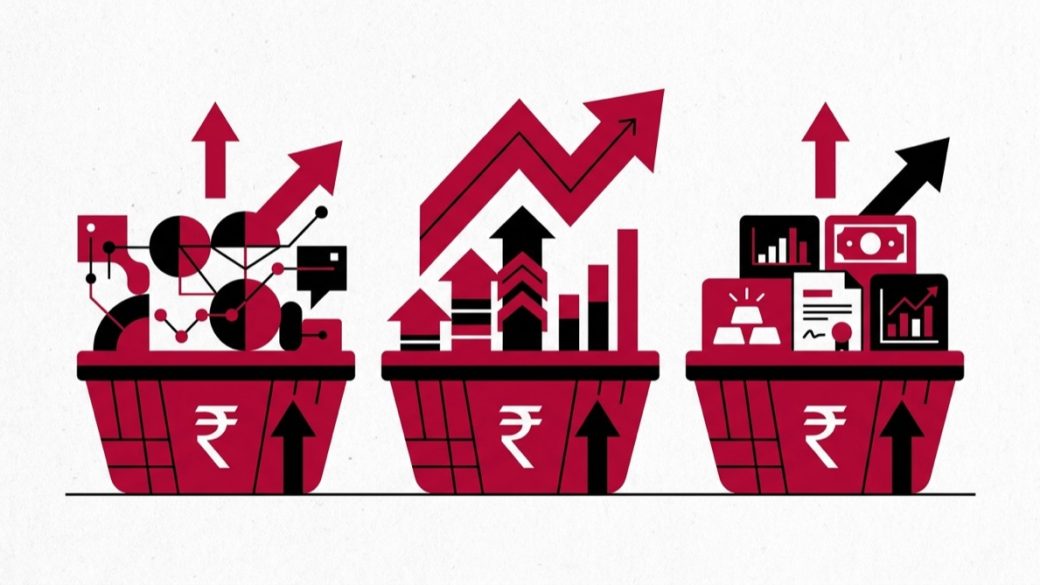
Mutual funds, stocks and ETFs are three different ways to put your money into the market, not three competing products you must choose between. Stocks mean buying shares of a single company directly. A mutual fund pools money from many investors and a professional manager invests it across dozens of stocks or bonds. An ETF (Exchange-Traded Fund) is a basket of securities, usually tracking an index like the Nifty 50, that trades on the exchange like a stock. For most beginners in India, mutual funds (via SIPs) and index ETFs are the simpler, more diversified starting point; direct stocks suit those willing to research and accept higher risk.
- What stocks, mutual funds and ETFs actually are
- Mutual funds vs stocks vs ETFs: the comparison table
- Direct stocks: pros, cons and who they suit
- Mutual funds and SIPs explained
- ETFs explained for Indian investors
- Risk and returns: what to realistically expect
- Costs and taxes in India (2026)
- Who should pick what
- How to start investing
- Frequently asked questions
What stocks, mutual funds and ETFs actually are
Before comparing them, it helps to be precise about what each one is, because the words get used loosely in everyday conversation.
Stocks (shares)
A stock (also called a share or equity) is a unit of ownership in one company. If you buy 10 shares of a listed company on the NSE or BSE, you own a tiny slice of that business and your fortunes rise and fall with that single company. You decide what to buy, when to buy and when to sell. There is no manager and no in-built diversification — the responsibility, and the risk, is entirely yours.
Mutual funds
A mutual fund collects money from thousands of investors and hands it to a professional fund manager at an Asset Management Company (AMC). The manager invests that pooled money according to the fund’s stated objective — for example, an equity fund buys a spread of company shares, a debt fund buys bonds, and a hybrid fund mixes both. You own “units” of the fund, and the value of each unit is the NAV (Net Asset Value), published once at the end of each trading day. In India, mutual funds are regulated by SEBI and you most commonly invest through a SIP (Systematic Investment Plan) — a fixed amount auto-debited every month.
ETFs (Exchange-Traded Funds)
An ETF is a hybrid of the two. Like a mutual fund, it is a basket holding many securities; like a stock, it is listed and trades on the exchange throughout the day at a live price. Most ETFs are passive — they simply mirror an index such as the Nifty 50, the Sensex, or Nifty Next 50, rather than trying to beat it. To buy an ETF you need a demat and trading account, exactly as you would for a stock.
Mutual funds vs stocks vs ETFs: the comparison table
Here is the side-by-side view of how the three differ on the points that matter most to an Indian investor.
| Feature | Direct stocks | Mutual funds | ETFs |
|---|---|---|---|
| What you own | Shares of one company | Units of a managed pool | Units of an index basket |
| Diversification | None unless you build a portfolio yourself | High, built in | High, built in |
| Managed by | You | A professional fund manager | Mostly passive (tracks an index) |
| How you buy | Demat + trading account | App/website or distributor; SIP friendly | Demat + trading account |
| Pricing | Live, all day | NAV once a day | Live, all day |
| Minimum to start | Price of one share | As low as Rs 100-500 per SIP | Price of one unit |
| Typical ongoing cost | Brokerage + charges per trade | Expense ratio (often higher for active) | Low expense ratio |
| Effort needed | High (research each company) | Low | Low |
| Best suited to | Hands-on, knowledgeable investors | Beginners and busy investors | Cost-conscious, DIY index investors |
Direct stocks: pros, cons and who they suit
Buying individual stocks is the most direct way to invest in companies you believe in. It is also the path where mistakes hurt the most, because there is no diversification or manager to cushion you.
Pros of direct stocks
- Full control: you choose exactly which businesses to back and in what proportion.
- Highest upside on a winner: a single great company can multiply your money far faster than a diversified fund.
- No annual management fee: you pay brokerage and statutory charges per trade, but no recurring expense ratio.
- Direct dividends and voting rights as a part-owner of the company.
Cons of direct stocks
- Concentration risk: if one company runs into trouble, a large chunk of your capital is exposed.
- Time and skill: reading annual reports, understanding a business and tracking news is real work.
- Emotional pressure: watching live prices tempts many people into panic-selling or over-trading.
- No built-in safety net: nobody rebalances or exits a deteriorating stock for you.
Mutual funds and SIPs explained
Mutual funds are the most popular entry point for Indian retail investors, largely because of how easy and disciplined SIPs make the process.
Main types of mutual funds in India
- Equity funds invest mainly in shares. Sub-categories include large-cap, mid-cap, small-cap, flexi-cap and sectoral/thematic funds.
- Debt funds invest in bonds and other fixed-income instruments; generally lower risk and lower return than equity.
- Hybrid funds mix equity and debt in one scheme (for example, balanced advantage or aggressive hybrid funds).
- Index funds are passive equity funds that track an index like the Nifty 50 at a low cost — the mutual-fund cousin of an ETF.
- ELSS (tax-saving) funds are equity funds with a three-year lock-in that qualify for deduction under Section 80C in the old tax regime.
What a SIP is and why it works
A SIP (Systematic Investment Plan) lets you invest a fixed amount — say Rs 1,000, Rs 5,000 or whatever you choose — automatically on a set date every month. Two things make it powerful:
- Rupee-cost averaging: because you invest the same amount regularly, you automatically buy more units when prices are low and fewer when prices are high, smoothing out your average cost.
- Discipline and compounding: automating the investment removes the temptation to “time” the market, and staying invested for years lets returns compound.
Direct plans vs regular plans
Every mutual fund offers two versions. A regular plan is bought through a distributor or agent and pays them a commission baked into a higher expense ratio. A direct plan is bought straight from the AMC or a direct platform and has no commission, so its expense ratio is lower and its NAV grows slightly faster over time. For the same fund, a direct plan simply costs you less.
ETFs explained for Indian investors
An ETF combines the diversification of a fund with the live trading of a stock. In India, the most popular ETFs track broad indices such as the Nifty 50, the Sensex and Nifty Next 50, while others track gold, specific sectors or international indices.
How ETFs differ from index mutual funds
An index fund and an index ETF can track the very same index, but the way you transact differs:
| Point | Index mutual fund | Index ETF |
|---|---|---|
| Account needed | No demat needed; buy from AMC/platform | Demat + trading account required |
| How you buy | By rupee amount; SIP-friendly | By units, at market price, during trading hours |
| Pricing | End-of-day NAV | Live price (may differ slightly from NAV) |
| Cost | Low expense ratio | Often even lower, but you pay brokerage per trade |
| Best for | Hands-off SIP investors | Investors comfortable placing market orders |
Things to watch with ETFs
- Liquidity: stick to ETFs with healthy trading volumes so you can buy and sell at a fair price. Thinly traded ETFs can have a wide gap between buy and sell prices.
- Tracking and price gap: an ETF’s market price can drift slightly above or below its underlying NAV; a small tracking difference versus the index is also normal.
- You need a demat account and you place orders yourself, which is a small extra step compared with a mutual-fund SIP.
Risk and returns: what to realistically expect
There is a simple principle behind all three: higher potential return comes with higher risk and higher short-term ups and downs (volatility). Diversification reduces the risk that any single company sinks your portfolio, but it does not remove market risk — when the whole market falls, diversified funds and ETFs fall too.
Key risk ideas in plain language
- Volatility is how sharply a value swings up and down in the short term. Equities are more volatile than debt.
- Time horizon matters: equity’s swings tend to matter less the longer you stay invested. Money you need within a year or two generally should not sit in equity.
- Past performance is not a promise. A fund that did well recently may not repeat it, which is why SEBI mandates that exact disclaimer on every fund communication.
Costs and taxes in India (2026)
Costs quietly eat into returns, so it pays to understand them. There are two layers: what you pay to invest, and what you pay in tax on your gains.
What investing costs
- Mutual funds — expense ratio: an annual percentage of your investment that covers management and administration. Actively managed equity funds usually cost more than index funds; SEBI caps expense ratios and they fall as a scheme’s assets grow. Direct plans cost less than regular plans.
- ETFs — expense ratio plus brokerage: ETFs typically carry a low expense ratio, but because you trade them, you also pay brokerage and statutory charges on each buy and sell.
- Stocks — transaction charges: no annual expense ratio, but each trade attracts brokerage, Securities Transaction Tax (STT), exchange and regulatory fees, stamp duty and GST on charges. Frequent trading multiplies these costs.
- Exit load: some mutual funds charge a small exit load if you redeem before a minimum holding period — always check the scheme document.
How investments are taxed
Taxation depends on the type of asset and how long you hold it. For equity (direct stocks, equity mutual funds and equity ETFs), gains on units or shares held up to 12 months are short-term capital gains (STCG), and gains on holdings beyond 12 months are long-term capital gains (LTCG). Debt funds and the holding-period rules for non-equity products are taxed differently, and tax rules can change in any Union Budget.
| Asset | Short-term (held ≤ 12 months) | Long-term (held > 12 months) |
|---|---|---|
| Direct stocks (listed equity) | Taxed as STCG on equity | Taxed as LTCG on equity, with an annual exemption limit |
| Equity mutual funds | Taxed as STCG on equity | Taxed as LTCG on equity, with an annual exemption limit |
| Equity ETFs (e.g. Nifty 50) | Taxed as STCG on equity | Taxed as LTCG on equity, with an annual exemption limit |
| Debt funds / non-equity | Holding-period and rate rules differ from equity; check current rules | |
Who should pick what
There is no single right answer — the best choice depends on your knowledge, the time you can give, your risk appetite and your goals. The framework below is a starting point, not a recommendation.
| If you are… | A sensible starting point | Why |
|---|---|---|
| A complete beginner with little time | Equity mutual fund SIP (or an index fund) | Diversified, automated, no need to pick stocks |
| Cost-conscious and comfortable with a trading account | Index ETF (e.g. Nifty 50) | Very low cost, transparent, broad market exposure |
| Keen to research companies and accept higher risk | A few direct stocks alongside funds | Control and upside, balanced by a diversified core |
| Investing for a short-term goal (1-3 years) | Debt or hybrid funds / safer instruments | Lower volatility protects money you will need soon |
| Wanting tax saving under the old regime | ELSS equity fund (3-year lock-in) | Section 80C deduction plus equity growth potential |
In practice, many Indian investors build a “core and satellite” portfolio: a diversified core of index funds or ETFs and broad equity mutual funds, with a smaller “satellite” of a few individual stocks they have researched. This captures the discipline and diversification of funds while leaving room for conviction bets.
How to start investing
Whichever route you choose, the practical steps are straightforward.
Step 1 — Get your basics in order
Complete your KYC (PAN, Aadhaar and bank details). For stocks and ETFs you will need a demat and trading account with a SEBI-registered broker. For mutual funds you can invest through an AMC website, a registrar, or a SEBI-registered investment platform without a demat account.
Step 2 — Define the goal and horizon
Decide what the money is for and when you will need it. A long horizon (5+ years) can support more equity; money needed soon should stay in safer instruments.
Step 3 — Pick the vehicle and start small
Begin with a diversified, low-cost option — an index fund SIP, a broad equity fund, or a Nifty 50 ETF — rather than chasing last year’s top performer. Starting small and automating is better than waiting for the “perfect” time.
Step 4 — Automate, review and stay diversified
Set up a SIP so investing happens automatically, review your portfolio once or twice a year rather than daily, and avoid putting everything into a single stock or theme. Keep an emergency fund separate from your investments.
Frequently asked questions
Are mutual funds better than stocks for beginners?
For most beginners, yes. Mutual funds (especially via SIPs) give instant diversification and a professional manager, so a single company’s troubles cannot wipe out your investment, and you do not need to research individual stocks. Direct stocks can deliver higher returns but require more knowledge, time and emotional discipline. Many people start with funds and add a few stocks later once they understand the market.
What is the difference between an ETF and a mutual fund?
Both are baskets of securities, but a mutual fund is priced once a day at its NAV and is bought directly from the AMC (often via SIP, no demat needed), while an ETF trades live on the exchange like a stock and needs a demat and trading account. ETFs are usually passive index trackers with low costs; mutual funds can be active or passive. An index mutual fund and an index ETF can track the same index but transact differently.
Which gives higher returns: stocks, mutual funds or ETFs?
A single winning stock can outperform any fund, but most investors do not consistently pick winners, and concentrated bets can also fall the hardest. Diversified equity funds and index ETFs aim for steadier, market-linked returns over the long run. There is no guaranteed “highest return” option — higher potential return always comes with higher risk, and past performance does not predict the future.
Can I invest in stocks, mutual funds and ETFs at the same time?
Yes, and many investors do. A common approach is a diversified “core” of index funds, broad equity funds or ETFs, plus a smaller “satellite” of a few directly chosen stocks. Holding all three lets you combine automated, diversified investing with selective, hands-on bets, as long as your overall mix matches your goals and risk appetite.
Do I need a demat account for mutual funds?
No. You can buy and hold most mutual funds without a demat account by investing directly through the AMC, a registrar, or a SEBI-registered platform. A demat and trading account is required for direct stocks and for ETFs, because those are bought and sold on the stock exchange.
What is a SIP and is it only for mutual funds?
A SIP (Systematic Investment Plan) auto-invests a fixed amount on a set date each month, which encourages discipline and averages your purchase cost over time. SIPs are most associated with mutual funds. You can also invest in some ETFs in a regular, staggered way, but the classic, fully automated SIP is a mutual-fund feature.
Are index funds and ETFs the same thing?
They are close cousins but not identical. Both can track the same index, such as the Nifty 50. An index fund is a mutual fund priced once daily and is SIP-friendly without a demat account; an index ETF trades on the exchange at a live price and needs a demat account. Choose the index fund for hands-off SIP investing and the ETF if you are comfortable placing market orders and want potentially lower costs.
Disclaimer: This article is for educational purposes only and is not investment/financial advice. Read all scheme/offer documents and consult a SEBI-registered adviser where relevant.