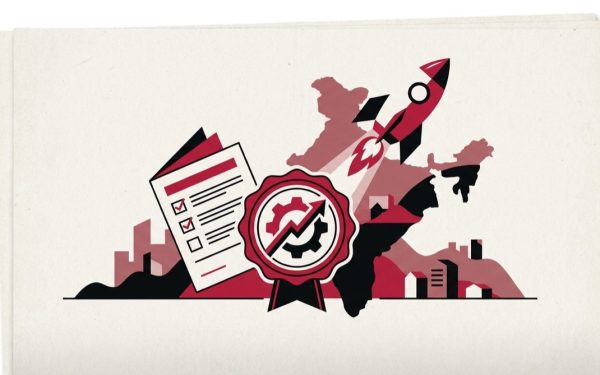
The Indian startup ecosystem is the world’s third-largest by number of startups, anchored by hubs in Bengaluru, Delhi NCR and Mumbai, fuelled by domestic and global venture capital, and shaped by government programmes like Startup India. It spans more than a hundred unicorns across fintech, software-as-a-service (SaaS), consumer internet, deep tech and agritech, and is increasingly defined in 2026 by a renewed focus on profitability, artificial intelligence and the public markets.
What the ecosystem is · Global rank & scale · Key startup hubs · Who funds startups · Hot sectors · Government support · Challenges · 2026 trends · FAQ
What is the Indian startup ecosystem?
A “startup ecosystem” is the full network of people, money and institutions that lets new, high-growth companies get founded, funded and scaled. In India that network has matured rapidly over the last decade. It now includes founders and operators, angel investors and venture capital (VC) firms, incubators and accelerators, universities and IITs/IIMs, large corporates running their own venture arms, government bodies, and a deep base of engineering and design talent.
The Department for Promotion of Industry and Internal Trade (DPIIT), under the Ministry of Commerce and Industry, formally recognises startups that meet certain criteria. The number of DPIIT-recognised startups crossed the 1.5 lakh mark and these recognised entities are spread across hundreds of districts, not just the big metros. The headline point: India is no longer a place where startups are an exception. They are a mainstream career and investment category.
How a startup is defined in India
Under the Startup India framework, an entity is generally treated as a startup for up to 10 years from incorporation, provided annual turnover stays within the prescribed limit (₹100 crore) and it is working towards innovation, development or improvement of products, processes or services, or has a scalable business model with potential for employment generation or wealth creation. This definition matters because DPIIT recognition unlocks tax and compliance benefits, covered later in this guide.
Global rank and scale
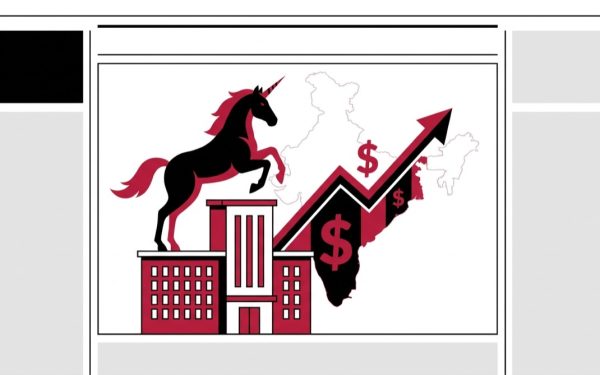
India consistently ranks as the third-largest startup ecosystem in the world by number of startups and unicorns, behind the United States and China. A unicorn is a privately held startup valued at $1 billion or more; a “soonicorn” is one widely expected to reach that mark. India is home to well over 100 unicorns, built across roughly the last decade, with a long pipeline of soonicorns behind them.
The growth has not been linear. The ecosystem saw a funding boom in 2021, a sharp correction through 2022–2023 (often called the “funding winter”), and a more disciplined, selective environment from 2024 onwards. The chart below shows the broad shape of that journey in qualitative terms.
What changed after the winter was not just the volume of money but its temperament. Investors began rewarding unit economics, a clear path to profit, and governance discipline over pure growth-at-all-costs. Several large consumer-internet companies responded by trimming losses, and a wave of them began listing on Indian stock exchanges.
Key startup hubs in India
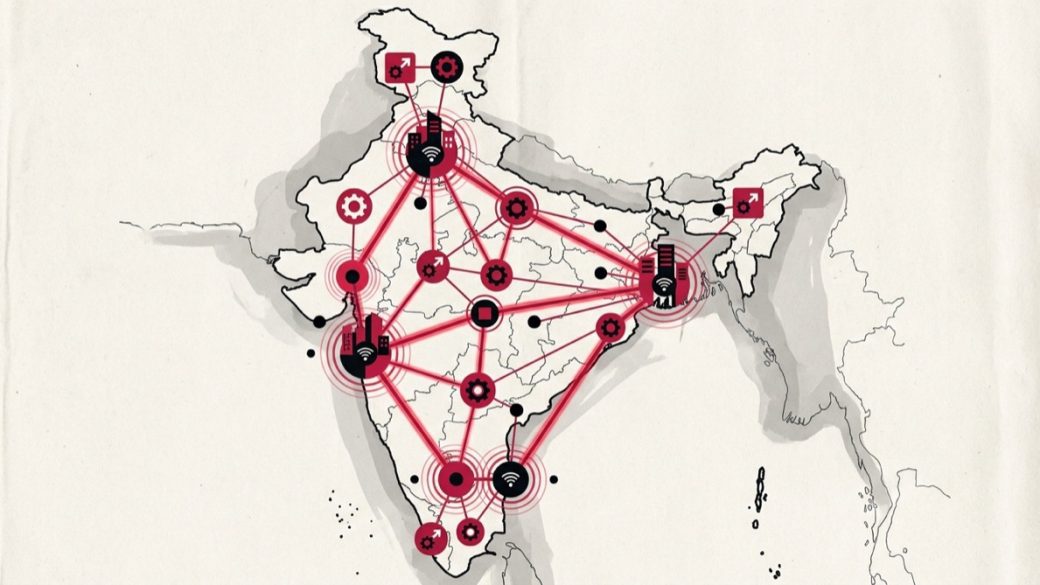
While DPIIT-recognised startups now exist in every state, capital, talent and exits still concentrate in a handful of cities. Understanding these hubs is the fastest way to understand the ecosystem’s geography.
Bengaluru — the capital of Indian startups
Bengaluru (Bangalore) is the undisputed centre of gravity. It combines the country’s densest pool of software engineers, the headquarters of global tech R&D centres, the largest cluster of VC and growth-equity offices, and a culture where leaving a stable job to start up is normal. A large share of India’s unicorns are headquartered here, spanning SaaS, fintech, consumer internet and deep tech.
Delhi NCR — scale and consumer reach
The National Capital Region (Delhi, Gurugram and Noida) is the second major hub and often rivals Bengaluru on the sheer number of unicorns. NCR’s strength is consumer-facing scale: e-commerce, food and grocery delivery, edtech, mobility and B2B commerce. Proximity to policymakers and a vast domestic market on its doorstep are added advantages.
Mumbai — capital, fintech and media
Mumbai is India’s financial capital, home to the stock exchanges, most large banks, and a growing concentration of fintech, insurtech, media and direct-to-consumer (D2C) brands. As more startups head towards IPOs, Mumbai’s role as the venue where companies meet public-market capital has only grown.
The rising rest: Pune, Hyderabad, Chennai and Tier-2 cities
Beyond the big three, Pune (SaaS and engineering), Hyderabad (enterprise tech and life sciences), Chennai (SaaS, fintech and deep tech) and Ahmedabad (D2C and manufacturing) are strong secondary hubs. Crucially, Tier-2 and Tier-3 cities — Jaipur, Indore, Kochi, Coimbatore, Chandigarh and others — now produce a meaningful and growing share of new recognised startups, helped by cheaper talent, state incubators and remote-first work.
Who funds Indian startups?
Capital flows into startups in stages, and different types of investors specialise in different stages. The ladder below is the standard path, though many companies skip or combine rounds.
Angel investors and angel networks
Angels are wealthy individuals — often successful founders or senior professionals — who write the earliest cheques. India has active angel networks and angel-led syndicates that pool money from many individuals into a single round, making early-stage investing more organised than it was a decade ago.
Venture capital and micro-VC
VC firms manage pooled money from institutions and wealthy individuals (called limited partners) and invest it in startups in exchange for equity. India has a deep bench of domestic and India-focused VC funds covering everything from pre-seed micro-VC to large growth rounds. Many global funds also invest actively in Indian startups. A notable 2026-era trend is the rise of homegrown, India-domiciled funds and family offices taking a larger role.
Corporates, PE and public markets
Large Indian and global corporates run corporate venture capital (CVC) arms and make strategic investments. Private equity (PE) firms come in at later, larger stages. And increasingly, the public markets themselves are a source of capital and exits, as profitable (or near-profitable) startups list on the BSE and NSE.
| Investor type | Typical stage | What they bring |
|---|---|---|
| Angel investors / networks | Pre-seed, seed | First capital, mentorship, early credibility |
| Incubators & accelerators | Idea to seed | Small cheque, workspace, structured programme, networks |
| Micro-VC & seed funds | Seed, pre-Series A | Focused early bets, hands-on support |
| Venture capital funds | Series A to C+ | Larger capital, board seats, hiring & scaling help |
| Growth / PE funds | Late stage, pre-IPO | Big cheques, governance, IPO readiness |
| Corporates / CVC | Any stage | Strategic capital, distribution, partnerships |
Hot sectors in 2026
India’s startup activity is broad, but a few sectors attract a disproportionate share of attention, talent and capital. These are the areas to watch in 2026.
Artificial intelligence (AI)
AI is the defining theme of the current cycle. Indian startups are building application-layer AI products, developer tooling, AI-native SaaS, and vertical AI for sectors like healthcare, legal and customer support. The India AI Mission and a large developer base have pushed both founders and investors strongly towards AI, with many existing startups rebuilding products around large language models.
Fintech
India is one of the world’s leading fintech markets, built on the back of the Unified Payments Interface (UPI), Aadhaar-based digital identity and India Stack. Sub-sectors include payments, digital lending, wealthtech, insurtech and neobanking. Regulation by the RBI and SEBI is tightening, which favours compliant, well-governed players.
Direct-to-consumer (D2C) and consumer brands
A new generation of D2C brands sells food, beauty, personal care, apparel and electronics directly to consumers online and through quick commerce. Rising digital payments, cheap logistics and quick-commerce platforms have made it possible to build national brands faster than the traditional retail route allowed.
Deep tech and the hard problems
Deep tech — startups built on genuine scientific or engineering breakthroughs — is a rising priority. This includes semiconductors and chip design, space tech, electric mobility and batteries, robotics, defence tech and climate tech. The government has signalled strong support for deep tech because it builds long-term, hard-to-copy advantages. Agritech, healthtech and B2B/SaaS round out the list of consistently funded categories.
Government support and Startup India
Government policy has been a major accelerant. The flagship Startup India initiative, launched in 2016, created a single framework of benefits for DPIIT-recognised startups. The most relevant supports are summarised below.
| Scheme / benefit | What it offers |
|---|---|
| DPIIT recognition | Official startup status that unlocks the benefits below; easier and free self-certification |
| Income-tax holiday (Sec 80-IAC) | Eligible startups can claim a deduction on profits for a defined period within their early years |
| Angel-tax relief | Recognised startups received exemptions designed to ease early fundraising from angels |
| Startup India Seed Fund Scheme (SISFS) | Early-stage grants and convertible support routed through approved incubators |
| Fund of Funds for Startups (FFS) | Government capital invested through SEBI-registered VC funds (managed via SIDBI) to deepen the pool |
| Self-certification & faster exit | Lighter compliance under select labour/environment laws and simpler winding-up provisions |
| Public procurement relaxations | Easier access to government tenders by relaxing prior-experience and turnover criteria |
Beyond the central scheme, almost every state now runs its own startup policy, incubators and challenge grants, and bodies like the IITs, IIMs and Atal Innovation Mission feed the early pipeline. The net effect is a far lower barrier to formally starting up than existed a decade ago.
Challenges the ecosystem faces
For all its progress, India’s startup ecosystem has real, structural challenges. A clear-eyed view of them is part of understanding it.
Profitability and the path to sustainable growth
The funding winter exposed how many startups had scaled losses faster than revenue. The post-2023 mandate is profitability and strong unit economics. This is healthy, but it makes fundraising harder for companies that cannot show a credible path to profit.
Late-stage capital, exits and depth
Early-stage capital is relatively abundant, but large late-stage cheques have historically been thinner and more dependent on global funds, making the ecosystem sensitive to global interest rates and sentiment. Exits — via IPOs or acquisitions — are improving as more startups list domestically, but a deeper, more reliable exit market is still a work in progress.
Regulation, talent and reverse-flipping
Evolving rules around data, fintech, gaming and consumer protection create uncertainty. Hiring senior product and AI talent is competitive and expensive. A notable 2026 trend is “reverse flipping” — startups that had earlier incorporated abroad (often in the US or Singapore) shifting their domicile back to India to list on Indian exchanges and be closer to their market.
| Challenge | Why it matters | Direction in 2026 |
|---|---|---|
| Path to profitability | Investors now demand sustainable unit economics | Improving; discipline is the new normal |
| Late-stage / growth capital | Big rounds depend heavily on global sentiment | Domestic capital and family offices rising |
| Reliable exits | Investors need IPOs/M&A to return money | More domestic IPOs; market deepening |
| Regulatory clarity | Rules shape fintech, AI, gaming, data | Tightening but maturing |
| Talent costs | AI and senior talent are scarce and costly | Persistent; remote and Tier-2 help |
Trends defining the ecosystem in 2026
Pulling the threads together, several trends define where the Indian startup ecosystem is heading.
1. AI-native, profit-first companies
The combination of cheap compute access, a vast developer base and the AI wave is producing a new cohort of AI-first startups — built lean, with a clearer line to revenue than the growth-at-all-costs era.
2. The IPO wave and reverse flipping
A growing pipeline of startups is heading to the public markets in India, and several that had domiciled abroad are shifting back home to list. This is creating real, liquid exits for early investors and employees holding stock options (ESOPs).
3. Bharat, Tier-2 and vernacular
Growth is increasingly coming from beyond the metros — smaller cities, regional-language users and first-time internet consumers, often reached through UPI, quick commerce and vernacular content.
4. Deep tech and sovereignty
Semiconductors, space, defence tech, EVs and climate are getting policy push and patient capital, reflecting a national interest in building hard, strategic technology at home.
Frequently asked questions
Why is the Indian startup ecosystem ranked third in the world?
India ranks third — behind the United States and China — primarily on the number of startups and unicorns. This scale is driven by a huge domestic market, a deep pool of engineering and tech talent, strong digital public infrastructure like UPI and Aadhaar, active venture capital, and supportive government policy through Startup India.
Which is the startup capital of India?
Bengaluru (Bangalore) is widely regarded as the startup capital of India. It has the largest cluster of software talent, venture capital offices and unicorns, spanning SaaS, fintech, consumer internet and deep tech. Delhi NCR is a very close second and sometimes leads on the raw number of unicorns.
What are the main hubs for Indian startups?
The three primary hubs are Bengaluru, Delhi NCR (Delhi, Gurugram, Noida) and Mumbai. Strong secondary hubs include Pune, Hyderabad, Chennai and Ahmedabad, while Tier-2 cities such as Jaipur, Indore and Kochi are producing a fast-growing share of new startups.
Which sectors are hottest in the Indian startup ecosystem in 2026?
The most active sectors are artificial intelligence (AI), fintech, direct-to-consumer (D2C) consumer brands, and deep tech — including semiconductors, space tech, electric mobility and climate tech. SaaS, healthtech and agritech also attract consistent funding.
Who funds startups in India?
Funding comes in stages: angel investors and angel networks at the earliest stage; incubators and accelerators; micro-VC and seed funds; larger venture capital funds for growth rounds; private equity and corporate venture arms at later stages; and increasingly the public markets through IPOs.
What is the government doing to support startups?
The flagship Startup India programme, through DPIIT recognition, offers a tax holiday for eligible startups, angel-tax relief, the Startup India Seed Fund Scheme, a Fund of Funds routed through SEBI-registered VC funds, lighter self-certified compliance and easier public procurement. States also run their own startup policies and incubators.
What are the biggest challenges for Indian startups?
The main challenges are achieving profitability and sustainable unit economics, securing reliable late-stage capital, building a deeper exit market, navigating evolving regulation, and managing rising talent costs — especially for AI and senior roles.
Disclaimer: This article is for educational purposes only and is not investment/financial advice. Startup investing carries a high risk of loss. Read all scheme/offer documents and consult a SEBI-registered adviser where relevant.