📚 New to this topic? Read our full guide: Stock Market Basics for Beginners.
Kospi Crash and Indian Markets: Why Experts Say the Spillover Will Be Small
South Korea’s stock market had a very bad day. But the link between the Kospi crash and Indian markets looks weak. That is what experts say. The Kospi is South Korea’s main stock index. A stock index is just one number. It tracks how a group of big companies’ shares are doing. India has one too, called the Nifty. On Friday, the Kospi fell so fast that all trading was stopped for 20 minutes. This was the second time it stopped in the same week.
The Financial Express spoke to market experts. They do not think this fall will hurt Indian shares much. Why? Because the two markets are built in different ways. They have also moved very differently this year.
What happened in South Korea
On Friday, the Kospi fell so hard that trading stopped on its own. This is called a trading halt. A trading halt is like a safety brake. It pauses trading when prices move too fast. This gives everyone time to calm down. Two big companies caused most of the fall. Samsung Electronics dropped 6.12%. SK Hynix dropped 8.40%. Both companies make memory chips. Memory chips are tiny parts that store data inside phones, laptops, and AI servers.
These two stocks have a huge effect on the Kospi. So when they fall, the whole index falls too. Most of the Korean drop came from just these two. That is a big reason the fall was so sharp.
Why India looks safe
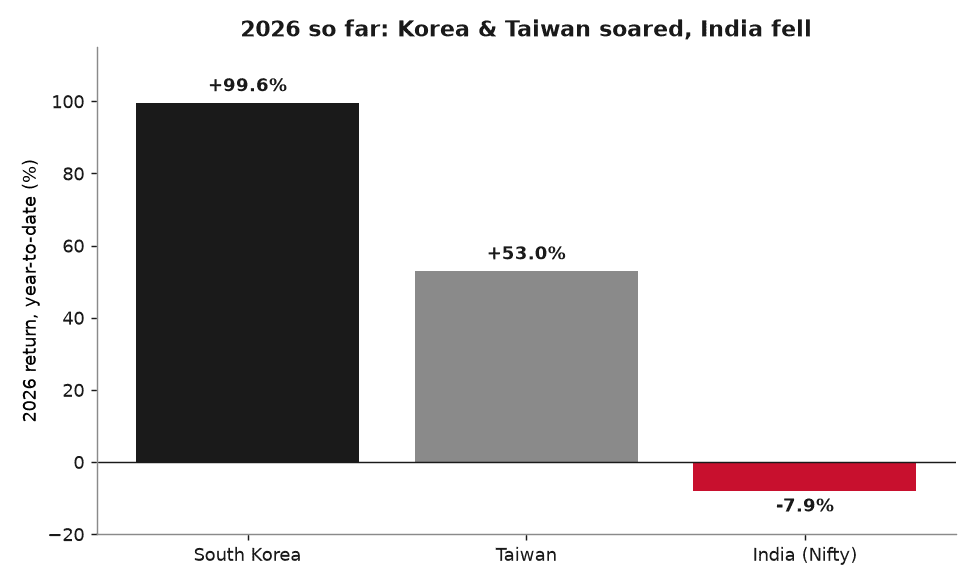
The first reason is how the markets did this year. South Korea’s market has gone up 99.6% since the start of 2026. Taiwan’s is up 53%. But India’s Nifty is down 7.9%. So Korea rose a lot. A market that rises too fast can “correct.” To correct means to fall back down after rising too much. India was already weak. So it has less room left to fall.
The second reason is the kind of companies in each market. Pankaj Pandey is head of research at ICICI Securities. He said the IT sector is only about 8% of India’s index. IT means information technology. These are software and tech-service firms. But in Korea, two chip companies are huge. So a chip sell-off in Korea does not match India well.
Arun Kejriwal is the founder of Kejriwal Research. He said, “Indian markets are most likely to remain rangebound. The Nifty is likely to move between 23,800 and 24,600.” “Rangebound” means the price stays inside a set band. It does not jump up or fall down sharply. He also said Indian IT stocks have already fallen a lot. So they should not fall much more.
Key facts at a glance
| Detail | What the report says |
|---|---|
| What happened | Kospi fell sharply Friday; 20-minute trading halt (2nd of the week) |
| Biggest drops | Samsung Electronics -6.12%, SK Hynix -8.40% |
| Korea 2026 gain | +99.6% year-to-date |
| Taiwan 2026 gain | +53% year-to-date |
| India Nifty 2026 | -7.9% year-to-date |
| IT in Indian index | Only about 8% |
| Expected Nifty range | 23,800 to 24,600 |
What could soften any fall
Pandey said Indian IT stocks could face some pressure. But strong banks could make up for it. He means banking, financial services, and insurance. Together these are called BFSI. In simple words, if tech shares dip, strong banks and lenders can hold the market up. He also said part of Korea’s drop may just be global investors moving their money around. This is called diversifying.
Vinit Bolinjkar works at Ventura Securities. He called the trouble a “market-specific event” for South Korea. He said Korea’s big rally had pushed valuations very high. Valuation means how costly a stock is compared with the company’s earnings. When prices rise far ahead of profits, a fall often comes next. He thinks Indian IT will bounce back fast. That is because India is still early in building AI infrastructure.
The bigger worry: AI getting too hot
Behind the Korean fall is a big question. Are AI stocks too hot? Chip and AI shares have risen a lot. Some people fear this rise may not last. Companies like Apple have raised their prices lately. So some investors ask if higher prices could hurt demand later. There are also worries about a delay in OpenAI’s IPO. An IPO is the first time a company sells its shares to the public.
Charu Chanana works at Saxo Markets. She told Bloomberg, “The memory trade still has legs, but the tailwind is selective while the headwind is much broader.” In simple words, memory chips can still do well, but only in some spots, while the risks are wider. There is more news too. Samsung and SK Hynix may announce huge new spending next week, worth hundreds of billions of dollars. This worried people about future cash flow. Cash flow is the money moving in and out of a company. Samsung Group alone is said to be planning a 1,000 trillion won spending plan over the next ten years.
Why it matters (especially for India and founders)
For Indian investors, the message is simple: stay calm. A crash in a foreign market makes big news. But what really matters is how much your own market is at risk. India has a small IT weight. And it has had a weak year. Both of these act like shock absorbers. The Nifty is expected to stay rangebound, not crash.
For founders and tech fans, the deeper signal is about AI valuations. When chip giants swing 8% in one day, it shows the market is nervous. People are not sure if AI spending will pay off. This same cost worry is pushing some firms to use cheaper tools. See how Coinbase moved to cheaper Chinese AI models. Also see how a tiny model is taking on the giants in our piece on Sina’s VibeThinker-3B.
FAQ
What is the Kospi?
The Kospi is South Korea’s main stock index. It tracks the country’s largest listed companies. Two chipmakers shape it the most: Samsung Electronics and SK Hynix.
Will the Kospi crash hurt Indian markets?
Experts say the effect on India should be small. India’s IT sector is just 8% of its index. And the Nifty did not have the big rally that Korea had. So it is less stretched.
How has India done versus Korea in 2026?
In 2026, South Korea is up 99.6% and Taiwan is up 53%. But India’s Nifty is down 7.9%. So India simply has less room to fall.
What is a trading halt?
A trading halt is an automatic pause in trading. It happens when prices move too fast. It gives investors time to calm down before trading starts again.
The takeaway
South Korea’s sharp fall is real. But experts see it as a Korea-only event. It was driven by two chip giants and a rally that grew too big. India is weaker this year. It also has fewer tech firms in its index. So it is expected to stay rangebound. The bigger story is not about one market. It is about whether the global AI boom can keep its very high prices going.
Source: Financial Express (June 26, 2026).