
📚 New to this topic? Read our full guide: Generative AI Explained.
Anthropic Survey: Half of Claude Users Say AI Already Does Half Their Work
AI means artificial intelligence. It is software that can read, write, and think in a way that feels human. Anthropic is a US company. It makes an AI helper called Claude. Anthropic ran a survey. A survey is when you ask many people the same questions and add up their answers. About half of the people said AI can already do half or more of their work. The survey asked about 9,700 Claude users. They use Claude through three products: Chat, Cowork, and Code. The question was simple: how much of your job can AI do today?
The website The Decoder shared the results. They show a clear pattern. Many workers already use AI for a big part of their tasks. And most of them think this part will grow fast.
What the numbers say
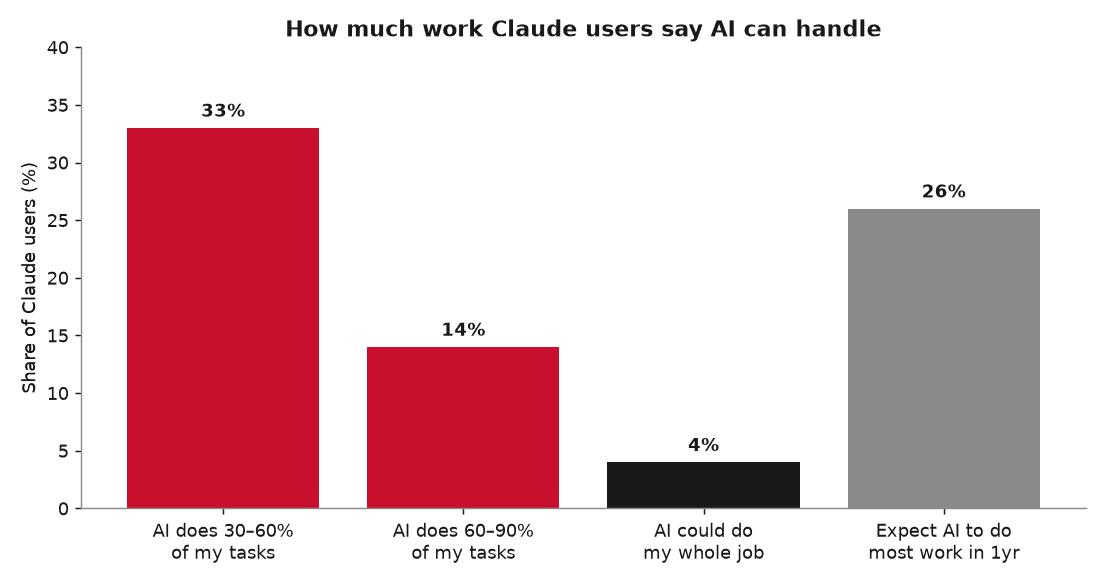
About 33% of users said AI can do 30% to 60% of their tasks. Another 14% said AI can do 60% to 90% of their tasks. About 4% said Claude could already do their whole job. Looking one year ahead, about 26% think AI will do most of their work. So the numbers are going up, not down.
But one thing is important. The survey asks about single tasks, like writing a piece of text. A real job is more than a list of separate tasks. The hard part is the “glue” that holds the tasks together. That glue is your judgment, knowing the full picture, and carrying what you learned from one task to the next. AI finds that glue hard to copy. So “half the tasks” does not always mean “half the job.”
Key facts at a glance
| Survey finding | Share of users |
|---|---|
| AI can do 30–60% of my tasks | 33% |
| AI can do 60–90% of my tasks | 14% |
| AI could already do my whole job | ~4% |
| Expect AI to do most of my work in 12 months | ~26% |
| Top use: database queries (Artifacts) | 82% |
| Top use: blog/article writing (Artifacts) | 81% |
| Top use: marketing content (Artifacts) | 80% |
| People surveyed | ~9,700 Claude users |
What people use AI for most
The top work uses in Anthropic’s data are database queries (82%), writing blogs or articles (81%), and making marketing content (80%). A database query is a request that pulls answers out of a big store of data. Marketing content is text or images that help sell a product. These numbers come from a Claude tool called “Artifacts.” With Artifacts, Claude makes a finished piece of work — like a document or a chart you can click and use — not just a chat reply. So people now use AI to make real work products, not just to ask questions.
Surprisingly similar views across the board
Anthropic says people agree a lot about how fast AI will get better. Their views are “strikingly consistent.” That means the answers are very alike across all groups. It does not matter how much experience they have, where they live, or what job they do. The study calls this a “rising tide” of AI skill that lifts many kinds of jobs. So this is not just a Silicon Valley idea. It shows up almost everywhere.
But how people feel about their careers depends on their stage. Early-career workers are new to their jobs. They see the most tasks that AI can do, and they worry the most. That makes sense. Junior tasks are often the easiest for a machine to take over. Still, the heaviest Claude users feel the most hopeful. They believe their skills are getting more valuable, not less, because they can do more with AI’s help.
Most people want to work with AI, not be replaced
The survey found that most people want to work next to AI, not be replaced by it. They want AI to take the boring, repeated work. And they want the benefits to be shared by many people, Anthropic says. That is a hopeful note in a debate that is often full of fear. People see AI as a helper for the dull parts. That frees them to do more important work.
Why it matters (especially for India and founders)
India has a huge number of young workers. It also has a giant IT and services industry — companies that build software and help other businesses. If AI can already do one-third to two-thirds of many tasks, the way teams work will change fast. For founders — the people who start companies — that is a chance. A small team can now do the work of a much bigger team, if they use AI well.
But it is also a warning for early-career workers, who feel the heat the most. The smart move is to learn to use AI well, not to fight against it. That matches what Indian founder Kunal Shah said about using your time to learn fast. You can read more in our piece on Kunal Shah’s lessons as the new WhatsApp CEO. There is a dark side too. As more work moves to AI, new kinds of cheating appear — like the AI-generated fake receipts now driving expense fraud.
FAQ
What did the Anthropic survey find?
About half of the roughly 9,700 Claude users said AI can already do half or more of their work. About 26% think AI will do most of their work within a year.
Does this mean AI will take half of all jobs?
Not really. The survey asks about single tasks, not whole jobs. Real work also needs judgment and the full picture, which AI handles less well. So half the tasks is not the same as half the job.
Who worries most about AI?
Early-career workers worry the most, because junior tasks are the easiest to automate — that is, to let a machine do them on its own. Heavy Claude users, on the other hand, feel the most hopeful about their future.
What do people use Claude for most at work?
Database queries (82%), writing blogs or articles (81%), and making marketing content (80%). They use Claude’s Artifacts tool, which makes finished pieces of work you can use.
The takeaway
Anthropic’s survey shows a clear mood. AI already does a real share of many people’s tasks. And most people think that share will grow. The fear is real for early-career workers. But the bigger lesson is to adapt. People who learn to work with AI see their skills become more valuable. For India’s young, AI-ready workers, that is both a challenge and a chance.
Source: The Decoder (June 27, 2026), citing an Anthropic survey of ~9,700 Claude users.