📚 New to this topic? Read our full guide: What Is Fintech?.
AI-Generated Fake Receipts Are Changing Expense Fraud — and India Leads in Submissions
People are using AI to make fake receipts. They use these fakes to cheat on their work expenses. AI, short for artificial intelligence, is software that can make pictures and text in seconds. A receipt is the little slip that proves you paid for something.
Here is how the cheating works. An expense claim is when a worker asks the company to pay them back for money they spent on work, like a taxi or a meal. To prove it, they show a receipt. Now AI can make a fake receipt in a few seconds. So a worker can ask to be paid back for something they never bought.
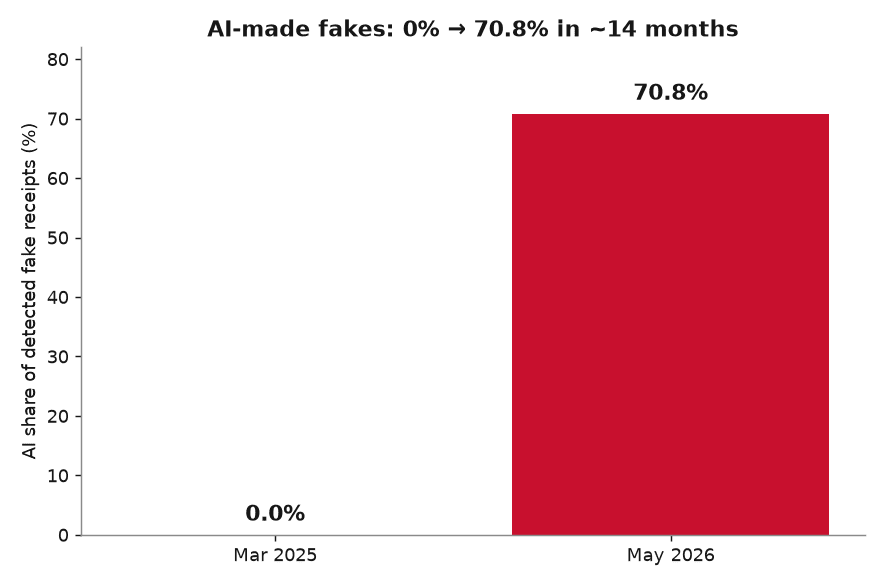
According to Forbes, the numbers are shocking. The data comes from a company called AppZen. AppZen uses software to check expense claims for big companies. It found that AI-made fakes went from 0% of all caught fakes up to 70.8%. That change happened between March 2025 and May 2026. In just over a year, fake AI receipts went from rare to most of the fakes.
How big is the shift?
In the 12 months up to May 15, 2026, AppZen caught 1,471 AI-made receipts. These came from 745 workers at 174 different companies. Together they asked for $148,143 to be paid back. (Paid back, or “reimbursed”, means the company gives the worker their money back.)
One important note: these are the fakes that got caught and flagged. They are not money the companies actually lost or paid out. The real number could be bigger, because some fakes were probably never caught.
A year before, most fake receipts were bought from websites. These sites sold “lost receipt” forms for five or ten dollars. By mid-May 2026, those old forms were only about 29% of fakes. AI image makers became the top tool instead. “The tools just got dramatically better,” said Kunal Verma. He is the chief technology officer of AppZen, which means he is the top tech boss there. “AI generators are free, instant, and good enough to fool a person.”
Key facts at a glance
| Detail | What the data shows |
|---|---|
| AI share of detected fakes | Rose from 0% to 70.8% (Mar 2025–May 2026) |
| AI receipts detected (12 months) | 1,471 receipts |
| People and companies | 745 employees across 174 companies |
| Claimed amount | $148,143 (flagged, not confirmed losses) |
| Average AI fake | $101 (median ~$32) |
| Older template fakes | Averaged ~$182 |
| Highest submissions by country | India (300 AI receipt lines, small amounts) |
Small amounts, sneaky strategy
The dollar amounts show the trick. AppZen says the average AI fake receipt was $101. The median was about $32. (The median is the middle value. So half of the fakes were below $32.) The older bought-form fakes averaged about $182. So the AI fakes were usually smaller.
Why keep them small? Many companies auto-approve claims under a set amount to save time. Auto-approve means the system says yes on its own, with no person checking it. By keeping fakes small, cheaters stay under that limit. So no human ever looks at them. The fraud is built to hide in the “too small to bother” zone.
Fraud is now decentralized
Old expense fraud was often a team effort. A few people would run a planned scheme together. Investigators could catch them by spotting the group. AI fraud is “decentralized.” That means many people are cheating alone, on their own. That is much harder to catch. About one-third of the workers who got caught had faked receipts more than once in the same 12 months.
One case really stands out. It happened at one Fortune 10 company. (Fortune 10 means one of the ten biggest US companies by money earned.) There, 142 workers in 22 countries sent in 340 AI receipts. They were worth $34,953 over a year. At that company, 41% of cheaters did it more than once. India had the most fakes sent in overall, with 300 AI receipt lines, but the amounts per receipt were fairly small. Australia had a bigger total in dollars. That was mostly because of one telecom worker who sent in 11.
Why the old defences fail
For years, checkers caught fakes just by looking. They looked for odd fonts or messy layouts. That trick no longer works. “The does it look real test is pretty much finished,” Verma said. AI fakes copy a real receipt perfectly. In one case, AppZen found a fake restaurant receipt that even had a fake scanner mark and a handwritten signature added to make it look more real.
There is one bit of hope. Some AI tools add hidden metadata to their images. Metadata is a hidden record of where an image came from and how it was made. Sometimes that record proved a receipt was made by AI. But metadata can disappear if the file is edited, squeezed smaller, or run through other software. So it cannot catch every fake.
Why it matters (especially for India and founders)
India had the most AI fake receipts in the data. So this is not a far-away Western problem. It is happening here. For Indian companies and founders, the old “just glance at the receipt” check is dead. Finance teams need new ways to stop it.
Experts suggest three simple steps. First, check each claim against other records, like card or bank statements. Second, lower or rethink the auto-approval limits, so small fakes get a second look. Third, use a few different checks instead of trusting just one. This is the dark side of the AI boom. As AI does more of our work — as shown in the Anthropic survey on AI handling half of users’ work — it also gives cheaters powerful new tools. Trust and money checks now need an upgrade. The pressure on honest money is real everywhere, as seen in how smaller lenders are struggling to raise funds.
FAQ
What are AI-generated fake receipts?
They are real-looking fake receipts made by AI image tools in seconds. People use them to claim money for things they never actually bought. They are now most of the fakes that get caught, says AppZen.
How common are they?
AppZen says AI fakes rose from 0% to 70.8% of caught fake receipts between March 2025 and May 2026. That was 1,471 receipts from 745 workers at 174 companies in one year.
Why are AI fakes so hard to catch?
They look perfectly real, so looking at them does not work. They are also kept small to slip under auto-approval limits. And the cheating is spread across many people acting alone.
How can companies fight back?
Check claims against bank or card records. Change the auto-approval limits so small claims still get checked. And use a few different checks, instead of trusting how the receipt looks.
The takeaway
AI has made fake receipts cheap, fast and convincing. It has turned expense fraud from rare and organised into common and scattered. India leads in fakes sent in. So Indian finance teams cannot trust a quick glance anymore. The fix is to use layered checks against real data — because the “does it look real” test is officially over.
Source: Forbes (June 28, 2026), citing AppZen data.