📚 New to this topic? Read our full guide: Types of Bank Accounts.
Smaller MFIs Seek Finance Ministry Help as Bank Funding Stays Tight
India’s small MFIs are running out of money. An MFI (a microfinance institution) is a lender that gives very tiny loans, often just a few thousand rupees. These loans go to poor people who cannot borrow from big banks.
Now these small lenders have asked the finance ministry for help. The finance ministry is the part of the government that looks after the country’s money. The lenders say banks are still scared to lend to them, even though the government has set up a safety net.
According to Financial Express, the government made a Rs 20,000 crore guarantee scheme. A guarantee scheme means the government promises to pay back most of the money if a borrower fails to repay. This is meant to make banks feel safe enough to lend. But so far, it has not helped the small MFIs much.
What the scheme promised
The scheme is named the Credit Guarantee Scheme for Microfinance Institutions (CGSMFI) 2.0. It started in March. Under it, a trust backed by the government pays part of the loss if loans to MFIs are not repaid.
The cover is up to 80% for small MFIs, 75% for medium ones, and 70% for large ones. So if a small MFI’s borrowers do not repay, the government pays 80% of the loss. The bank loses only the other 20%.
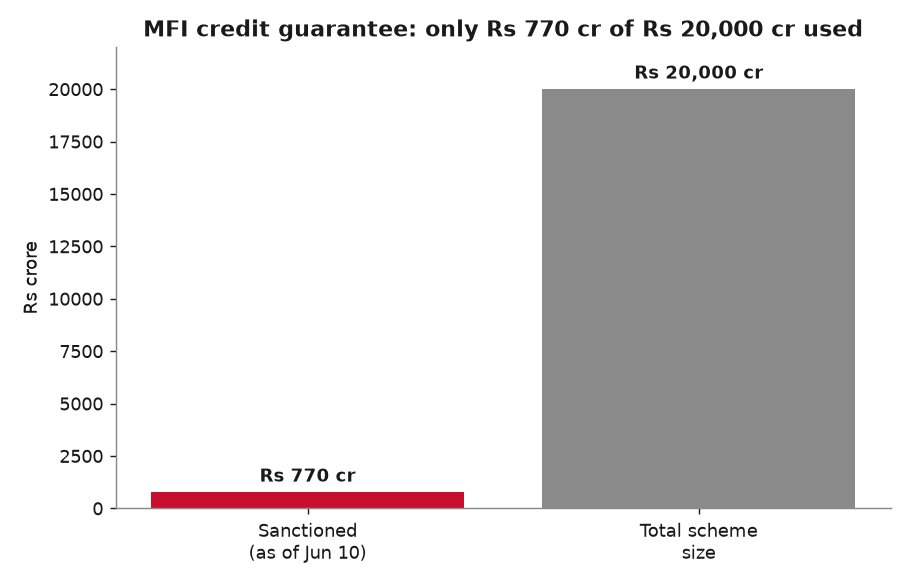
At first the scheme was set to end on June 30. Then it was pushed to August 31, or until Rs 20,000 crore of guarantees are given out. But here is the problem: only Rs 770 crore had actually been approved by June 10. That is a very small part of the Rs 20,000 crore on offer.
Why banks are still saying no
The main reason is the credit rating. A credit rating is a score that shows how likely a borrower is to pay the money back. A higher score means safer. Most banks lend only to MFIs with a good rating, usually BBB+ or higher.
In India, a rating of BBB- or higher is called “investment grade,” which simply means safe enough to lend to. Anything below that is seen as risky. So banks stay away from low-rated MFIs.
“Some banks remain hesitant to lend to smaller institutions, citing concerns over their creditworthiness,” a senior microfinance leader told Financial Express. Vivekanand Salimath, chairman of IDF Financial Services in Bengaluru, said the scheme is a good step. But he said small lenders have not really gained from it yet.
After a hard time, many small MFIs had their rating cut to a lower score. This makes banks even more worried. Salimath also pointed to a past scheme that worked better.
During the pandemic, that earlier scheme was called the Emergency Credit Line Guarantee Scheme, or ECLGS. It pushed banks to lend even to weaker, BB-rated firms. “This time, no such direction has been given,” he said.
Key facts at a glance
| Detail | What the report says |
|---|---|
| Scheme | Credit Guarantee Scheme for MFIs (CGSMFI) 2.0, launched March 2026 |
| Total size | Rs 20,000 crore in guarantees |
| Sanctioned so far | Only Rs 770 crore (as of June 10) |
| Guarantee cover | 80% small MFIs, 75% medium, 70% large |
| Deadline | Extended to August 31, 2026 |
| Main hurdle | Banks lend mostly to BBB+ and above rated MFIs |
| Sector loan book | Rs 3.25 lakh crore in Q4 FY26 (up 3%) |
A sector slowly healing
The microfinance world has had a tough time for a while. Many borrowers had taken too many loans at once. This is called overleveraging, which means owing more money than you can easily pay back.
Some states also made new rules to stop harsh ways of collecting loans back. All of this meant fewer loans were paid back on time. That hurt the lenders.
But there is a sign of recovery now. The sector’s total loans, called the gross loan portfolio (the full amount of money lent out), grew 3% to Rs 3.25 lakh crore in the fourth quarter of FY26. That is the January to March 2026 period. This ended seven quarters in a row of falling loans — a small but real turnaround.
What the industry wants next
K. Paul Thomas is the new chairman of an industry group called Sa-Dhan. He said helping smaller MFIs raise money will be one of his top jobs. “We will continue engaging with banks and policymakers to address this issue,” he said.
Sa-Dhan is also running a programme to help 21 small MFIs. The goal is to help them run better and follow better rules. This is so that banks see them as safer to lend to.
A finance ministry official has asked banks and MFIs for feedback. They want to know why the scheme is not reaching the small lenders. But experts warn there is a limit to what guarantees can do.
Sonam Chandwani of KS Legal & Associates said banks are now using “risk-based lending.” This means they lend mostly to safer borrowers. A guarantee can give them a small push, she said, but it cannot force them to fund firms with weak money or weak rules.
Why it matters (especially for India and founders)
Microfinance reaches people that big banks often skip. Think of small shopkeepers, farmers, and women running tiny businesses from home. When small MFIs cannot raise money, these people lose their loans too.
So a money problem at the top can quietly hurt millions of people at the bottom. That is why this matters so much.
For founders, there is a sharp lesson here. A government guarantee is not the same as real cash in your hand. Banks still check your rating, your books, and how well you run things.
The same money squeeze is seen all across India’s economy. You can even see it in big projects like the new PM MITRA textile parks that need steady private funding. And when markets get nervous, lenders grow even more careful — as our look at South Korea’s Kospi crash and its impact on Indian markets shows.
FAQ
What is an MFI?
An MFI, or microfinance institution, is a lender that gives very small loans. These loans go to poor and low-income people who usually cannot borrow from big banks.
Why are smaller MFIs short of money?
Banks mostly lend to MFIs with a good credit rating (BBB+ and above). After a tough time, many small MFIs had their rating cut. So banks stay careful, even with the government guarantee.
How much of the scheme has been used?
Only Rs 770 crore had been approved by June 10. That is out of a total Rs 20,000 crore in guarantees on offer.
Is microfinance recovering?
There are early signs. The sector’s loan book grew 3% to Rs 3.25 lakh crore in Q4 FY26. This ended seven quarters in a row of falling loans.
The takeaway
A Rs 20,000 crore safety net sounds big. But only Rs 770 crore has reached borrowers so far. The gap shows that guarantees alone cannot make banks lend when ratings are low and trust is weak.
Smaller MFIs want the finance ministry to push banks harder, the way it did during the pandemic. Whether that happens will decide if loans reach the small borrowers who need them most.
Source: Financial Express (June 28, 2026).