📚 New to this topic? Read our full guide: Biggest Companies in India.
DCM Shriram’s Jhagadia Plant Joins WEF’s Elite Global Lighthouse Network
An Indian factory has won a rare global award. The DCM Shriram Jhagadia plant in Gujarat has joined the World Economic Forum’s Global Lighthouse Network (GLN). The World Economic Forum, or WEF, is a famous world group that studies business and the economy. The Global Lighthouse Network is its list of factories that lead the world in using new technology. Think of it as a hall of fame for smart, modern factories.
This news comes from Financial Express. The Jhagadia plant is one of only 16 factories in the whole world added in 2026 with a special “Distinction in Productivity.” Productivity means getting more useful work done with the same time, money and resources. The plant sits in Bharuch district, Gujarat. It is India’s biggest maker of caustic soda. Caustic soda is a simple chemical used to make soap, paper, cloth and more.
What the recognition means
The plant now joins a small club of 238 factories around the world. The WEF picks these factories for using “Fourth Industrial Revolution” technology well. That phrase means modern tools used in factories, like AI, data analytics and automation. AI is software that can learn and make choices. Data analytics means studying data to find useful patterns. Automation means machines doing tasks with little help from people.
The “Distinction in Productivity” is an even higher honour. It goes to factories that make big gains in cost and quality through technology. They must also use their machines and people better. Only 16 factories in the world earned it in 2026. That makes the Jhagadia win a big deal for India.
The numbers behind the win
Making caustic soda needs a lot of electricity. So power is a big part of the cost. To cut that cost, the plant added 45 advanced digital and analytics tools. These include AI-based process controls and a “GenAI-powered maintenance manager.” GenAI, or generative AI, is software that can create content and suggestions. Here it helps plan and predict machine repairs before things break.
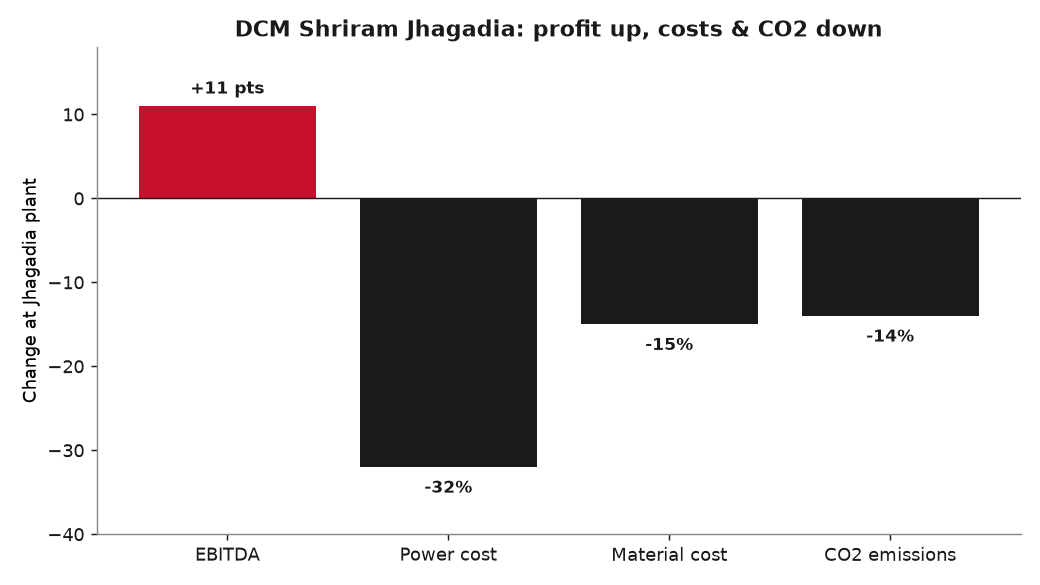
The results were strong. The company says the programme raised its EBITDA by 11 percentage points. EBITDA is a way to measure a business’s main profit. It is the money a business earns from its core work, before counting interest, taxes and the wear-and-tear of equipment. The plant also cut power costs by 32%. It cut material costs by 15%. And it cut carbon dioxide emissions by 14%. So the plant became both more profitable and cleaner at the same time.
Key facts at a glance
| Detail | What the report says |
|---|---|
| Plant | DCM Shriram Chemicals, Jhagadia (Bharuch, Gujarat) |
| What it makes | Caustic soda (India’s largest such site) |
| Honour | WEF Global Lighthouse Network, Distinction in Productivity 2026 |
| Exclusivity | 1 of only 16 sites worldwide with the distinction |
| EBITDA gain | +11 percentage points |
| Power cost | Down 32% |
| Material cost | Down 15% |
| CO2 emissions | Down 14% |
How they did it: Project BLESSED
The big change came from a programme called Project BLESSED. It started in July 2024. The name stands for “Becoming a Lighthouse through Exemplary Safety Systems & Excellence in Digitalization.” Digitalization just means moving from manual, paper-based work to digital, data-driven work. The project pushed faster use of digital tools. It also built stronger safety systems. And it used data to make better choices.
The company’s top leaders were proud. “This recognition from the World Economic Forum reflects DCM Shriram’s long-standing commitment to building world-class manufacturing businesses driven by technology, innovation and operational excellence,” said Ajay S. Shriram, Chairman and Senior Managing Director, and Vikram S. Shriram, Vice Chairman and Managing Director, in a joint statement. They said that smart digital spending, plus hard work by staff, can sharply boost productivity. It can also boost competitiveness and sustainability.
Why it matters (especially for India and founders)
This is a proud, real example of “Make in India” done with top technology. An Indian chemical plant beat thousands of factories around the world to win a top global award. It proves Indian factories can lead, not just follow.
For founders and factory owners, the lesson is clear. Digital tools are not just hype. Here they cut power costs by almost a third. They also lifted profits and cut pollution. That mix of profit and clean work is what investors and global buyers want more and more. It also helps India’s bigger factory push. That is the same goal behind the new PM MITRA textile parks at Lucknow and Vansi. And it shows how AI is creating real value. This echoes the same trend in our story on Kunal Shah’s move to lead WhatsApp, as Indian talent rises around the world.
FAQ
What is the WEF Global Lighthouse Network?
It is the World Economic Forum’s list of the best factories. These factories use new technology like AI, data analytics and automation to work better and cleaner. The list now has 238 factories around the world.
What did DCM Shriram’s Jhagadia plant achieve?
It used 45 digital and AI tools. It raised EBITDA by 11 percentage points. It cut power costs 32%, material costs 15% and CO2 emissions 14%. For this, it earned a Distinction in Productivity.
What is caustic soda?
Caustic soda is a basic factory chemical. It is used to make soap, paper, cloth, aluminium and many other products. Making it needs a lot of electricity.
What was Project BLESSED?
It was DCM Shriram’s change programme. It started in July 2024. Its goal was to speed up digital tools, make safety stronger, and use data for better choices at the Jhagadia plant.
The takeaway
DCM Shriram’s Jhagadia plant shows what smart, digital factories can do. They can have lower costs, higher profits and cleaner work, all at once. The plant won one of only 16 global “Distinction in Productivity” honours. That puts an Indian factory among the best in the world. It is a clear sign that India’s factory future can be both high-tech and clean.
Source: Financial Express (June 26, 2026).