📚 New to this topic? Read our full guide: Biggest Companies in India.
ICRA Triples India’s FY27 Airline Industry Loss Estimate to Rs 38,000 Crore
India’s airlines are about to have a much harder year. Together, they may lose around Rs 36,000 to 38,000 crore in FY27. That is almost three times the earlier guess. This new number comes from ICRA. ICRA is a rating agency, which means it is a company that checks how risky a business or an industry is for the banks and people who lend it money. ICRA shared this number in its newest report about flying, dated 26 June 2026. The news was reported by the Financial Express.
First, two words to know. FY27 means the financial year 2026-27. In India, this year runs from April 2026 to March 2027. Crore is an Indian way to count 10 million. So Rs 38,000 crore is the same as Rs 380 billion, or about 4.5 billion US dollars today. That is a huge amount of money to lose in just one year.
What ICRA actually changed
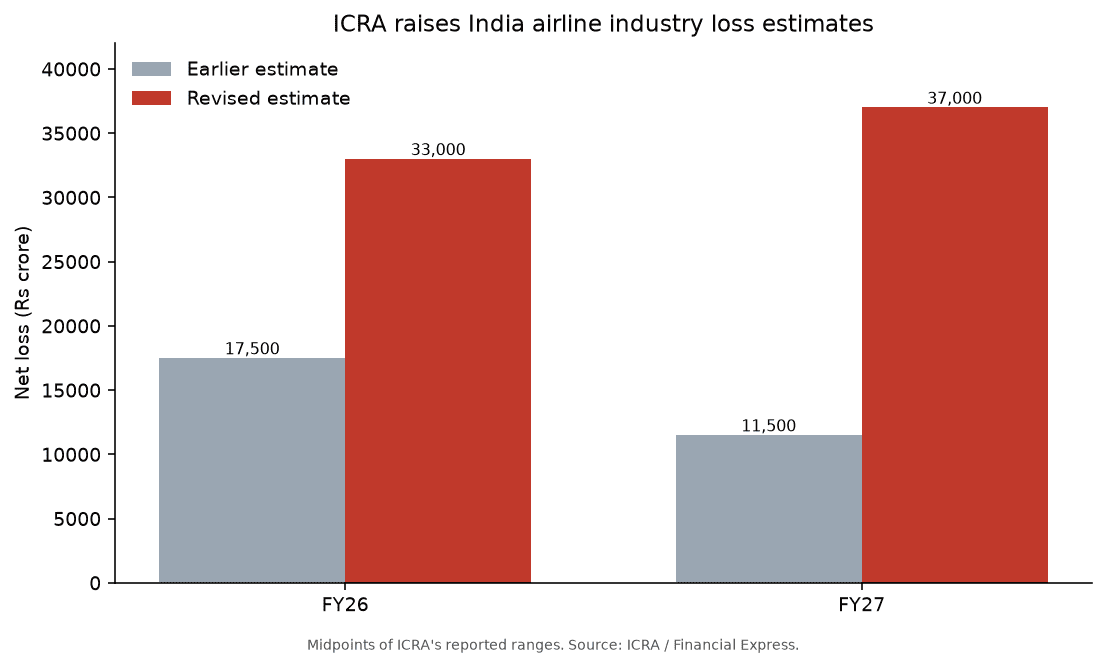
ICRA did not make a small change. It raised its guess by a lot. It now thinks airlines will lose Rs 36,000-38,000 crore in FY27. Before, it had guessed only Rs 11,000-12,000 crore. This loss is called a net loss. A net loss is the money left over as a loss after a business pays all its bills.
ICRA also said this year looks worse too. It raised its FY26 loss guess to Rs 32,000-34,000 crore. Before, it was Rs 17,000-18,000 crore. So both this year and next year are now expected to hurt much more than ICRA first thought.
Key facts at a glance
| Item | Figure |
|---|---|
| FY27 loss estimate (new) | Rs 36,000-38,000 crore |
| FY27 loss estimate (earlier) | Rs 11,000-12,000 crore |
| FY26 loss estimate (new) | Rs 32,000-34,000 crore |
| FY26 loss estimate (earlier) | Rs 17,000-18,000 crore |
| FY27 domestic traffic growth (cut to) | 3-6% (from 6-8%) |
| FY27 international traffic growth (cut to) | 0-3% (from 8-10%) |
| May 2026 domestic passengers | 15.64 million (+11.3% YoY) |
| May 2026 passenger load factor | about 88.8% |
| Grounded aircraft (March 2026) | about 99 planes (11-13% of fleet) |
Why the losses are rising
Many costs are going up at the same time. The first one is fuel. Planes run on a special fuel called aviation turbine fuel, or ATF. In June, the price of this fuel for local flights stayed the same as in April and May. But it was still 26.9% higher than one year ago. For flights to other countries, the fuel was about 45% higher than a year ago. Fuel is a big deal. It makes up 30-40% of what it costs to run an airline. So even a small price rise hurts a lot.
The second cost is the value of money. Airlines pay a big part of their bills in US dollars, about 35-50% of all their spending. This includes fuel, plane rent and repairs. Plane rent here means lease rentals, which is the rent airlines pay to use planes they do not own. When the Indian rupee becomes weaker against the dollar, these bills cost more rupees.
The third cost is war. ICRA pointed to the West Asia conflict, which grew worse from late February. This pushed fuel prices up, forced some flights to be cancelled, and closed some airspace. Closed airspace means planes must fly longer routes, which costs more. Airlines cannot pass all of these extra costs on to flyers through higher ticket prices.
Grounded planes and supply problems
India’s airlines also cannot fly every plane they own. Some planes are stuck on the ground. This is because of supply problems and faults in Pratt & Whitney engines. As of March 2026, about 99 planes were grounded. That is 11-13% of all the planes in the industry.
There is some good news here. This is better than before. Back in September 2023, 20-22% of planes were grounded. Still, a parked plane earns no money, but its costs keep going. So this adds to the pain.
Which airlines feel it
ICRA’s report looks at the whole industry. It does not name one winner or one loser. But two big groups rule India’s skies. The first is IndiGo, which is by far the biggest airline in the country. The second is the Air India group, which includes Air India and Air India Express. Engine grounding problems have hurt IndiGo’s plans in the past. The Air India group is busy fixing itself, which costs a lot of money. Both groups face the same fuel, money and plane rent problems that ICRA talks about.
ICRA also pointed out the help the government is giving. This includes a 25% cut in landing and parking fees. It also includes a Rs 5,000-crore emergency loan line, which the airline SpiceJet has partly used. There is also a new, approved Rs 10,000-crore ATF Price Stabilisation Fund. This fund is meant to smooth out big jumps in fuel prices.
Demand is strong, but it may cool
Here is the strange part. People are still flying a lot. In May 2026, the number of local passengers went up 11.3% to 15.64 million. The passenger load factor stayed high at about 88.8%. The load factor simply means how full the planes are. So 88.8% full is healthy demand.
But ICRA still lowered its growth guesses. It now thinks local flying will grow just 3-6% in FY27, down from 6-8%. It thinks flying to other countries by Indian airlines will grow only 0-3%, down from 8-10%. The reason is price. Higher fares, closed airspace and cancelled flights may make some people wait or skip trips they do not really need. ICRA still has a negative outlook on the sector. A negative outlook means it expects things to stay hard.
Why it matters (especially for India and founders)
Flying is about more than just tickets. Planes carry business people, tourists and costly goods. When airlines lose money, the trouble spreads. Fares can stay high. Some routes can be cut. Weaker airlines can get into deep trouble. All of this gives people fewer choices.
For founders and small business owners, this is a warning to plan ahead. (A founder is a person who starts a company.) You may need extra money in your travel budget for FY27. Costs linked to the dollar, fuel and global war can rise fast, even while your own customers keep buying. Strong sales do not always mean big profit. ICRA’s airline numbers show this gap clearly.
FAQ
What is ICRA?
ICRA is an Indian rating agency. It studies companies and industries. It grades how risky they are for the banks and people who lend them money. Many people watch its reports closely.
Why is the FY27 loss estimate so much bigger now?
Costs went up more than ICRA first expected. Higher fuel prices, a weaker rupee, costlier plane rent and the West Asia war all played a part. Together they pushed the FY27 loss guess from Rs 11,000-12,000 crore to Rs 36,000-38,000 crore.
If demand is strong, why are airlines losing money?
Planes are full, but each flight now costs more to run. Fuel and dollar bills went up faster than ticket prices. So airlines earn good money, but the high costs eat up the gains and turn into losses.
The takeaway
India’s skies are busy, but its airlines are under heavy money strain. ICRA’s big jump in the FY27 loss guess to about Rs 38,000 crore shows the problem. Fuel, the value of money and war can beat even strong demand from flyers. Government help may ease some of the pain. But ICRA’s negative outlook tells us the recovery will be slow and bumpy.
Source: Financial Express.