📚 New to this topic? Read our full guide: Indian Economy Explained.
India Set to Become World’s No. 2 Solar Market as Capacity Crosses 150 GW
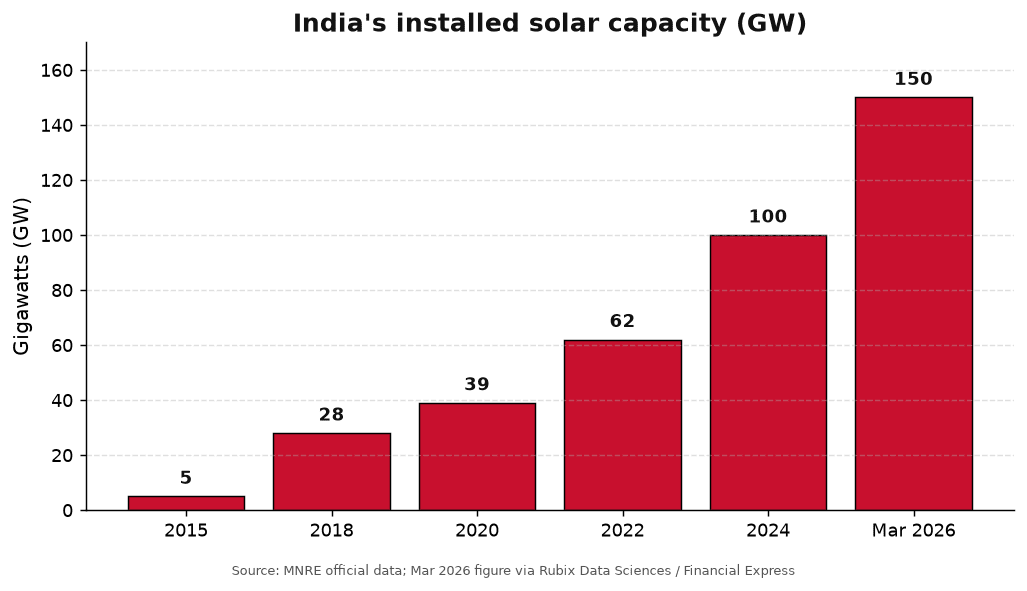
India’s solar power story just hit a big milestone. The country has now built 150 GW of solar power in total. Solar power means electricity made from sunlight using flat panels.
This 150 GW number is big news. It means India is set to become the world’s second-largest solar market in 2026. Only China will be ahead.
So what is a GW? GW means gigawatt, which is just a way to measure power. One gigawatt equals 1,000 megawatts, or about one billion watts. In simple words, 150 GW is enough clean power to light up tens of millions of homes when the sun shines.
These numbers come from Rubix Data Sciences. That is a company that studies data and technology. The news was reported by the Financial Express.
India crossed 150 GW of “cumulative installed solar capacity” in March 2026. That long phrase just means the total amount of solar power that has been built and switched on, added up over all the years.
From 9th place to the world’s No. 2
India’s rise has been very fast. In 2015, India was ninth in the world for total solar power. By 2025, it had climbed to third place.
Now, in 2026, India is set to take the No. 2 spot. Only China is ahead of it.
This makes India one of the fastest-growing solar markets in the world. And the growth is meant to keep going. Rubix thinks India’s solar power will reach nearly 280–300 GW by 2030.
Key facts at a glance
| Indicator | Figure |
|---|---|
| Installed solar capacity (March 2026) | 150 GW |
| Global rank in 2015 | 9th |
| Global rank in 2025 | 3rd |
| Expected rank in 2026 | 2nd (after China) |
| Projected capacity by 2030 | 280–300 GW |
| National non-fossil capacity target | 500 GW |
| Module manufacturing capacity (2025) | ~210 GW |
| Domestic annual demand | 40–45 GW |
| Solar FDI in 2025 | ~$2.37 billion |
What is driving the growth?
A few things are pushing India’s solar boom. First, the government wants 500 GW of “non-fossil fuel” power. Non-fossil fuel means power that does not come from coal, oil or gas. Instead it comes from sources like solar, wind, water and nuclear.
The 150 GW of solar is a big part of that goal.
Demand at home is also rising. More homes, farms and factories want cheaper, cleaner power. Big companies are spending billions of rupees to build solar factories.
Rubix names some of the major players. They include Adani Group, Tata Power Renewable Energy, Waaree Energies, Jakson Group and Solex Energy. These firms are investing across the whole supply chain.
Money is also coming in from other countries. This is called foreign direct investment, or FDI. FDI is money that foreign companies put into Indian businesses.
In 2025, FDI in solar was nearly $2.37 billion. That was more than 4% of all the FDI coming into India. It was also about 76% of all the FDI going into clean energy.
Made in India: cutting reliance on China
India still depends on China for one key part. A solar panel is built from PV cells. PV cells, or photovoltaic cells, are the small parts that turn sunlight into electricity.
India buys many of these cells from other countries. China’s share of those imports was 65% in FY26. (FY26 means the financial year 2025–26.) That is down from 83% the year before, but it is still high.
To fix this, the government is using a rule called ALMM. ALMM stands for the Approved List of Models and Manufacturers. It is simply an official list of approved solar makers and products.
From June 2026, government-backed projects must use only solar cells from this list. This pushes companies to make cells in India instead of buying them from China. Another list, for ingots and wafers, starts from June 2028. Ingots and wafers are the raw building blocks used to make cells.
A US tariff problem and a supply glut
It is not all smooth, though. The United States is India’s biggest export market for solar modules. It buys about 97% of them.
But the US has now put heavy taxes on Indian solar. A “tariff” is a tax on goods coming in from another country. The US added a 123% anti-dumping duty plus a 125% countervailing duty. Together, these taxes add up to more than 200%. So Indian panels become much more costly for US buyers.
Because of this, India’s solar exports dropped. They fell from a high of $1.97 billion in FY24 to $1.12 billion in FY25. Rubix says Indian makers will need to find new buyers in other countries, not just the US.
There is also a “supply glut” at home. A supply glut means there is far more being made than people need. India’s factories can now make around 210 GW of modules a year. But demand at home is only 40–45 GW.
That is nearly four times more supply than needed. So factories are not running at full speed. Factory use has dropped to about 40%, down from over 70% in FY23. Rubix expects weaker, smaller firms to merge or shut down, while large, well-organised companies survive.
Why it matters (especially for India and founders)
Cheap, clean solar power is good news for almost everyone. More solar can help keep electricity bills steady over time. That is because sunlight is free, and panel prices keep falling.
Solar also cuts pollution. And it means India needs to buy less costly coal and oil from abroad.
For founders and business owners, this is a fast-growing field. (A “founder” is a person who starts a company.) Building, installing and looking after solar creates many jobs, from factory floors to rooftops.
New startups can find work too. They can clean panels, store power, lend money, or build software that manages solar. This fits India’s bigger clean-energy push, much like the boom in India’s electric vehicle market, where clean tech is creating fresh business chances.
It is also a story of Indian companies growing bigger. This is true even as some other sectors struggle, such as India’s airline industry, whose FY27 loss forecast was sharply raised. In fast-changing markets, the bigger and stronger players tend to lead.
FAQ
What does 150 GW of solar capacity mean?
It means India has built and switched on 150 gigawatts of solar power in total. A gigawatt is one billion watts. In plain words, 150 GW is enough to power tens of millions of homes when the sun is shining.
Why is India set to become the No. 2 solar market?
India’s solar power has grown very fast. It went from 9th place in the world in 2015 to 3rd in 2025. With capacity crossing 150 GW in 2026, India is now expected to rank second, behind only China.
What is India’s solar target for 2030?
Rubix expects India’s solar power to reach nearly 280–300 GW by 2030. This helps the national goal of 500 GW of non-fossil fuel (clean) energy.
The takeaway
India crossing 150 GW of solar is a big step on the road to clean power. It brings cheaper energy, new jobs, and a push to make more of the parts at home.
There are still real problems, like US taxes and too many factories. But demand is rising, big money is coming in, and government rules are helpful. So India’s climb to the world’s No. 2 solar market looks set to continue.
Source: Financial Express.