📚 New to this topic? Read our full guide: Startup Funding Explained.
Ola Electric Sales Rise on EV Boom, But the Turnaround Is Far From Over
Ola Electric is selling more scooters again. For months, its sales kept falling. Now they are going up. Ola Electric is India’s biggest maker of electric scooters. An EV (an electric vehicle, which runs on a battery instead of petrol) boom is helping it. A boom means lots of people are buying these vehicles right now. But a turnaround (when a sick, money-losing company gets healthy again) takes more than one good stretch. Ola Electric still has a long way to go. This is based on a Financial Express report.
What is happening with Ola Electric sales?
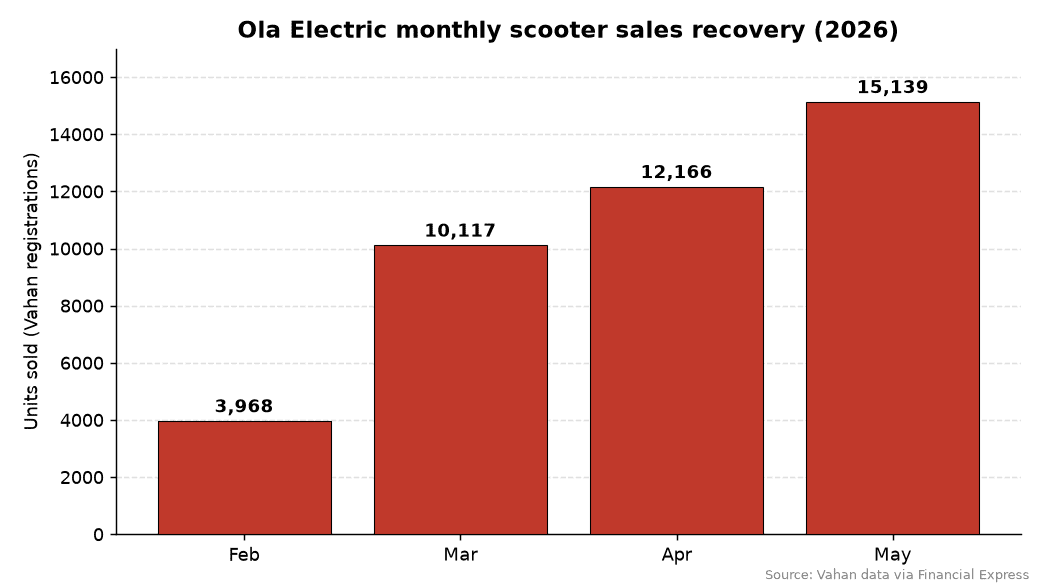
For a long time, Ola Electric sold fewer scooters every month. Sales dropped to just 3,968 units in February 2026. (A unit means one scooter.) That was very low. Ola Electric once led the whole market, so this was a bad sign.
Then the numbers started going up again. Sales rose to 10,117 units in March. They reached 12,166 in April and 15,139 in May. The company told its investors to expect 40,000 to 45,000 units in the June quarter. (A quarter is a three-month period. Investors are people who put money into the company.) Vahan data is the government’s record of vehicles people have signed up to own. It shows Ola had already sold 40,540 scooters in that quarter. So the company is on track to hit its goal, or even beat it.
The EV boom is lifting the whole market
This comeback is not just about Ola Electric. The whole market for electric two-wheelers in India is growing fast. (A two-wheeler is a scooter or bike.) In May, the number of new electric two-wheelers signed up jumped 63% from a year earlier. That came to 170,733 units. It was the second-highest monthly number ever. This comes from a group called FADA. FADA stands for the Federation of Automobile Dealers Associations. It speaks for the shops that sell vehicles.
EV penetration also went up. EV penetration means how many of the two-wheelers sold are electric, out of every 100. It rose to 9.3%, up from 6.1% a year ago. One big reason is petrol prices. The head of FADA, C S Vigneshwar, said fuel costs went up because of fighting in West Asia. That made buyers think harder about how much petrol costs to run a vehicle. Many people switched to electric to save money over time.
Key facts at a glance
| Measure | Figure |
|---|---|
| FY26 revenue (actual) | Rs 2,253 crore (vs Rs 3,000–3,200 cr guided) |
| FY26 scooters sold | under 174,000 (vs 325,000–375,000 guided) |
| June-quarter sales so far | 40,540 units (target 40,000–45,000) |
| Same quarter last year | over 68,000 units |
| Market share now | around 8% (once nearly 50%) |
| FY27 revenue forecast | Rs 27.7 billion, up 23% (Visible Alpha) |
A few words from the table: revenue is the total money a company brings in from sales. Guided means the number the company promised it would reach. Market share is the slice of all sales that one company gets, out of 100. FY26 and FY27 are money years used by businesses. A forecast is a careful guess about the future. Visible Alpha is a research firm that studies companies.
Why the turnaround is far from over
The good news comes with a big warning. Ola Electric missed its own FY26 goals by a lot. It had promised revenue of Rs 3,000–3,200 crore. But it made only Rs 2,253 crore. It had promised to sell 325,000–375,000 scooters. It sold under 174,000.
Even if Ola hits its June-quarter goal, that is still far below last year. In the same quarter a year ago, it sold more than 68,000 scooters. So sales are going up, but the company is still much smaller than before.
Service problems and brand trust
Ola Electric’s biggest weak spot has been after-sales service. (That means the help and repairs you get after you buy a scooter.) The founder, Bhavish Aggarwal, admitted there was a service backlog. (A backlog is a big pile of work that is not done yet.) He said this hurt customer trust and pulled sales down. “We do have a service challenge, which we are working through,” he said on an earnings call. (An earnings call is a phone meeting where a company tells investors how it is doing.)
The company started a plan called “Hyper Service” to fix this. Aggarwal said repairs now take much less time, down 88%. About 87% of repairs are now done the same day. Parts shortages dropped 69%. (A parts shortage is when there are not enough spare pieces to fix scooters.) But the problem is not gone. A consumer court in Andhra Pradesh recently told Ola Electric to repair a scooter for free and pay Rs 45,000 to the owner for poor service. (A consumer court helps buyers who were treated unfairly.)
The competition is closing in
Ola Electric once had almost half of India’s electric two-wheeler market. Today its share is only around 8%. Other companies grew stronger while Ola struggled. TVS Motor, Bajaj Auto, Ather Energy and Hero MotoCorp have all taken more of the market.
This is the hard part of the turnaround. Selling more scooters is one thing. Winning back market share from strong rivals is much harder. Analysts at Visible Alpha expect Ola to grow its revenue again in FY27. (An analyst is an expert who studies companies and makes guesses about them.) They expect sales to go up about 7%, to 185,622 units. That would be progress, but only a small step.
Why it matters (especially for India and founders)
Ola Electric’s story is a lesson for founders. (A founder is the person who starts a company.) Big dreams get attention. But doing the work well is what wins in the end. Aggarwal often set goals that were bigger than what the company could really do. The gap between his promise and the real result hurt the brand. It also hurt the share price. (The share price is the cost of one small piece of the company that people can buy.)
For India, the bigger story is the EV boom itself. The move to electric two-wheelers is real and growing fast. That helps the whole industry move to cleaner transport. It also leaves room for many companies to win, not just one. Investors will watch to see if Ola can turn a growing market into lasting gains in market share and, one day, profit. (Profit is the money left over after a company pays all its costs.)
For more on India’s clean-energy growth, see how India became the world’s second-largest solar market. And for another industry under money pressure, read about India’s airline industry losses.
Frequently asked questions
What does “turnaround” mean for Ola Electric?
A turnaround means bringing a struggling company back to health. For Ola Electric, that means selling more again, fixing service, winning back market share, and finally making a profit. So far, only sales have gotten better.
How much market share has Ola Electric lost?
Ola Electric once had close to 50% of India’s electric two-wheeler market. That has now dropped to around 8%. Rivals like TVS, Bajaj, Ather and Hero MotoCorp took the rest.
Is Ola Electric profitable yet?
No. The company is still trying to make a profit. FY26 revenue was Rs 2,253 crore, below what it had promised. Experts expect its revenue to grow again only in FY27.
The takeaway
Ola Electric’s recent rise in sales is a good first step. But it is not the finish line. A helpful EV boom and better work have stopped the fall. Keeping it going depends on service, trust and market share. For a founder whose dreams often ran ahead of results, the next few months will show if things have really changed.
Source: Financial Express.