
📚 New to this topic? Read our full guide: Stock Market Basics for Beginners.
India’s PMS Client Base Falls for a Third Month as Market Volatility Bites
Fewer rich people in India are using PMS right now. PMS means Portfolio Management Services. It is a service where an expert looks after your money for you. That expert buys and sells shares and bonds on your behalf. Shares are small pieces of a company. Bonds are loans you give a company or the government, which pay you back with interest. To join PMS, you usually need to put in at least Rs 50 lakh. That is a lot of money, so it is mostly for very rich people.
In May 2026, the number of these rich clients fell again. This was the third month in a row that it fell. Why? The stock market has been jumpy. So careful investors are waiting and not putting in new money yet.
These numbers come from APMI. APMI is short for the Association of Portfolio Managers in India. It is the group that keeps track of all PMS companies. Its numbers show clients leaving or pausing for three months in a row. This report was shared by the Financial Express.
What the numbers actually show
PMS lost 310 clients in May. On its own, that sounds small. But it came after two much bigger drops. PMS lost 1,038 clients in March. Then it lost 3,738 clients in April. Add all of this up. The total number of clients fell from about 217,000 to about 212,000.
Now here is the surprising part. Even though people left, the money already invested grew a little. This money is called AUM. AUM means assets under management. It is the total pool of money that the managers are looking after. In the discretionary part of PMS, AUM went up from Rs 35.45 lakh crore to Rs 36.06 lakh crore. Discretionary means the manager can buy and sell freely. The manager does not have to ask the client each time.
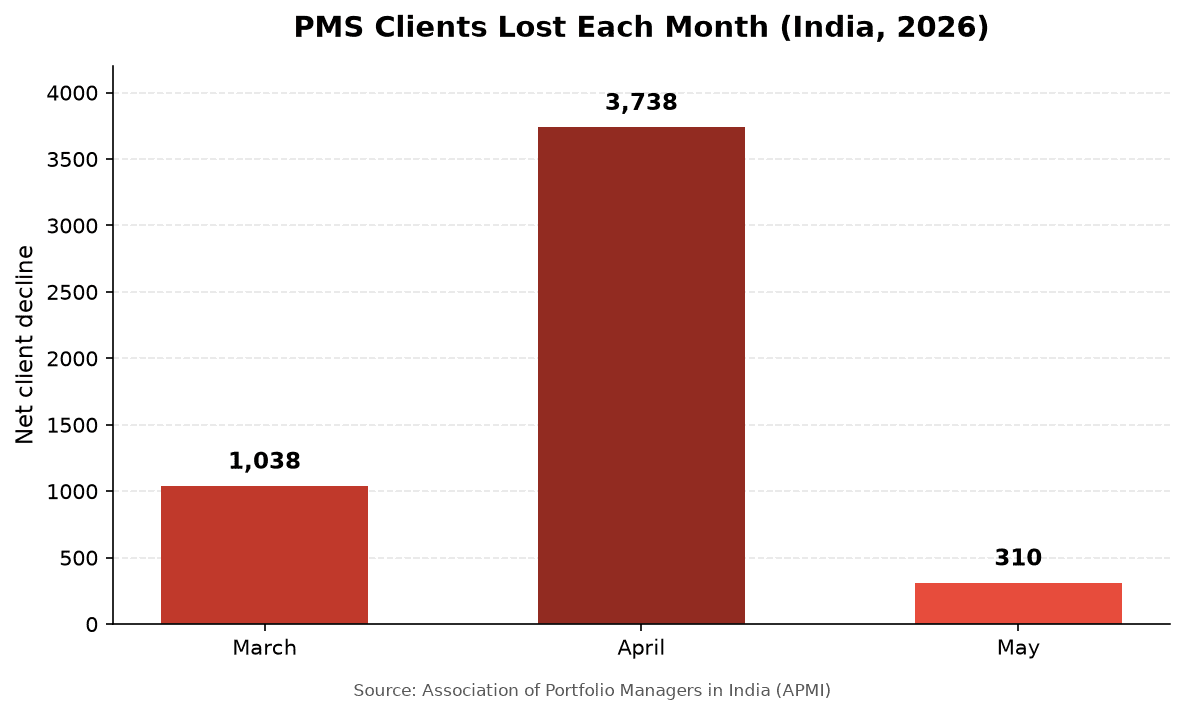
Key facts at a glance
| Item | Figure |
|---|---|
| Clients lost in March 2026 | 1,038 |
| Clients lost in April 2026 | 3,738 |
| Clients lost in May 2026 | 310 |
| Total client base | ~217,000 down to ~212,000 |
| Discretionary PMS AUM | Rs 35.45 lakh cr to Rs 36.06 lakh cr |
| Drop in net inflows (May) | Down 91% |
| Source | APMI |
Why are clients leaving or pausing?
The main reason is market volatility. Volatility means prices go up and down fast and hard to guess. When prices swing this much, rich investors get worried. So many of them booked their profits. Booking profit means selling shares that have gone up. You do this to turn your gains into cash and keep them safe.
The drop was worst in the discretionary part. Net inflows there fell by a huge 91% in May. Net inflow is the new money coming in, minus the money taken out. Sandeep Jethwani is a co-founder of a firm called Dezerv. He said three things caused this: people booking profits, people putting in less new money during the uncertain times, and money still leaving.
There is one more reason. Rajkumar Singal is the MD and CEO of Quest Investment Advisors. He said some HNIs chased other gains instead. HNI means high-net-worth individual. That is a person with a lot of money to invest. Many of them moved their money into commodity ETFs. An ETF is a basket of many assets that you can buy and sell like one single share. A commodity is a raw material like gold or oil. These investors jumped in to make money from rising prices of things like gold.
Singal pointed out one more difference. “Unlike mutual funds, PMS does not have the concept of regular monthly investments such as SIPs, making inflows more volatile,” he said. A mutual fund is a pool where many people put money together to invest. A SIP is a Systematic Investment Plan. With a SIP, a fixed amount is invested every month on its own, like a regular habit. PMS has no SIP. So without that steady monthly drip, PMS money moves in and out faster when investors get scared.
Is this a warning sign?
Not really, the experts say. Vikas Khemani is a board member at APMI. He called this a phase of consolidation, not weaker demand. Consolidation means a healthy pause where things settle down. It does not mean people have lost interest.
“During periods of uncertainty, investors typically take longer to commit fresh capital, particularly in discretionary investment products, preferring to assess market conditions before making any allocation decisions,” Khemani said. In simple words: when things look shaky, rich people wait and watch before they put in new money.
The fact that AUM still went up is a good clue. It tells us that the money already invested held its value, or even grew. This happened even though fewer new people joined. So this looks more like being careful than being scared.
What experts expect next
The mood for the next few months is careful but hopeful. Jethwani thinks the money coming in will go back to normal and slowly get stronger. He expects steady support from HNIs and UHNIs. UHNI means ultra-high-net-worth individual. That is an investor with an even bigger pile of wealth than an HNI.
Singal said two things could help. First, if valuations cool down. Valuation is how costly a share is compared to the profit the company makes. Second, if company earnings get better. Earnings are the profits a company makes. If both of these happen, the market could do better. And when the market does better, investors usually come back to PMS.
Why it matters (especially for India and founders)
PMS is where India’s richest investors keep a lot of their money. So what they do is a handy way to read the mood at the top of the market. When HNIs hold back, it is a sign that many people are unsure where stocks are going.
For founders and business owners, there is a lesson here. Founders are people who start their own companies. The same wild market that scares PMS clients also affects two big things. One is fundraising, which is when a company collects money from investors to grow. The other is IPO timing. An IPO is the first time a company sells its shares to the public. When rich investors turn careful, money becomes harder to raise. So watching where the rich move their money is a smart early warning sign.
It also shows how money moves between products. When markets wobble, investors shift between PMS, ETFs, and safer choices. This is the same careful mood we see across many savings choices. We even see it in EPFO interest rate decisions, which millions of normal savers watch closely. To learn more about that, see our explainer on the EPFO interest rate.
Frequently asked questions
What is PMS in simple terms?
PMS means Portfolio Management Services. It is a service where an expert invests money for rich clients. You usually need at least Rs 50 lakh to join. It is more personal than a mutual fund, which is a shared pool of money from many people.
Why is the PMS client base falling?
Mostly because the stock market has been jumpy. Sharp price swings made HNIs (rich investors) book their profits and pause new investments. Some also moved their money into commodity ETFs to make quick gains.
Did the money in PMS shrink too?
No. Even with fewer clients, discretionary PMS AUM (the total money being managed) went up from Rs 35.45 lakh crore to Rs 36.06 lakh crore. Fewer new clients did not shrink the money already invested.
Is this a bad sign for the market?
Experts say it is consolidation (a healthy pause), not weakness. They expect new money to come back if valuations ease and company earnings get better in the coming months.
The takeaway
The fall in PMS clients is real, but it is not a crash. It is the rich pressing pause while the market settles down. The rising AUM and the experts’ calm both point to a wait-and-watch moment. If the market steadies, India’s richest investors are likely to come back. Read the full report at the Financial Express.