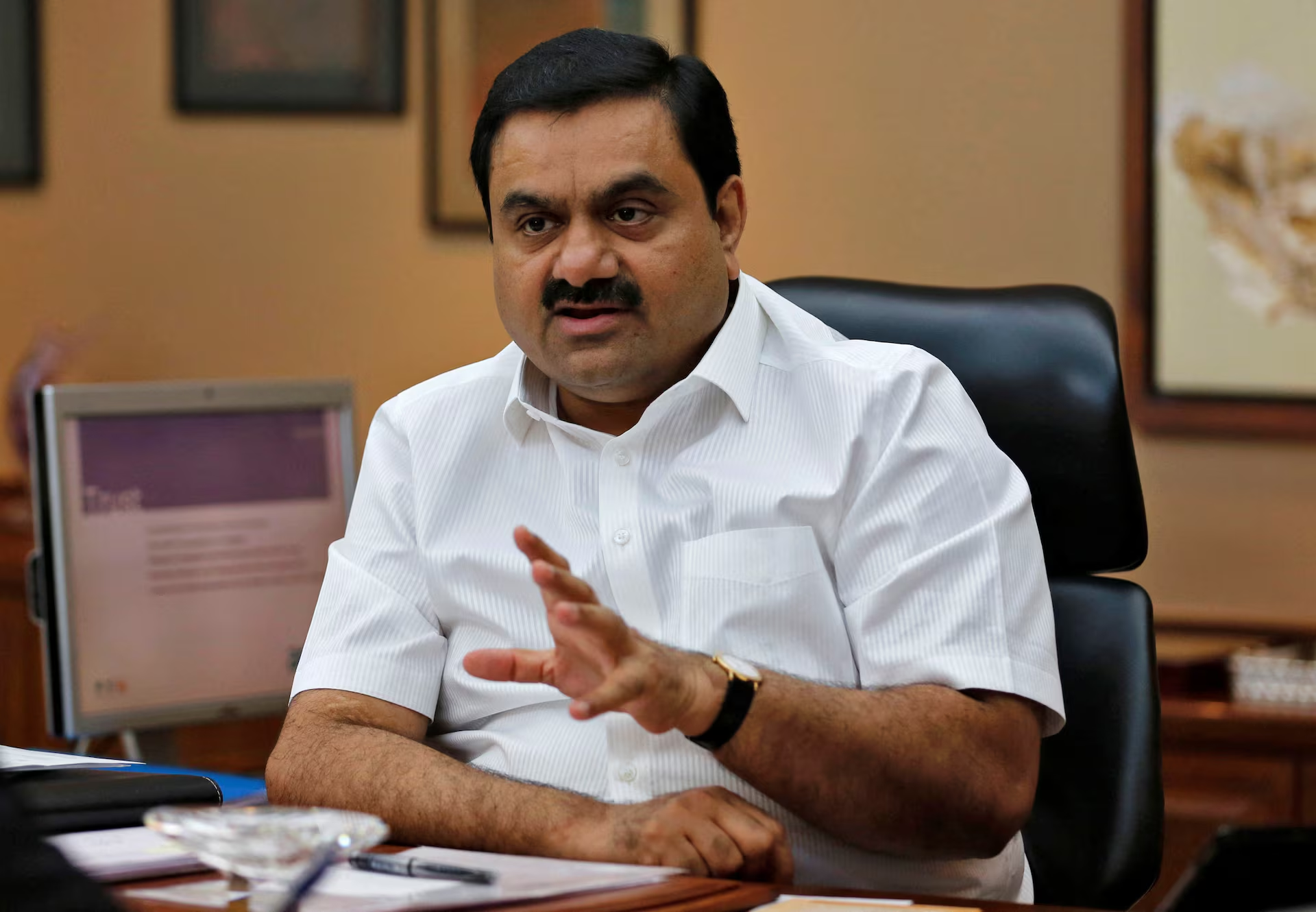
In an unexpected twist to one of the most high-profile corporate legal battles of recent years, U.S. District Judge Nicholas Garaufis has declined to immediately dismiss the criminal case against Indian billionaire Gautam Adani.
The ruling, issued on Friday, June 26, 2026, by the Brooklyn-based federal court, temporarily blocks a request by Adani’s lawyers to throw out the multi-million-dollar bribery and fraud indictment. Instead of rubber-stamping the request, the judge has ordered the U.S. Department of Justice (DOJ) to explicitly justify its sudden decision to drop the charges.
1. The Judicial Pushback: “Terse, Bland, and Conclusory”
The ruling marks a significant judicial speed bump for both Adani’s legal team and the Trump administration’s Justice Department, which had filed a motion on May 18 to abandon the prosecution.
Under Rule 48(a) of the Federal Rules of Criminal Procedure—often called a “sunshine provision”—a prosecutor’s request to dismiss an indictment requires formal court approval. Judge Garaufis ruled that the government had utterly failed to meet its legal obligation to provide adequate reasoning, stating:
“The Government’s terse, bland and conclusory statement affords the court neither a sufficient basis to reach any conclusion, nor the opportunity to conduct any analysis of the Government’s request for dismissal.”
The DOJ had originally argued simply that, “in its prosecutorial discretion,” it had decided not to devote further government resources to the case. Judge Garaufis gave prosecutors a strict deadline until July 13, 2026, to submit a detailed, factually supported explanation for each reason they wish to abandon the case.
 [ Nov 2024 Indictment ]  ──► Adani charged with securities fraud & $265M solar bribery scheme.
                                                │
                                                ▼ (May 18, 2026 Post-Election Pivot)
 [ DOJ Moves to Drop Case ] ──► Cites "prosecutorial discretion" to withdraw resources.
                                                │
                                                ▼ (June 26, 2026 Judicial Block)
 [ Judge Orders Halt ]      ──► Rejects immediate dismissal; demands full DOJ justification by July 13.
2. The Political Friction & The “Quid Pro Quo” Allegations
The case has become a lightning rod for political controversy in Washington. The original indictment, brought in late 2024 under the Biden administration, accused Gautam Adani, his nephew Sagar Adani, and other executives of orchestrating a $265 million (₹2,029 crore) scheme to bribe Indian state officials to secure lucrative solar energy contracts, while simultaneously misleading U.S. investors to raise over $3 billion in capital.
The DOJ’s sudden U-turn under the current administration triggered heavy scrutiny following explosive investigative reports:
- The Defense Team: Adani hired a powerhouse legal team at Sullivan & Cromwell led by Robert J. Giuffra Jr., who notably serves as U.S. President Donald Trump’s personal defense lawyer. Giuffra met with top DOJ officials in Washington, presenting a 100-slide deck highlighting “legal and factual weaknesses,” including arguments that the alleged conduct fell entirely outside U.S. jurisdiction.
- The Investment Offer: Media reports revealed that during these high-level legal negotiations, Adani’s team floated proposals indicating the billionaire would invest $10 billion into the U.S. economy and create 15,000 jobs if the criminal charges were dropped.
- Capitol Hill Backlash: This reported overlap prompted swift condemnation from Democratic senators, who publicly blasted the arrangement as an “egregious quid pro quo offer.”
3. The Separated Settlement Realities
While the criminal indictment hangs in limbo waiting for the DOJ’s July 13 submission, the broader civil and regulatory components of the Adani case have already moved toward structured multi-million-dollar resolutions:
| Case Vertical | Regulatory Entity | Status & Financial Outcomes (Mid-2026) |
| Criminal Indictment | U.S. Federal Court (EDNY) | On Hold: Formal dismissal deferred until the judge reviews the DOJ’s mandated rationale. |
| Civil Securities Fraud | U.S. Securities & Exchange Commission (SEC) | Proposed Settlement: Gautam Adani has agreed to pay a $6 million civil penalty, while his nephew Sagar Adani will pay $12 million (consenting to the fines without admitting or denying the allegations). |
| Sanctions Violations | U.S. Treasury Department | Settled: Adani Enterprises Ltd has agreed to a separate $275 million payout to resolve civil liabilities tied to illicit imports of Iranian-origin liquefied petroleum gas (LPG). |
While the Adani Group has continuously maintained that all allegations are entirely baseless, Judge Garaufis’s refusal to quietly bury the case ensures that the internal mechanics behind Washington’s decision to drop the prosecution will be dragged into public view before any final dismissal can take place.