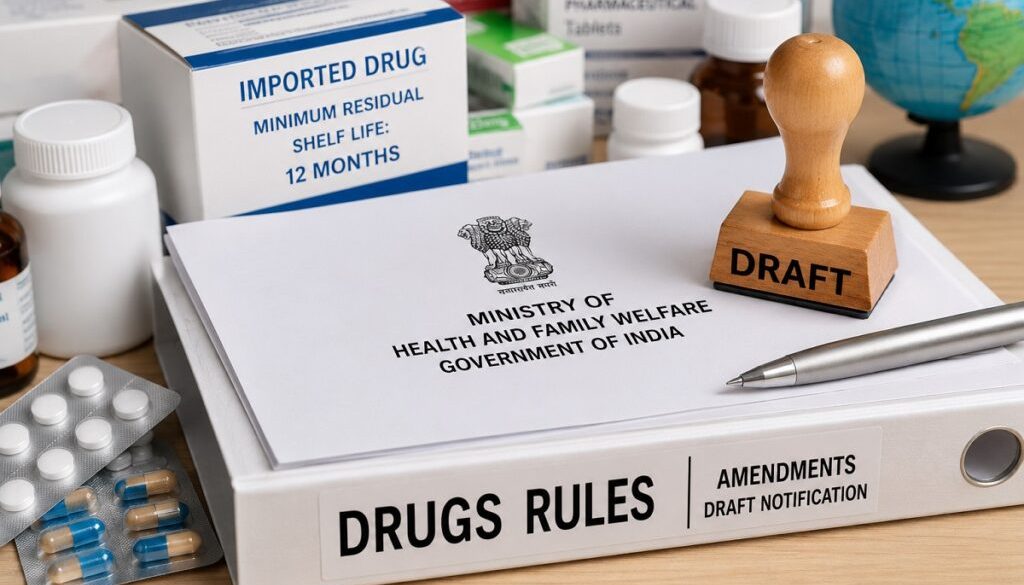
The Union Ministry of Health and Family Welfare has issued a major draft notification proposing amendments to Rule 31 of the Drugs Rules, 1945.
The policy shift, published via Gazette Notification G.S.R. 505 (E), aims to cut massive pharmaceutical supply chain wastage and radically boost the Ease of Doing Business for life-saving imported treatments—such as high-value cancer therapies and rare disease medicines.
The government has formally placed the draft in the public domain, inviting objections and suggestions from stakeholders over a standard 30-day window before finalizing the law.
1. The Pivot: From Percentage to a Flat 12-Month Clock
The proposed change replaces a highly restrictive, calculation-heavy framework with a simplified, uniform timeframe:
- The Old Rule (The >60% Trap): Under the legacy system, a drug could not clear Indian customs unless it had more than 60% of its total approved shelf life remaining. For advanced biological treatments or specialty medications with naturally long manufacturing and transit cycles, meeting this percentage was an immense logistical hurdle, frequently causing entire batches to be rejected and destroyed at port.
- The Proposed Standard: The ministry is tossing out the percentage calculation. Instead, most imported medicines will simply need to have a minimum residual shelf life of 12 months at the exact time they enter India.
 [ Legacy Framework ] ──► Mandatory >60% Total Usable Shelf Life Left
                                        │
                                        ▼ (June 2026 Shift)
 [ Proposed Blueprint ] ──► Flat 12-Month Minimum Remaining Clock at Port
2. Supply Chain and Patient Impact
By easing these restrictive bottlenecks, the Health Ministry expects a highly positive domino effect across the Indian healthcare market:
- Drastic Inventory Optimization: Importers will no longer be forced to discard perfectly safe, viable medicine batches simply because a shipping delay caused the remaining lifespan to tick down to 59%. This will sharply lower inventory wastage and overhead costs.
- Securing High-Value Medicines: The change is highly pragmatic for critical, low-volume segments like specialized oncological (cancer) treatments and rare disease therapies. These high-value drugs are typically imported in precise quantities and can now be distributed fluidly without regulatory timeline blocks.
- Sufficient Treatment Runway: The 12-month standard ensures that even after clearing port, patients and hospitals retain a comfortable, safe timeframe to distribute and consume the medication long before the expiry date hits.
3. The Structural Boundary: Exceptions & Quality Shielding
To prevent the domestic market from becoming a dumping ground for near-expiry experimental products, the government has carved out clear regulatory guardrails:
| Regulatory Category | Proposed Rule Update | Strategic Rationale |
| Standard Imported Drugs | Slashed to a flat 12-month minimum remaining lifespan. | To standardize imports, lower logistical frictions, and smooth out standard pharmacy distribution loops. |
| Biologicals & Radiopharmaceuticals | Retains the strict >60% rule. (No change) | Their highly volatile chemical nature, short radioactive half-lives, and critical public health weight demand stricter margin buffers. |
| Safety & Efficacy Benchmarks | Remains entirely unchanged. | The Health Ministry explicitly clarified that this amendment only touches the import timeline. Every incoming drug must still pass the rigorous quality, safety, and performance checks mandated under the Drugs and Cosmetics Act, 1940. |
Parallel to the shelf-life rewrite, the ministry is introducing a secondary draft amendment to streamline pharmaceutical research. It aims to replace the slow, legacy licensing process for importing small trial drug quantities with a rapid, online acknowledgement-based system. Once an R&D firm submits a prior intimation online, the instant digital receipt will double as import clearance, cutting weeks of administrative bureaucracy out of medical research cycles heading into 2027.