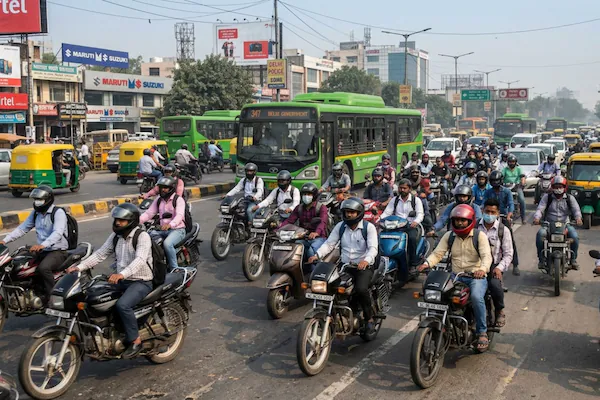
In a sweeping regulatory move to combat the national capital’s persistent air pollution, the Delhi government has finalized the draft for its Delhi Electric Vehicle (EV) Policy 2.0 (2026–2030).
The most dramatic mandate in the newly minted policy stipulates that no new petrol-powered motorcycles or scooters will be allowed for registration in Delhi starting April 1, 2028. From that cutoff date onward, all fresh two-wheeler registrations must be 100% electric.
1. Scope of the Mandate: What it Means for Riders
The landmark policy sets a strict clock on the future of internal combustion engine (ICE) commuting, though it explicitly protects current vehicle owners:
- No Retroactive Ban: The law does NOT ban petrol two-wheelers that are already registered. If you purchase or currently own a petrol bike before March 31, 2028, you can legally ride it for its full standard lifecycle.
- The Fleet Caps: Commercial aggregators, including delivery partners and bike-taxi fleets, face an accelerated timeline and are barred from onboarding new petrol two-wheelers.
- Three-Wheeler & Four-Wheeler Limits: The green transition extends across categories. New registrations for petrol and CNG auto-rickshaws will be completely halted on January 1, 2027. For private passenger cars, households are capped at registering a maximum of two non-electric cars; a third vehicle purchase must be an EV.
2. The Subsidy Structure: Incentivizing the Switch
To ease the financial friction of the transition, the Delhi government is backing the mandate with a front-loaded, multi-year financial subsidy roadmap for locally manufactured electric two-wheelers priced under ₹2.25 lakh (ex-showroom):
| Policy Timeline | Available Battery Subsidy | Maximum Outpocket Benefit |
| Year 1 (Post-Notification) | ₹10,000 per kWh | Up to ₹30,000 |
| Year 2 (Post-Notification) | ₹6,600 per kWh | Up to ₹20,000 |
| Year 3 (Post-Notification) | ₹3,300 per kWh | Up to ₹10,000 |
The Scrappage Kicker: To systematically remove the most polluting vehicles, consumers who actively choose to scrap an old, Delhi-registered BS-IV or older petrol two-wheeler to upgrade to an EV will receive an additional ₹10,000 scrappage incentive. All EVs registered during this window will also receive a 100% exemption from road tax and registration fees through 2030.
3. Intense Auto Industry Pushback
The sheer aggression of the April 2028 hard stop has triggered a massive wave of panic and formal complaints from key automotive industry bodies:
- The Emission Paradox (SIAM): The Society of Indian Automobile Manufacturers (SIAM) submitted a formal petition to Chief Minister Rekha Gupta arguing against the registration blockade. SIAM pointed out that modern, highly optimized BS-VI compliant petrol two-wheelers emit negligible particulate matter. Instead of banning new, clean vehicles, they urged the state to focus entirely on phasing out pre-BS-IV two-wheelers (more than 10–15 years old), which account for a staggering 99.5% of the segment’s actual emissions.
- Demand Migration (FADA): The Federation of Automobile Dealers Associations (FADA), led by Chief Executive Saharsh Damani, warned that a total ban inside territorial Delhi would not stop people from wanting petrol bikes. Instead, it will likely trigger a massive “demand migration,” where Delhi buyers simply buy and register vehicles in neighboring NCR cities like Noida, Gurugram, or Ghaziabad and ride them across state borders—hurting local dealerships and workshops without cleaning the regional air.
Despite intense lobbying from legacy manufacturing giants, government officials maintain that vehicular emissions constitute roughly 23% of the city’s baseline winter pollution. With the previous EV framework expiring, the cabinet is poised to formally notify the 2.0 blueprint before the end of June 2026, setting off a high-stakes, 22-month countdown for the Indian automotive ecosystem.