📚 New to this topic? Read our full guide: How Recessions Happen.
Japan Visa Fee Hike From July 1: Why Indians Still Pay Just Rs 500
Japan is making its visa fees five times higher from July 1, 2026. But the Japan visa fee for Indians stays at just Rs 500. A visa is an official stamp or paper that lets you enter another country. Japan has not raised this fee in almost 50 years. So this is a big jump for most travellers. But Indian citizens are mostly safe from it.
The news comes from Financial Express. A “single-entry” visa lets you enter Japan one time. Its fee will go up from ¥3,000 to ¥15,000. A “multi-entry” visa lets you enter many times. Its fee will go up from ¥6,000 to ¥30,000. (The ¥ sign means yen. The yen is Japan’s money, like the rupee is India’s money.) For most people who need a visa before they travel, the cost jumps a lot. But Indians will still pay only Rs 500.
What changes for most travellers
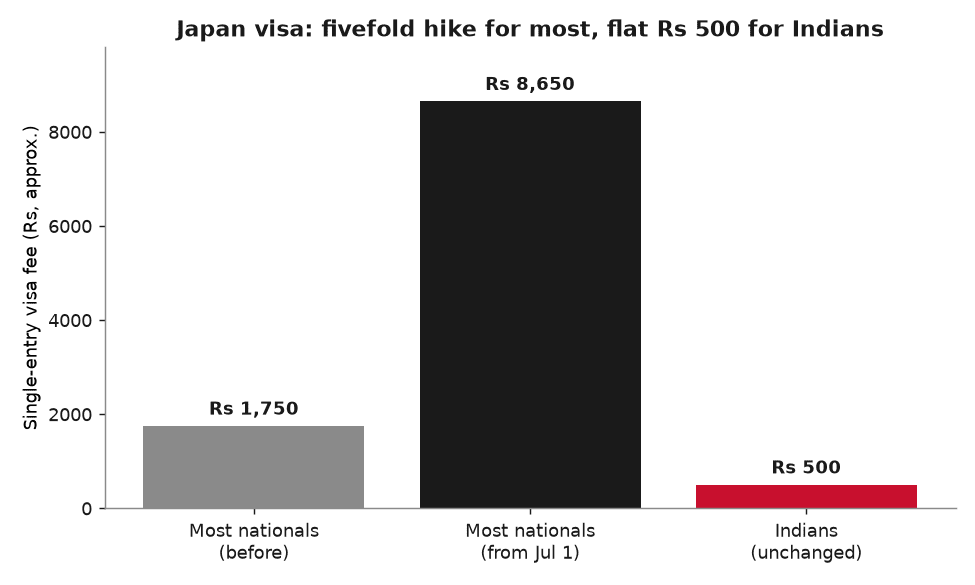
From July 1, the new higher fee is five times the old one. It applies to travellers who need “pre-arrival clearance.” That just means you must get your visa approved before you travel. Take China, the Philippines, and Vietnam as examples. For them, a single-entry tourist visa will now cost about Rs 8,650. Before, it was around Rs 1,750. A multi-entry visa for them goes up from about Rs 3,500 to Rs 17,350. That is a very big rise.
What it means for Indians
Indians apply for the visa through VFS Global. (VFS Global is a company that does visa paperwork for embassies. An embassy is a country’s official office in another country.) It is Japan’s official visa partner in India. Right now, Indians pay Rs 500 for both single-entry and multi-entry visas. From July 1, the Embassy of Japan in India says Indians will still pay only Rs 500. The transit visa used to cost Rs 50. It will now just be put into the single-entry group.
There is one more cost on top of the visa fee. VFS charges Rs 800 for its service (this includes taxes), for each application. This charge is not changing. So the full cost for an Indian applicant stays about Rs 1,300. That is Rs 500 for the visa plus Rs 800 for the service. In short, Indians are mostly safe from the worldwide fee rise.
Key facts at a glance
| Detail | Before July 1 | From July 1 |
|---|---|---|
| Single-entry (general) | ¥3,000 | ¥15,000 |
| Multi-entry (general) | ¥6,000 | ¥30,000 |
| Indians: visa fee | Rs 500 | Rs 500 (unchanged) |
| Indians: total outgo | ~Rs 1,300 | ~Rs 1,300 |
| China/Philippines (single) | ~Rs 1,750 | ~Rs 8,650 |
| UK/US/Australia (short trips) | Visa-exempt — unaffected | |
Why is Japan doing this?
Japan’s fees had stayed the same since 1978. The government says the old, low fees no longer pay for the real work of giving out visas and handling immigration. (Immigration means people coming to live or stay in a country.) Two things are pushing this change. First, the number of foreign people in Japan went past 4 million for the first time. It reached 4,125,395 residents by the end of 2025. That is a record rise of 9.5% in just one year. More residents means more office work.
Second, the Japanese yen has slowly lost value since 2021. It is now near its lowest point in 40 years. When the money is worth less, the old fees buy even less than before. Last month, Japan’s Upper House approved a new law. (The Upper House is one part of Japan’s parliament, which makes the country’s laws.) The law raises some visa fees by up to 30 times. For example, the top fee for permanent residency (the right to live in Japan forever) goes from ¥10,000 to ¥300,000.
Who is affected, who is not
The fee change hits citizens from more than 100 countries who need a visa before they travel. This includes big markets like China, India, and Vietnam. But people from about 70 “visa-exempt” places are not affected for short trips. (Visa-exempt means they do not need a visa at all.) These include the UK, the US, and Australia. They do not need a visa for short stays, so the change does not touch them.
For Indian applicants using VFS Global, the steps stay the same. You do not need to book an appointment first. It takes at least about six working days to process. You can pay in rupees by cash, card, or UPI. The foreign ministry also says you pay no fee if your visa is refused.
Why it matters (especially for India and founders)
Japan is a big destination for Indian tourists, students, and business travellers. Keeping the fee at Rs 500 makes Japan much cheaper to visit for Indians than for many other people. That is a quiet but real plus. For founders who want Japanese clients or partners, low travel costs make it easier to meet face to face. (A founder is a person who starts a company.)
The likely reason for this special deal is “reciprocity” and the warm ties between India and Japan. (Reciprocity means two countries treat each other the same way.) Countries often match each other’s visa rules. As Indian talent works around the world, easy travel matters. We look at this idea in Kunal Shah becoming WhatsApp’s CEO. And as India builds its own industries, like the new PM MITRA textile parks, strong global links and cheap business travel only help. One reminder: visa fees and rules can change. So always check the latest with the Embassy of Japan before you apply.
FAQ
How much is a Japan visa for Indians now?
Indians still pay Rs 500 for single or multi-entry visas. They also pay an Rs 800 VFS service charge. That is about Rs 1,300 in total, even after the July 1 fee rise.
How much will the fee rise for others?
For most people who need a visa, single-entry goes from ¥3,000 to ¥15,000. Multi-entry goes from ¥6,000 to ¥30,000. That is five times more. For China and the Philippines, a single-entry visa goes to about Rs 8,650.
Why is Japan raising visa fees?
The fees had not changed since 1978. They no longer pay for the cost of processing visas. A record foreign population (over 4 million) and a weak yen pushed the government to change them.
Who is exempt from the hike?
Indians keep the Rs 500 fee. Travellers from about 70 visa-exempt countries (like the UK, US, and Australia) are not affected for short holiday stays.
The takeaway
This is Japan’s first visa fee rise in almost 50 years. From July 1, it will make travel costlier for most of the world. But Indians keep their low Rs 500 fee. That is a small but real edge for tourists, students, and business travellers. It shows the strong ties between India and Japan. And it is a good reminder to always check the latest rules before you apply.
Source: Financial Express (June 27, 2026). Always verify current fees with the Embassy of Japan or VFS Global.