Anthropic has launched Claude Tag, completely revamping its approach to workplace collaboration by turning Claude into a persistent, multi-step AI teammate living inside Slack.
Instead of acting like a traditional Q&A chatbot that only speaks when spoken to, Claude Tag operates as a shared virtual employee that can build long-term organizational context, handle tasks asynchronously over days, and even take initiative in “ambient” mode.
1. The Core Architecture: Multiplayer & Persistent Memory
Claude Tag shifts the AI experience from private, single-user windows into a collaborative, multiplayer environment powered by Claude 3.5 Opus.
- Shared Channel Context: When added to a Slack channel, there is a single instance of
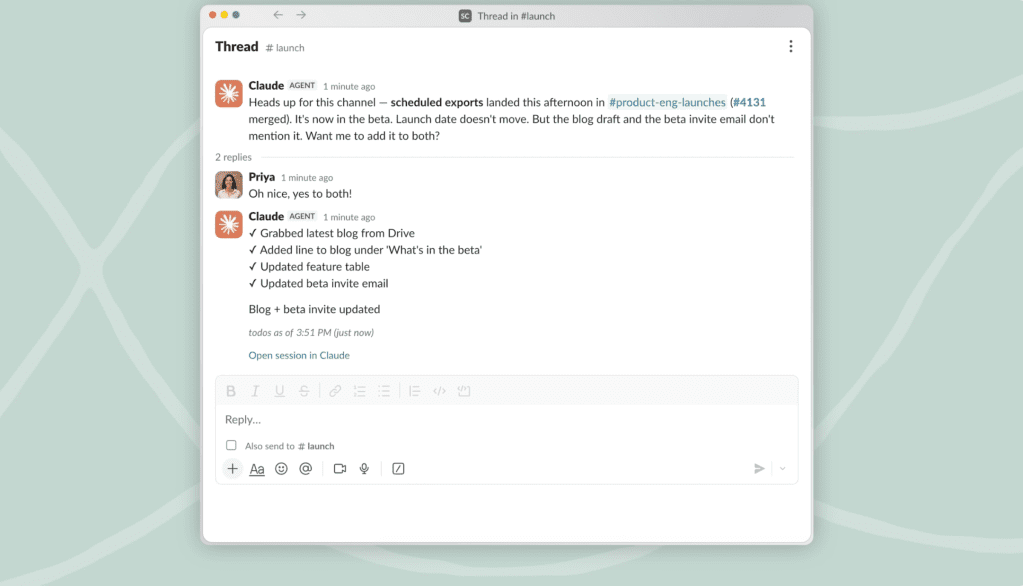
@Claudethat everyone interacts with. Teammates can see exactly what the agent is working on, chime in, or pick up a conversation exactly where another colleague left off. - Persistent Learning: Claude Tag follows along with channel discussions over time to build tacit knowledge about your projects. Users no longer need to copy-paste context or explain background parameters from scratch with every single prompt.
- Asynchronous Project Execution: You can delegate complex, multi-day tasks to Claude (like triaging support tickets, generating product metrics, or chasing down complex bugs) and walk away. It will break the project down into individual steps, post a visible checklist, and execute the work independently in the background.
2. Taking the Initiative: Ambient Mode
One of the most disruptive additions is Ambient Mode, which allows Claude Tag to act proactively rather than waiting to be prompted. If enabled by administrators, Claude will actively monitor channels and:
- Proactively jump into active threads to flag relevant information or cross-reference metrics from other connected tools.
- Gently follow up on critical discussion threads that have gone completely quiet without reaching a clear resolution.
- Generate scheduled summaries, compile weekly digests, or prepare comprehensive meeting briefs automatically.
[User tags @Claude in thread] ──► Claude builds multi-step plan ──► Works asynchronously in background ──► Ambient Mode proactively flags updates
3. “Agent Identity” Security and Spend Safeguards
To resolve the massive compliance and security hurdles associated with giving autonomous agents access to enterprise files, Anthropic built a brand-new security framework called Agent Identity:
- Independent Accounts: Claude Tag does not borrow a human user’s login credentials. It operates via its own dedicated, audited service account.
- Granular Sandboxing: System administrators explicitly dictate exactly which tools, codebases, and channels each unique Claude identity can see. For example, a Claude instance with access to GitHub can be strictly quarantined to a single private engineering channel.
- Consumption-Based Spend Ceilings: Instead of charging per seat, Claude Tag is billed to the organization based on token consumption. To prevent runaway costs from autonomous loops, administrators can set hard monthly spending limits on the workspace or individual channel level.
The Migration Timeline: Claude Tag is available in beta for all Claude Enterprise and Claude Team workspaces. It completely replaces the legacy “Claude in Slack” application. Administrators are given a 30-day window to opt in and migrate their systems before the old experience is permanently deprecated.
The release lands at a highly competitive moment in the enterprise software stack. Recent corporate spending data reveals that Anthropic has pulled ahead of OpenAI in enterprise adoption for the first time, with 34.4% of surveyed firms maintaining an active Claude subscription compared to 32.3% using OpenAI tools. By anchoring a deeply integrated, memory-retaining agent directly inside Slack, Anthropic is looking to lock down its lead in institutional workflow automation.