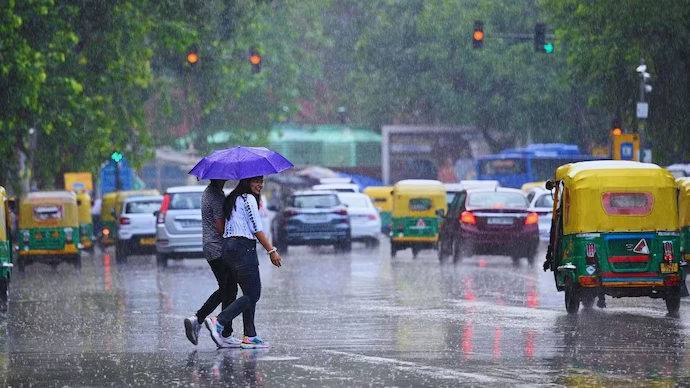
India saw a sharp June rain deficiency this year. June rain deficiency means the country got much less rain than normal in June. The India Meteorological Department, or IMD, said rainfall was 43% below normal. That made it the driest June in 16 years.
Key takeaways
- India’s June rainfall was 43% below the long-period average, IMD data shows.
- It was the driest June since 2009, after a weak start to the southwest monsoon.
- Rain improved in early July, so the full season picture can still change.
- Less June rain can hurt sowing, water storage, and power demand in the short term.
Why did June rain deficiency become such a big story?
The big reason is simple: June is the opening month of the southwest monsoon. The southwest monsoon is the main rainy season that waters farms, fills dams, and cools cities. When June starts badly, people worry fast because crops and drinking water depend on those first rains.
According to IMD, India received about 89 millimetres of rain in June, against a normal of about 157.1 mm. That’s a gap of roughly 68 mm. In percentage terms, the June rain deficiency was 43%, which is huge for a whole country.
That weak start made June 2025 the driest June in 16 years. The last time June was this poor was 2009. Back then too, farm output and market mood took a hit because the monsoon lagged badly.
What exactly happened with the monsoon this year?
The monsoon reached parts of India, but it did not move ahead smoothly. IMD had said the monsoon stalled for a while. A stall means the rainy system stops advancing for some days, so many areas stay dry even in the monsoon season.
Weather systems over the Arabian Sea and Bay of Bengal also matter a lot. These systems help pull moist winds inland. When they are weak or poorly placed, clouds don’t spread evenly, so rain stays patchy.
That’s what many regions saw in June. Some pockets got bursts of rain, but large farming belts stayed far below normal. As a result, the headline number for the whole country sank hard.
India June rainfall: actual vs normalActual: 89 mmNormal: 157.1 mm43% low
How does June rain deficiency affect farms and food?
Farmers feel the first shock. Many kharif crops are planted around this time. Kharif crops are rainy-season crops such as rice, soyabean, cotton, and pulses. If fields stay dry, sowing slows or farmers wait for better moisture.
A delay of even one or two weeks can matter. Seeds need enough water to sprout well. If rains come late, farmers may switch crops, use more irrigation, or plant less area.
That doesn’t always mean a bad harvest. If July and August bring strong rain, some lost ground can be recovered. But an early June rain deficiency still raises risk because the season begins on the back foot.
This matters for prices too. If sowing falls, traders often worry about lower output later. That can push up prices of food items, especially if heat and weak water storage add more pressure.
What does this mean for cities, dams, and power use?
It’s not just a farm story. Cities watch the monsoon because reservoirs and groundwater need replenishment. A reservoir is a stored lake that holds water for homes, farms, and power plants. Weak June rain can slow that refill.
Power demand can also climb when rain is late. Hotter days mean more fans and air-conditioners run longer. So electricity use rises, while hydropower may stay under pressure if water levels remain low.
In recent weeks, India has also tracked other pressure points tied to weather and the economy. For example, market nerves have shown up in stories like the Kospi crash and Indian markets. Personal finance worries matter too, as seen in our explainer on how EPFO decides your PF interest rate.
Is the June rain deficiency likely to last all season?
Not necessarily. Weather can change quickly in July and August. In fact, IMD said rainfall improved in early July, which helped the monsoon regain some speed. That means the scary June number may not define the whole season.
Still, June sets the tone, so people are right to pay attention. A full monsoon season runs from June to September. Even if later rain improves the total, a weak first month can leave short-term damage behind.
That’s why the June rain deficiency is important but not the final verdict. Think of it like a cricket team losing early wickets. The match isn’t over, but the pressure goes up fast.
| Measure | June 2025 | Normal |
|---|---|---|
| All-India rainfall | 89 mm | 157.1 mm |
| Departure from normal | -43% | 0% |
| Status | Driest June in 16 years | — |
What should readers watch next?
First, watch IMD’s weekly rainfall updates on its official weather portal. They show whether the June rain deficiency is shrinking as July moves on. Second, watch sowing data from the farm ministry and related updates from the Department of Agriculture.
Those two sets of numbers tell a clear story. If rain improves and sowing catches up, the damage may stay limited. But if both remain weak, concerns about crops, inflation, and water could grow.
There’s also a wider industry angle. Rain matters for factories, supply chains, and rural demand. Readers tracking the real economy may also want our report on DCM Shriram’s Jhagadia plant joining the WEF lighthouse network and our coverage of India’s solar market crossing 150 GW.
Here is the simplest way to read it:
India’s June rain deficiency means the monsoon’s first month was far weaker than normal, with rainfall 43% below average. That raises early risks for farming, water, and prices, but stronger rain in July and August could still repair part of the damage.
Why this matters beyond one bad month
One dry June does not decide the whole year. But it does show how tightly India is linked to the monsoon. A swing of 43% below normal in just one month can touch farms, food bills, power demand, and household planning.
So the story is bigger than weather charts. The June rain deficiency is a reminder that a late or weak monsoon start can ripple across the economy. And that’s why so many people, from farmers to stock traders, are watching the clouds.
FAQs
What is June rain deficiency?
June rain deficiency means India got less rain than the normal June average. This year, IMD said the gap was 43%.
Why does a dry June matter so much?
June is the start of the main monsoon season. Farmers use this rain for sowing, and dams use it to begin refilling.
Can the monsoon still recover after a weak June?
Yes, it can. If July and August bring strong rain, the seasonal total and crop outlook can improve a lot.