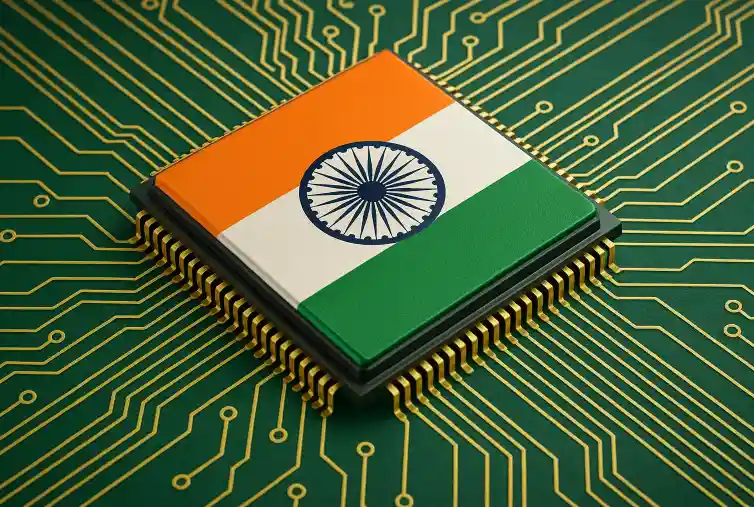
The AI chip race is the global push to build faster chips for artificial intelligence. Chips are the tiny brains inside computers. For Indian startups, the AI chip race could open fresh space in design, tools, and special-purpose hardware, even if they do not build giant factories.
Key takeaways
- Indian chip startups may gain from the AI boom by designing niche chips and core technology.
- They are more likely to start with design and IP, not costly chip factories.
- AI demand is rising fast, so global firms need more suppliers and new ideas.
- India already has strong chip design talent, but funding and manufacturing remain hard.
Why is the AI chip race suddenly such a big deal?
The AI chip race matters because AI systems need huge computing power. Computing power means the ability to process lots of tasks quickly. Training one big AI model can require thousands of advanced chips, so demand has shot up around the world.
Nvidia has become the best-known name in this market. But one company cannot meet every need forever. That gap creates room for startups, especially those that build tools, chip blocks, or chips for narrow jobs.
Think of it like roads in a growing city. If one highway gets crowded, cities build flyovers, side roads, and shortcuts. In the same way, the AI chip race is creating side paths where smaller companies can win.
How could Indian startups fit into the AI chip race?
Most Indian startups will not begin by making giant fabrication plants. A fab is a factory that physically makes chips. These plants can cost billions of dollars, so they are out of reach for most young firms.
Instead, Indian founders are more likely to focus on chip design. Design means planning what a chip does and how its parts work. They can also build IP, or intellectual property, which means reusable chip building blocks that other firms can license.
That matters because India already has a deep design base. Big global firms have long run chip design centers in Bengaluru, Hyderabad, Noida, and Pune. So the country has engineers who know how to build processors, memory systems, and software that helps chips run.
The AI chip race could also help startups that work on edge AI chips. Edge AI means AI that runs on a device itself, not only in a faraway data center. For example, a camera, car, drone, or factory sensor may need a small chip that can make quick decisions on the spot.
What kinds of products might these startups build?
Not every startup needs to challenge Nvidia head-on. In fact, that would be the hardest path. A smarter route may be to solve one sharp problem well.
Some may design chips for low power use. Low power means the chip does more work while using less electricity. That is useful in phones, robots, smart cameras, and industrial machines.
Others may build interconnect technology. Interconnects are the links that help chips talk to each other fast. In AI systems, that speed matters because delays can slow the whole machine.
Startups may also work on compiler software. A compiler turns code into instructions a chip can understand. Good compiler tools can make a chip more useful, even before the hardware changes.
| Area | What it means | Why it matters |
|---|---|---|
| Chip design | Planning the chip’s functions | Lower cost than running a fab |
| IP blocks | Reusable chip parts | Can be licensed to many firms |
| Edge AI chips | AI on devices | Useful for cars, cameras, factories |
| Chip software | Tools that help hardware run | Improves speed and efficiency |
What numbers show the size of the opportunity?
The numbers are huge. One advanced AI server can use 4, 8, or even more accelerator chips. An accelerator is a chip built to speed up a specific job, such as AI math.
Training clusters often use thousands of chips together. Some top data centers now link tens of thousands of GPUs. A GPU is a graphics processing unit, and today it also powers many AI tasks.
India’s broader chip push is growing too. The government has already backed the India Semiconductor Mission 2.0 with ₹1.25 lakh crore. That money will not solve everything, but it shows long-term intent.
AI chip race: where startups may playToolsDesignEdge AI356
The chart is simple, but the message is clear. Startups often have a better shot in tools, design, and edge AI than in giant manufacturing. That’s because those areas need brains and speed more than massive spending.
What could hold Indian chip startups back?
The AI chip race brings promise, but it also brings tough barriers. Building chips costs a lot of money. Testing them, proving they work, and finding customers can take years.
Access to advanced manufacturing is another problem. The most cutting-edge chips are made by only a few companies worldwide. If a startup depends on foreign fabs, delays and export controls can hurt it.
Export controls are government rules that limit who can buy certain technologies. These rules matter because top AI chips are now tied to national security. That means business choices can suddenly become political choices too.
Funding is also uneven. Software startups can launch with a small team and a laptop. Chip startups need expensive design tools, prototypes, and long development cycles, so investors must stay patient.
Why does this matter for India beyond startups?
The AI chip race is not only about founders making money. It is also about whether India can keep more value from the tech it helps create. For years, India has supplied engineering talent, while much of the final product value stayed elsewhere.
If more local firms own chip designs or key IP, that can change. It could create better-paid jobs and stronger supply chains. It may also reduce some dependence on imports over time, though not quickly.
This wider shift connects with other digital and finance moves too. For example, stronger hardware can support future payment and identity systems. You can see that push in stories like the Razorpay-NBBL mobile-first netbanking tie-up and the new UIDAI Aadhaar app update.
A simple way to say it is this: the AI chip race gives Indian startups a real shot, mainly in design, IP, software, and edge devices. The biggest wins may not come from copying global giants. They may come from solving smaller, useful problems faster and cheaper.
What should readers watch next?
Watch for startup funding rounds, pilot projects, and partnerships with global chip firms. Those deals often matter more than big promises. They show whether a company has technology that real customers want.
Also watch policy support. India is trying to build a larger semiconductor base, and official schemes could shape who survives. You can track those plans through the Ministry of Electronics and IT and updates from the India Brand Equity Foundation.
One more clue will be where startups aim first. If they target cars, factories, cameras, or telecom gear, that may be smart. Those markets are large, and they do not always need the most advanced chips on Earth.
FAQs
What is the AI chip race?
The AI chip race is the global effort to build faster chips for AI tasks. These chips help train and run AI systems.
How can Indian startups benefit?
They can design chips, build IP blocks, and create software tools. They may also make edge AI chips for devices like cameras and cars.
Why won’t most startups build chip factories?
Factories cost billions of dollars and take years to set up. So most startups will begin with design, software, or licensing technology instead.