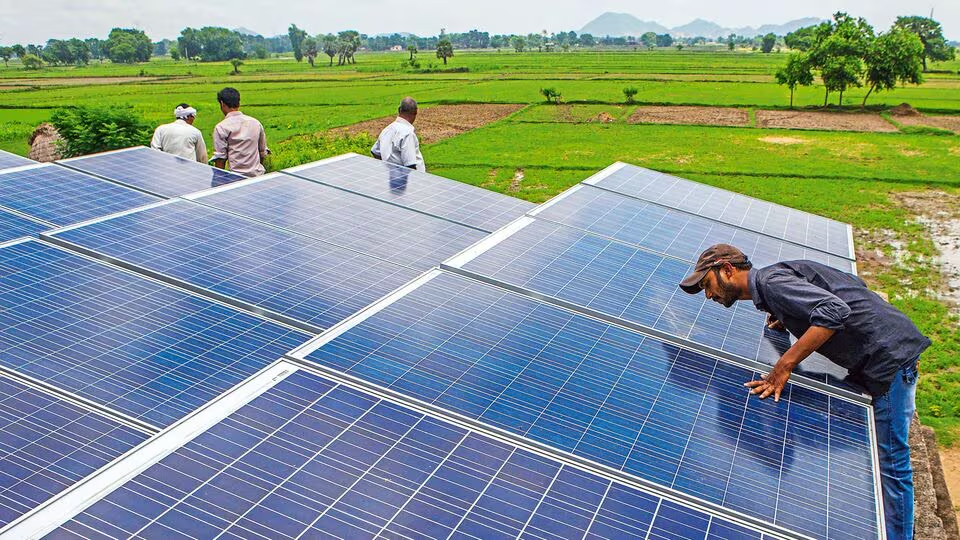
In a major structural push toward a circular clean-energy economy, the Indian government has finalized a binding regulatory framework making the storage, handling, and recycling of end-of-life solar photovoltaic (PV) modules mandatory.
While solar panels were technically grouped under the E-Waste (Management) Rules, 2022, the sector lacked actionable operational enforcement. The Central Pollution Control Board (CPCB) has officially rolled out strict compliance mandates, forcing manufacturers, solar developers, and bulk consumers to safely account for every panel or face severe environmental penalties.
The policy shift addresses a massive looming environmental bottleneck: research by the Council on Energy, Environment and Water (CEEW) warns that India’s rapid solar expansion will generate 600 kilo-tonnes of cumulative solar panel waste by 2030, ballooning to a staggering 19,000 kilo-tonnes by 2050.
1. The Core Directives of the New Mandate
The CPCB guidelines lay down explicit operational rules that effectively criminalize the traditional practice of selling dead panels to the informal scrapping sector or dumping them in landfills.
- Absolute Landfill Ban: Solar waste is strictly prohibited from open dumping. Because crystalline silicon panels contain trace hazardous elements with high leaching potential—such as antimony, cadmium, arsenic, and lead—careless disposal directly threatens soil and groundwater tables.
- The Tracking Registry (EPR Portal): Through the CPCB’s operational Extended Producer Responsibility (EPR) portal, solar module producers must maintain a comprehensive database of all customers. Panels must carry unique traceability identifiers to map their lifecycle from initial commissioning to end-of-life collection.
- Mandatory Infrastructure Standards: The government has established 13 strict storage and transport protocols. Facilities holding old panels must utilize covered, dry, well-ventilated spaces featuring impervious, non-leachable flooring. Furthermore, any broken or disintegrated modules must be stored separately in rigid, water-resistant containers.
 [ RETAIL / UTILITY SOLAR DISPOSAL ROADMAP ]

 Decommissioned Panels ──► Transported via Covered Trucks ──► Registered CPCB Storage Hub
                                                                     │
   ┌─────────────────────────────────────────────────────────────────┘
   ▼
 [ THE MECHANICAL DISMANTLING & RECOVERY PATH ]
   ├── Frame & Glass Separation (75-80% of total weight) ──► Standard Melt Recycling
   └── Specialized Cell Processing (High-Value Stream)    ──► Extraction of Silver, Copper, & Silicon
2. The Financial Catalyst: The ₹1,500 Crore Critical Mineral Link
To prevent the mandatory rules from becoming an unsustainable financial burden on solar developers, the government is reframing solar recycling as a strategic resource-mining play.
The Ministry of Mines has launched a ₹1,500 crore recycling incentive scheme under the National Critical Mineral Mission (NCMM). While 80% of a solar panel’s weight consists of easily recyclable aluminum frames and glass, the true economic and technological challenge lies in isolating the high-purity silicon, copper, and silver embedded within the solar cells.
By heavily subsidizing certified, advanced recycling facilities (such as specialized metallurgy partnerships emerging in recycling hubs like Pune), the incentive scheme aims to make domestic material recovery cheaper than importing raw, unrefined tech minerals.
3. Shifting the Industry Responsibility Matrix
The regulation forces a major operational pivot across the entire clean-energy supply chain, establishing clear-cut liabilities:
| Sector Stakeholder | New Legal Obligation Under the Mandate |
| Solar Module Manufacturers | Must establish dedicated consumer take-back mechanisms, public collection centers, and fund end-of-life logistics under Extended Producer Responsibility (EPR). |
| Commercial & Utility Developers | Legally barred from offloading old arrays to uncertified local scrap dealers; must hand waste exclusively to CPCB-registered recyclers. |
| Logistics Providers | All solar waste transport must occur strictly in covered trucks to mitigate structural breakage risks and exposure to weather weathering. |
The Long-Term Vision
By linking the recycling mandate with the recently enforced Approved List of Models and Manufacturers (ALMM) List-II—which mandates that government solar projects use cells completely manufactured in India—the government is attempting to close the clean-energy loop.
Instead of treating dead solar fields as an expensive waste-management crisis 25 years down the line, the new policy landscape forces the green energy sector to treat yesterday’s broken panels as the foundational raw material feedstocks for tomorrow’s new domestic solar factories.