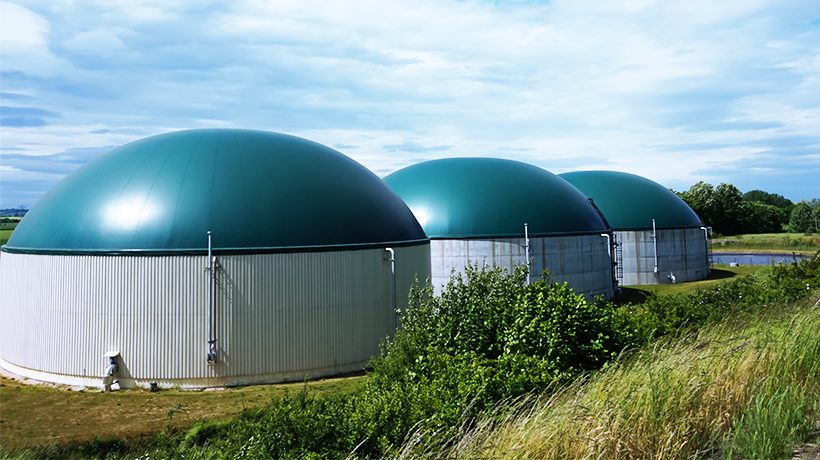
Driven by the prolonged closure of the Strait of Hormuz and a critical need to insulate itself from global energy supply shocks, the Indian government is rolling out a massive multi-pronged strategy to curb its heavy reliance on imported Liquefied Natural Gas (LNG) by aggressively scaling up domestic Compressed Biogas (CBG) production.
India currently imports over 50% of its natural gas needs, making its energy security highly vulnerable to price spikes. To replace these costly imports, the Ministry of Petroleum and Natural Gas (MoPNG) is executing three critical fiscal and structural interventions:
1. Launch of the “Sampoorn” Program
The government is readying the official debut of Sampoorn (“Complete”), a specialized incentive policy designed to fix the long-standing financial bottlenecks that plagued earlier bio-energy initiatives.
- Price Upgrades: Under the new framework, state-owned Oil Marketing Companies (OMCs) and gas utilities will sharply increase the guaranteed purchase offtake price for CBG—which previously hovered around a lower ₹72 to ₹74 per kilogram.
- Subsidies for New Infrastructure: The policy offers direct financial support and enhanced capital subsidies via the Ministry of New & Renewable Energy (MNRE), providing between ₹4 crore and ₹10 crore in Viability Gap Funding (VGF) to set up new plants.
- The Target: The program explicitly aims to rapidly expand the number of operational CBG plants nationwide from roughly 200 to over 700 facilities within the next few years.
2. Transitioning to an Ironclad 3% Blending Mandate
As of the current financial year, the Compressed Biogas Obligation (CBO) has transitioned from a voluntary standard into an enforceable legal directive.
City Gas Distribution (CGD) networks are legally required to blend bio-CNG directly into their commercial supply loops. Industry officials confirmed that India has successfully reached a 2% blending level and is fully on track to achieve its 3% target for the fiscal year, on its way to a strict 5% mandate by FY 2028–29.
             [ MANDATORY CBG BLENDING TRAJECTORY ]

  [ FY 2025-26 ] ──► 1% Mandatory Base (Successfully Executed)
                          │
                          ▼
  [ FY 2026-27 ] ──► 3% Blending Target (Currently hovering near 2%)
                          │
                          ▼
  [ FY 2027-28 ] ──► 4% Blending Target
                          │
                          ▼
  [ FY 2028-29 ] ──► 5% Long-Term Legal Mandate ──► Saves billions in Forex
3. The Union Budget 14% Excise Tax Break
To completely de-risk project economics for major listed city gas players like GAIL, Indraprastha Gas Limited (IGL), and Mahanagar Gas (MGL), the government implemented a vital structural tax overhaul.
Previously, both pure fossil-derived CNG and biogas-blended CNG were hit with a flat 14% central excise duty, resulting in a punishing double-taxation issue since CBG was already subject to GST. Under the new provisions, the biogas component within a blended CNG mix is entirely exempt from the 14% central excise duty.
💡 How the Tax Shield Works: If an OMC or distribution retail outlet pipes in a mixture that is 50% conventional CNG and 50% locally sourced CBG, exactly half of that collective gas volume is instantly spared from the excise tax. This creates a massive commercial incentive for distributors to maximize their bio-gas blending ratios far ahead of the legally required minimums.
4. Solving the North Indian Stubble Burning Crisis
Beyond saving vital foreign exchange reserves, the macro-shift relies heavily on transforming India’s most persistent seasonal environmental hazard—agricultural crop residue burning across Punjab, Haryana, and Uttar Pradesh—into cash-crop feedstock.
  [ THE AGRI-ENERGY CIRCULAR ECONOMY ]

  Paddy Straw / Crop Residue ──► Local Aggregation ──► 96%+ Purity Biomethane Upgrading (VSA Tech)
                                                                 │
                                                                 ▼
  Biofertilizer Return to Soil ◄── Organic Manure Yield ◄── CBG Piped to Cars / Homes (Cuts LNG Import)
By establishing a robust, localized supply corridor for high-methane agricultural waste (such as paddy straw and sugarcane press mud), the country is building a stable, decentralized bio-refinery network. According to the Indian Biogas Association, this optimized alignment is projected to pull in up to ₹1,00,000 crore in private infrastructure investment by 2032, paving a clean, domestic runway toward long-term energy independence.