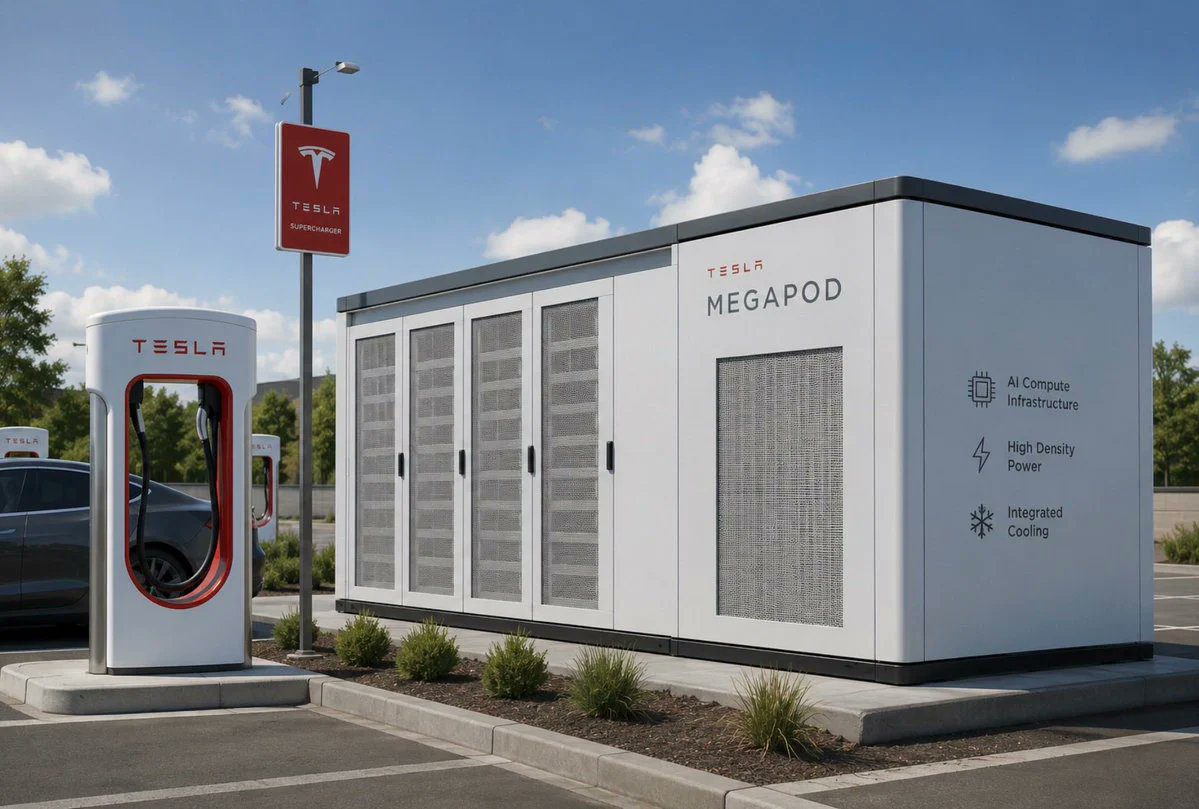
Tesla has officially filed a trademark application with the United States Patent and Trademark Office (USPTO) for “MEGAPOD,” revealing a major strategic push into modular, self-contained AI data center hardware. The tesla megapod is being positioned as a building block for distributed AI compute that plugs directly into the company’s existing energy footprint.
Filed under serial number 99893717, the application is structured as an “intent-to-use” filing. The documentation explicitly covers a comprehensive hardware package designed for heavy AI workloads, including computer servers, AI processing hardware, networking gear, power distribution units (PDUs), and advanced liquid cooling systems.
The move signals an ambitious plan to monetize the infrastructure it already has in the ground, bridging Tesla’s energy expertise with its computing goals. It also fits neatly into Elon Musk’s AI timeline, which leans heavily on a rapid build-out of compute and robotics.
What Is Tesla Megapod?
Tesla Megapod is the name Tesla has trademarked for a modular, prefabricated unit of AI data center hardware. Rather than building a single sprawling data center, the concept packages servers, AI processing hardware, networking, power distribution, and liquid cooling into a self-contained block that can be shipped and dropped onto a site where power is already available.
According to the filing, each Megapod is intended to function as a ready-to-deploy compute node. This modular approach mirrors how Tesla already sells energy products in repeatable, scalable units, and it lets the company stand up AI capacity incrementally instead of waiting on a multi-year construction cycle. Because the hardware is standardized, a Megapod can in theory be replicated across many locations, turning a network of small sites into a single large distributed compute fabric.
1. The Supercharger Connection: Leveraging 7 GW of Power
The filing lands right after Elon Musk’s recent teaser regarding Tesla’s “Digital Optimus” initiative. In March 2026, Musk noted that Tesla intended to deploy “millions of dedicated Digital Optimus units” globally. This push into physical AI and robotics depends on having abundant, cheap compute close to where it is used.
The Megapod appears to be the branded physical hardware designed to turn that concept into reality. By co-locating these modular compute units directly at its existing global Supercharger network, Tesla gains an immediate infrastructure advantage:
- Pre-wired Power: The Supercharger network commands roughly 7 gigawatts (GW) of available grid capacity.
- Bypassing the Permitting Wall: In 2026, the biggest bottleneck for the AI boom isn’t chip manufacturing; it’s securing land, massive power allocations, and local grid permitting. Tesla can bypass years of data center construction by dropping prefabricated Megapod units onto land plots where they already control the electrical tap.
- The Silicon Engine: The system is expected to utilize Tesla’s proprietary AI4 chip silicon—the same computer architecture that powers the latest Full Self-Driving (FSD) capabilities in its vehicles—optimized here for high-density edge inference.
2. Expanding the “Mega” Brand Ecosystem
The name Megapod slots directly into Tesla Energy’s established naming convention for commercial-scale infrastructure.
[Megacharger] ───► High-power commercial vehicle charging (Semi)
[Megapack]     ───► Utility-scale battery storage (Grid stabilization)
[MEGAPOD]      ───► Modular data center hardware (Distributed AI workloads)
By packaging computing infrastructure the same way it packages giant grid batteries, Tesla can theoretically pitch Megapods to external enterprise clients—such as utilities or factories—seeking ready-to-deploy, localized AI compute blocks.
3. The Enterprise Hurdle
While tech circles are tracking the trademark as a direct infrastructure challenge to server giants like Dell, Hewlett Packard Enterprise, and Nvidia, enterprise execution requires a completely different playbook than selling consumer EVs.
Commercial data center operators prioritize ironclad service-level agreements (SLAs), 24/7 on-site parts replacement pipelines, and predictable thermal performance. Tesla has historically shown massive hardware engineering talent but uneven service turnaround times.
Because the USPTO filing is a preliminary trademark application, the hardware remains technically hypothetical for now. However, with Tesla targeting early trials for its distributed Supercharger compute network by September 2026, the Megapod nameplate suggests the company is moving quickly to turn its charging pitstops into one of the largest distributed AI networks in the world.
Why It Matters for the AI Compute Race
The central constraint in scaling AI today is not just chips but power and the time it takes to bring new capacity online. By tying compute hardware to a charging network it already owns, Tesla is effectively trying to skip the slowest part of the process: securing land and grid permits. If the Megapod approach works, it could give Tesla a structural edge that pure-play data center builders and even rivals wrestling with their own infrastructure limits would struggle to match.
That edge is meaningful in a market where compute access has become a competitive moat. Reports of xAI’s compute struggles show how hard it is to keep large AI operations fed with power and hardware, which is exactly the bottleneck Tesla’s Supercharger-linked Megapod is designed to attack.
Frequently Asked Questions
What is Tesla Megapod?
Tesla Megapod is a trademarked name for a modular, self-contained unit of AI data center hardware. The USPTO filing describes a package that includes computer servers, AI processing hardware, networking gear, power distribution units, and liquid cooling systems, designed to be deployed as a ready-made block of compute, potentially at Tesla’s Supercharger sites.
When will Megapod launch?
No firm launch date has been confirmed. The USPTO application is a preliminary “intent-to-use” filing, so the hardware remains hypothetical for now. Tesla is targeting early trials for its distributed Supercharger compute network by September 2026, which is the nearest concrete milestone tied to the Megapod concept.
What is the difference between Tesla Megapod and Megapack?
Megapack is Tesla’s utility-scale battery storage product used for grid stabilization, while Megapod is the trademarked name for modular AI data center hardware aimed at distributed AI workloads. Both follow Tesla Energy’s “Mega” naming convention for commercial-scale infrastructure, but Megapod packages compute (servers, AI processing, networking, and cooling) rather than battery storage.
What chip will Tesla Megapod use?
The Megapod is expected to use Tesla’s proprietary AI4 chip silicon—the same computer architecture that powers the latest Full Self-Driving (FSD) capabilities in its vehicles—optimized here for high-density edge inference rather than in-car driving tasks.