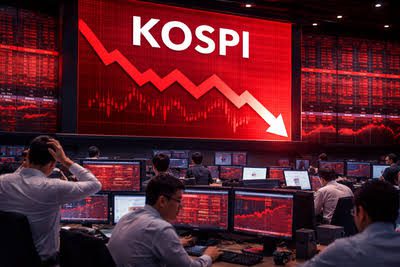
The panic selling gripping global tech markets has hit ground zero in Seoul. Today, Friday, June 26, 2026, South Korea’s benchmark KOSPI index plunged over 8%, triggering an automatic, market-wide Level 1 circuit breaker that completely halted all securities trading for 20 minutes.
This dramatic crash marks the second time this week alone that South Korea has been forced to freeze its markets, and represents only the 11th such emergency trading halt in the country’s history.
1. The Catalysts Behind the Crash
The 8.18% plunge—which dragged the KOSPI down to 8,199.81—was not caused by a single isolated event, but a severe convergence of macroeconomic and sectoral pressures that landed simultaneously:
- The OpenAI IPO Shockwave: Fresh reports that OpenAI plans to postpone its highly anticipated initial public offering until 2027 shattered public market optimism. Because institutional investors had aggressively priced in massive, near-term liquidity gains from the AI landscape, the delay triggered a rapid exit from highly valued tech names.
- The Apple Supply Chain Warning: Apple announced an unprecedented global shortage of memory chips due to surging AI data center demand, forcing it to hike prices across its Mac and iPad lines. This stoked acute fears on Wall Street that rising input costs will inevitably choke consumer demand and compress margins for hardware vendors.
- Massive Foreign Capitulation: Global institutional funds aggressively unwound their long-term position holdings, dumping nearly 3 trillion won (approx. $1.9 billion) worth of KOSPI equities in the first half of the trading session alone.
[OpenAI 2027 IPO Delay] + [Apple Memory Shortage Warning] ──► Massive Institutional Offloading (~3 Trillion Won) ──► KOSPI Plunges 8%+ ──► 20-Min Circuit Breaker Halt
2. Market Impact: The Heavyweights Collapse
Because the KOSPI index is heavily concentrated around South Korea’s elite semiconductor and automotive supply chains, a sharp drop in just a handful of entities virtually guarantees an index-wide collapse:
| Impacted Giant | Intraday Share Drop | Macro Structural Trigger |
| Samsung Electronics | -9.4% | Bearing the brunt of global AI valuation scrutiny, despite preparing a massive $648 billion domestic infrastructure outlay for Monday. |
| SK Hynix | -10.2% | Facing wild near-term volatility as macro rate-path uncertainty overshadows its upcoming Nasdaq ADR listing plans. |
| LG Energy Solution | -7.1% | Squeezed by broader risk-off sentiment hitting next-generation EV and industrial automation batteries. |
| Hyundai Motor | -8.5% | Dragged down symmetrically alongside industrial manufacturing lines as domestic market breadth deteriorated (848 decliners vs. only 61 gainers). |
3. The Big Picture: Reversal or Correction?
Despite the staggering single-day loss—marking the KOSPI’s worst cumulative weekly performance since early March—broader institutional tracking notes that the market’s long-term structure remains historically elevated. Even with this week’s 9.4% aggregate pullback, the KOSPI remains up close to 95% for the year, following a massive 76% gain carved out across 2025.
Financial regulators at the Korea Exchange (KRX) held an emergency stabilization session following the 20-minute halt. While domestic retail investors are attempting to aggressively “buy the dip” in leveraged chip products, analysts suggest the market is undergoing a painful but necessary transition away from high-beta momentum buying toward a strict, earnings-and-valuation-driven framework.