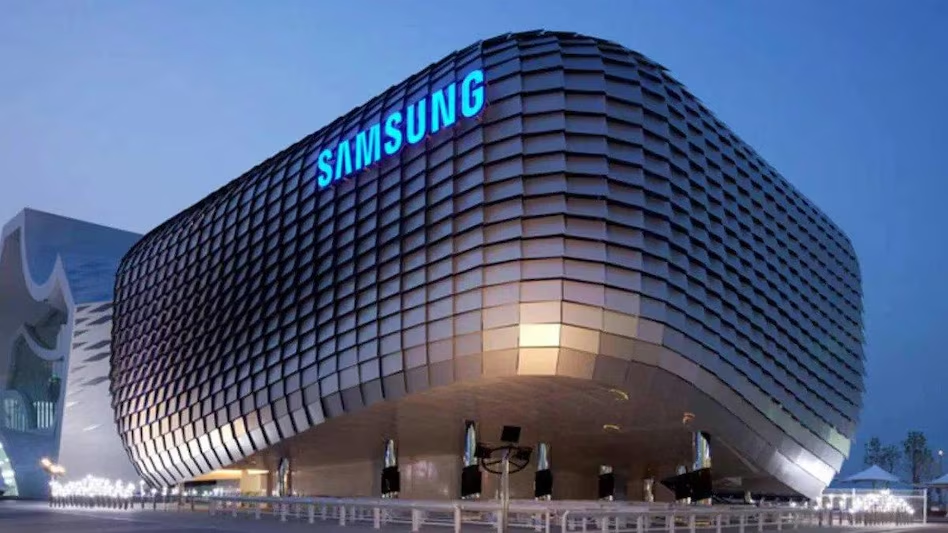
Samsung Group is preparing to unveil a massive, decade-long investment blueprint, pledging 1,000 trillion won (approximately $648 billion) to anchor South Korea’s next growth cycle.
Reported by South Korea’s Maeil Business Newspaper on June 26, 2026, the unprecedented spending plan represents one of the largest corporate investment commitments in the country’s history—equivalent to roughly half of South Korea’s annual GDP.
The strategy is aimed at capturing the relentless demand of the global AI boom, but it is also triggering domestic political friction over how the technology windfall should be shared.
1. The Core Strategic Catalyst: Diversifying Beyond Seoul
For years, Samsung and its semiconductor rival, SK Hynix, have concentrated their high-tech fabrication plants around the Seoul metropolitan area. However, that rapid centralization has run into critical infrastructure bottlenecks—specifically a looming shortage of land, electrical power grids, and water resources required to cool massive next-generation machinery.
To address these caps, the South Korean government under President Lee Jae-myung has aggressively pushed for a balanced regional development policy. Samsung’s $648 billion blueprint is designed to heavily align with this state strategy:
                          [ Samsung $648 Billion Regional Outlay ]
                                             │
          ┌──────────────────────────────────┼──────────────────────────────────┐
          ▼                                  ▼                                  ▼
[ Southwestern Cluster ]             [ Chungcheong Region ]             [ Ulsan Battery Base ]
• ~300 Trillion Won ($194B)          • ~56 Trillion Won ($36B)          • Targeted Factory Upgrades
• Building 4–5 cutting-edge          • Packaging, back-end research,    • Next-gen solid-state
  semiconductor fabs.                  and assembly facilities.           electric vehicle batteries.
2. Sector-by-Sector Investment Architecture
The 1,000 trillion won war chest is being pooled across Samsung’s key advanced technology affiliates over the next ten years, prioritizing infrastructure layers that directly feed into the global AI ecosystem:
| Targeted Industry | Earmarked Allocation | Core Strategic Mandate |
| AI Data Centers | ~350 Trillion Won ($226B) | Developing massive, energy-efficient AI server hubs to absorb rapid data compute demand. |
| Semiconductor Fabs | ~300 Trillion Won ($194B) | Constructing deep-submicron manufacturing lines outside Seoul to expand foundry capacity. |
| Advanced Packaging | ~56 Trillion Won ($36B) | Building specialized chip packaging and backend testing clusters to link memory to compute engines. |
| Displays & Batteries | Remainder of Pool | Upgrading Samsung SDI and Samsung Display factories to scale next-gen solid-state automotive batteries and high-refresh AI hardware panels. |
3. The Financial Backing: Surging Memory Supercycle
While a $648 billion commitment sounds staggering, market analysts note that Samsung Electronics is flush with liquidity thanks to a historic hardware supercycle. High-bandwidth memory (HBM) and data center solid-state drives are drawing massive price premiums globally.
Samsung’s combined operating income for the 2026 to 2028 window alone is projected to reach an estimated 1,500 trillion won, giving the conglomerate more than enough internally generated cash flow to comfortably finance its ten-year rollout without taking on toxic debt burdens.
4. The Political Flashpoint
Despite the economic promise, the announcement is generating heated domestic friction ahead of South Korea’s upcoming political contests:
The Opposition Pushback: Opposition lawmakers have openly accused President Lee’s administration of using state leverage to pressure private tech giants. They argue that directing Samsung to place a massive 300 trillion won chip cluster in the southwest—a historical stronghold for the ruling party—is a politically driven maneuver to secure local votes ahead of the party’s leadership contest.
The formal, coordinated unveiling of the plan—dubbed by the Blue House as part of the “Three Mega-Projects for South Korea’s Great Leap Forward”—is scheduled for a joint government-industry summit on Monday, June 29, 2026, where top tech executives will officially finalize the timeline alongside state regulators.