In a direct acknowledgment of the extreme complexities facing human spaceflight, ISRO Chairman V. Narayanan has signaled that the formal timeline for India’s landmark Gaganyaan human spaceflight mission is being strategically extended.
Delivering the Air Marshal L.M. Katre Memorial Lecture in Bengaluru on Saturday, June 27, 2026, the ISRO chief presented an updated roadmap indicating that the first uncrewed test flight could shift as far out as the third quarter of 2027, effectively pushing the primary crewed orbital launch into 2028.
1. The Dual Timeline Reality
During his presentation on the “Indian Space Programme – The Challenges and Way Forward,” a minor point of confusion arose when the Chairman’s slides slated the uncrewed test flight for Q3 2027, even as he verbally maintained that internal teams are actively busting gut to try and pull off a launch by the end of 2026.
When pressed on the conflicting dates, Narayanan emphasized that human spaceflight leaves zero margin for error, stating:
“The Gaganyaan programme is a very important technology-intensive mission and human safety is very important. … A space mission is zero or 100%. We have to be 100 on 100. The programme is undergoing constant review, and the first unmanned flight will be launched on the basis of the progress.”
 [ Original Target Track ] ──► Uncrewed G1 Mission in 2024/2025 ──► Crewed Flight Late 2025/2026
                                                                             │
                                                                             ▼ (June 2026 Realignment)
 [ Calibrated 100/100 Track] ──► First Uncrewed Flight: Q3 2027 Baseline ──► Maiden Manned Crew Launch: 2028
2. Rigorous Groundwork: 8,000 Tests and Counting
Despite the timeline extension, the program is far from stalled. The delay reflects a transition from hasty, early-stage schedules to strict, uncompromised quality controls:
- The Ground Test Battery: ISRO confirmed it has already executed over 8,000 comprehensive ground tests to ensure the complete structural integrity of the human-rated launch vehicle and crew safety parameters.
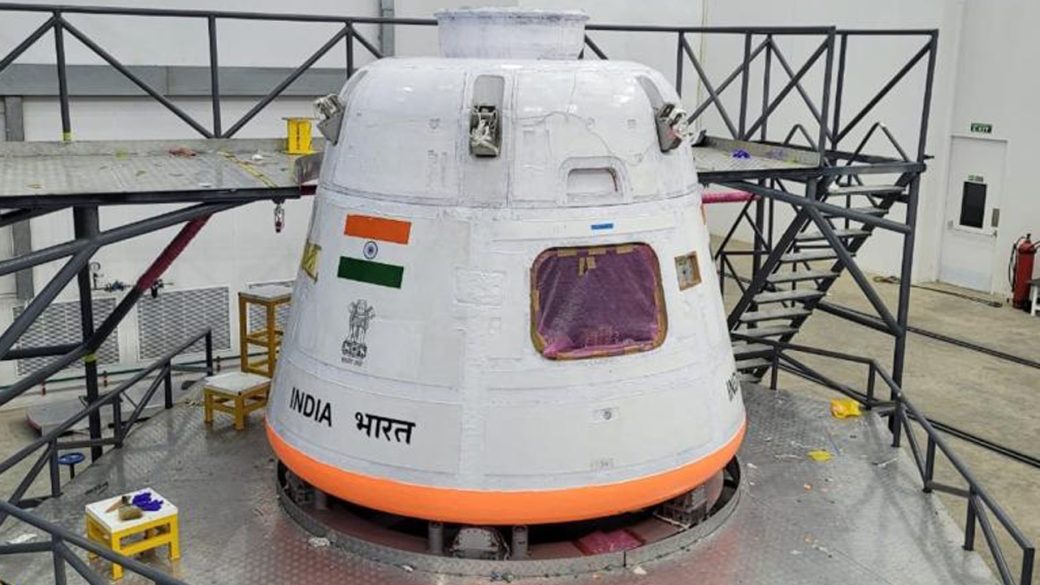
- The Three-Flight Shield: To completely certify the spacecraft before any Indian astronauts (Gaganauts) step into the cockpit, ISRO has committed to conducting three sequential uncrewed test missions. The first of these, the G-1 (half-humanoid) mission, received formal clearance from the National Review Committee in May 2026 and is currently entering final simulation phases across facilities in Bengaluru and Thiruvananthapuram.
3. Shaking Off Parallel Setbacks
The careful approach to Gaganyaan is heavily informed by recent logistical hurdles across ISRO’s broader launch roster. The agency is actively navigating recovery protocols following two successive sub-optimal setbacks involving its aging workhorse PSLV rockets over the 2025–2026 window, alongside a strategic push to launch four supplementary satellites to restore the NavIC navigation constellation to full capacity.
However, the space agency’s technical momentum remains incredibly high. Just days prior to the lecture, ISRO completed a triumphant, high-thrust 175-tonne hot test of its new semi-cryogenic engine power head, laying down the precise industrial framework required to power the heavier, next-generation rockets that will eventually support both the crewed Gaganyaan pods and India’s upcoming national space station modules.