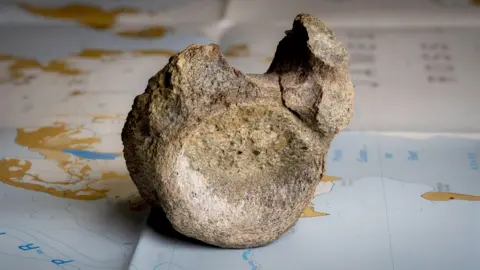
An unassuming, lumpy grey fossil that spent 40 years sitting forgotten in a museum drawer has just been officially identified as the first-ever dinosaur bone discovered on the continent of Antarctica.
A team of scientists from the British Antarctic Survey (BAS), the Natural History Museum in London, and University College London (UCL) published their study in the journal Acta Palaeontologica Polonica, formally identifying the fossil as a tail vertebra belonging to a titanosaur—a member of the long-necked sauropod family that includes the largest land animals to ever live.
1. The 40-Year Journey from Ice to Identification
The story of the discovery reveals a classic paleontological twist, where the breakthrough happened in a climate-controlled archive rather than out in the field:
- The 1985 Discovery: The late geologist Dr. Mike Thomson originally picked up the bone on December 9, 1985, during a mapping expedition to James Ross Island on the Antarctic Peninsula. Primarily searching for marine invertebrates like ammonites, Thomson logged the 10-centimeter bone in his field notebook simply as a “vertebra of a large reptile.”
- The Cambridge Drawer: Because the expedition was focused on marine layers, the unstudied bone was boxed up, transported back to the United Kingdom, and placed in a storage drawer within the BAS geological collection in Cambridge, where it collected dust for decades.
- The Rediscovery: Dr. Mark Evans, the curator and manager of the BAS geological collections, recently spotted the unique shape of the bone while reviewing old holdings. Suspecting it was a dinosaur, he reached out to Professor Paul Barrett, a merit researcher at the Natural History Museum, who immediately recognized its distinct ball-and-socket configuration as uniquely titanosaurian.
 [ Dec 1985: James Ross Island ] ──► Found by Dr. Mike Thomson ──► Logged as a "large reptile"
                                                                              │
                                                                              ▼
 [ 1986 - 2026: The Archive Slumber ] ──► Stored in a geological drawer in Cambridge, UK
                                                                              │
                                                                              ▼
 [ June 2026: The Identification ] ──► Dr. Mark Evans & Prof. Paul Barrett confirm it as a Titanosaur
2. Prehistoric Context: What Did It Look Like?
While some South American titanosaurs grew to lengths of over 30 meters and weighed more than 15 tonnes, the Antarctic specimen represents a much smaller individual:
- Size Estimates: Based on the dimensions of the tail vertebra, scientists estimate this particular dinosaur was roughly 6 to 7 meters (20 to 23 feet) in length. Researchers cannot yet confirm if the bone belonged to a juvenile still in its growth phase or a distinct dwarf island species.
- The “Bloat and Float” Journey: The fossil was recovered from the Santa Marta Formation, a marine rock layer dating back to the Late Cretaceous period (around 82 million years ago). Because it was found alongside sea creatures, scientists believe the dinosaur died on land, its carcass was washed into the ocean by river runoff (“bloat and float”), and it eventually settled on the ancient seabed to fossilize.
3. Rewriting Prehistoric Maps
The formal confirmation of this 82-million-year-old vertebra solves a major geographical puzzle regarding how dinosaurs migrated across the ancient southern supercontinent of Gondwana.
                [ THE LATÉ CRETACEOUS MIGRATION PATH ]

  [ South America ] ──────► [ Antarctic Peninsula ] ──────► [ New Zealand & Australia ]
  (Abundant Titanosaurs)    (The Missing Link Bridge)       (Aided by connected landmasses)
During the Late Cretaceous, Antarctica looked nothing like the frozen wasteland it is today. Fueled by heavy volcanic activity that pumped carbon dioxide into the atmosphere, the continent was a warm, lush environment covered in dense, temperate forests of conifers, ferns, and palms.
Because titanosaurs are well-documented in South America but remain elusive in Australia, proving that these massive herbivores lived in Antarctica strongly supports the theory that the Antarctic Peninsula acted as a vital green land bridge—allowing massive land animals to cross between now-separated global landmasses before continental drift tore them apart.