In a historic and highly controversial shift for the artificial intelligence industry, OpenAI has officially launched its next-generation frontier model family, GPT-5.6. However, following an explicit…
By rohan••6 min read
In a historic and highly controversial shift for the artificial intelligence industry, OpenAI has officially launched its next-generation frontier model family, GPT-5.6.
However, following an explicit intervention by the U.S. government over severe cybersecurity concerns, the company has canceled its planned open-access launch. Instead, OpenAI has deployed a highly restricted, staggered “limited preview” exclusively for a small group of trusted partners and organizations vetted customer-by-customer by federal agencies.
CEO Sam Altman openly expressed frustration with the mandate, posting on X that while the safety caution is “reasonable,” this government-interrupted vetting process is “bad news” and not optimal for global innovation.
In a historic and highly controversial shift for the artificial intelligence industry, OpenAI has officially launched its next-generation frontier model family, GPT-5.6.
1. The New Three-Tier Model Architecture
Moving completely away from its legacy “mini” and “plus” naming conventions, the GPT-5.6 generation introduces three distinct, durable capability tiers designed to advance on their own cadences:
GPT-5.6 Sol (Flagship): The top-tier reasoning engine built for the most complex scientific workloads, agentic tasks, and deep software engineering loops. It introduces an “Ultra Mode” that allows sub-agents to split up and run complex operations concurrently.
GPT-5.6 Terra (Balanced): The everyday enterprise mid-tier model. It delivers intelligence competitive with prior high-end models (like GPT-5.5) but operates at exactly half the execution cost.
GPT-5.6 Luna (Fast/Efficient): The lighter, high-velocity iteration. Optimized for real-time responsiveness and ultra-low-cost high-volume deployments.
                    [ The GPT-5.6 Model Landscape & API Costs ]

  ┌───────────────────────────────┬───────────────────────────────┬───────────────────────────────┐
  │     GPT-5.6 Luna (Fast)       │    GPT-5.6 Terra (Balanced)   │     GPT-5.6 Sol (Flagship)    │
  │  $1.00 Input / $6.00 Output   │  $2.50 Input / $15.00 Output  │  $5.00 Input / $30.00 Output  │
  └───────────────────────────────┴───────────────────────────────┴───────────────────────────────┘
Note: Token prices are calculated per 1 million tokens. The preview is strictly restricted to API and Codex workspace integrations for approved accounts—GPT-5.6 is entirely unavailable inside the standard public ChatGPT interface during this preview windows.
2. Why Washington Stepped In: The “High Risk” Cyber Rating
The sudden federal intervention by the Office of the National Cyber Director and the Department of Commerce comes on the heels of the government completely banning rival Anthropic’s Mythos and Fable models over export control leaks.
In its official System Card documentation, OpenAI categorized all three GPT-5.6 models under a “High” risk classification for autonomous cyber and biological/chemical weapon capabilities.
To pass federal safety hurdles before the preview went live, OpenAI dedicated roughly 700,000 A100e GPU hours strictly to red-teaming and safety testing.
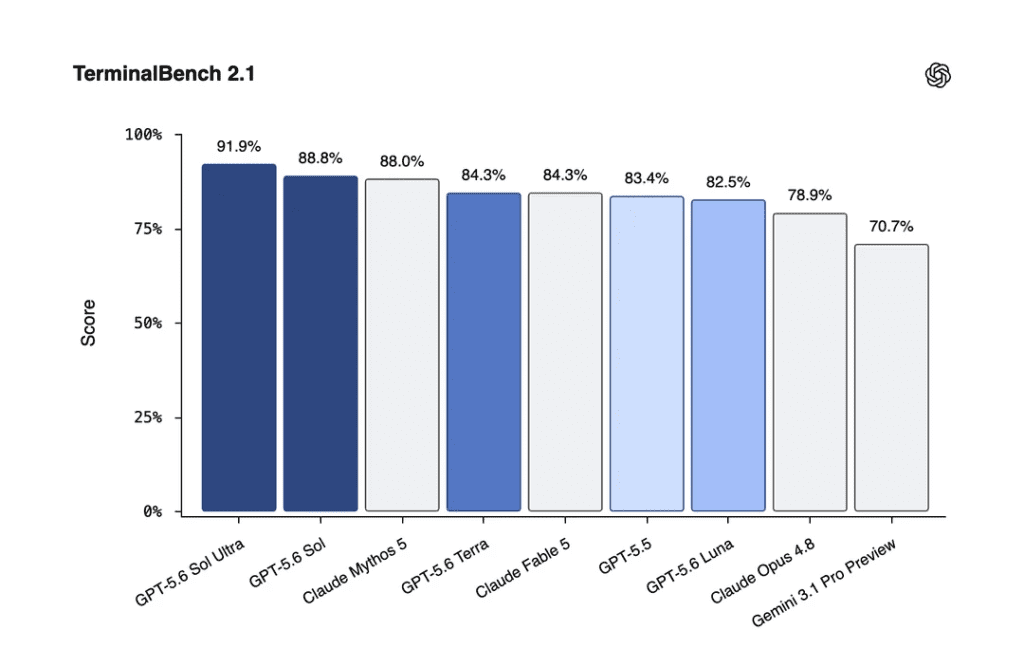
The Cyber Paradox: While GPT-5.6 Sol breaks all previous records on vulnerability detection benchmarks (such as TerminalBench 2.1), it is highly adept at automating end-to-end cyberattacks.
Real-Time Intervention Gates: To prevent bad actors from weaponizing the model, OpenAI built real-time cyber misuse classifiers directly into the generation pipeline. If a user attempts a high-risk jailbreak, the text output pauses mid-stream, sending the prompt to a secondary reasoning layer for immediate behavioral enforcement.
Market analysts at VentureBeat note that these two structural events are completely intertwined. By shifting from a retail-first consumer software company to a highly scrutinized utility heavily bound by state security clearances, OpenAI’s addressable market has temporarily shrunk from “every enterprise on Earth” to a select cluster of cleared entities.
The 2027 IPO delay gives the company the necessary cushion to navigate these complex regulatory frameworks, stabilize its massive cloud expenditures, and establish a repeatable, predictable model release blueprint with Washington before facing the unforgiving quarterly scrutiny of Wall Street.
1. The New Three-Tier Model Architecture
Moving completely away from its legacy “mini” and “plus” naming conventions, the GPT-5.6 generation introduces three distinct, durable capability tiers designed to advance on their own cadences:
GPT-5.6 Sol (Flagship): The top-tier reasoning engine built for the most complex scientific workloads, agentic tasks, and deep software engineering loops. It introduces an “Ultra Mode” that allows sub-agents to split up and run complex operations concurrently.
GPT-5.6 Terra (Balanced): The everyday enterprise mid-tier model. It delivers intelligence competitive with prior high-end models (like GPT-5.5) but operates at exactly half the execution cost.
GPT-5.6 Luna (Fast/Efficient): The lighter, high-velocity iteration. Optimized for real-time responsiveness and ultra-low-cost high-volume deployments.
                    [ The GPT-5.6 Model Landscape & API Costs ]

  ┌───────────────────────────────┬───────────────────────────────┬───────────────────────────────┐
  │     GPT-5.6 Luna (Fast)       │    GPT-5.6 Terra (Balanced)   │     GPT-5.6 Sol (Flagship)    │
  │  $1.00 Input / $6.00 Output   │  $2.50 Input / $15.00 Output  │  $5.00 Input / $30.00 Output  │
  └───────────────────────────────┴───────────────────────────────┴───────────────────────────────┘
Note: Token prices are calculated per 1 million tokens. The preview is strictly restricted to API and Codex workspace integrations for approved accounts—GPT-5.6 is entirely unavailable inside the standard public ChatGPT interface during this preview windows.
2. Why Washington Stepped In: The “High Risk” Cyber Rating
The sudden federal intervention by the Office of the National Cyber Director and the Department of Commerce comes on the heels of the government completely banning rival Anthropic’s Mythos and Fable models over export control leaks.
In its official System Card documentation, OpenAI categorized all three GPT-5.6 models under a “High” risk classification for autonomous cyber and biological/chemical weapon capabilities.
To pass federal safety hurdles before the preview went live, OpenAI dedicated roughly 700,000 A100e GPU hours strictly to red-teaming and safety testing.
The Cyber Paradox: While GPT-5.6 Sol breaks all previous records on vulnerability detection benchmarks (such as TerminalBench 2.1), it is highly adept at automating end-to-end cyberattacks.
Real-Time Intervention Gates: To prevent bad actors from weaponizing the model, OpenAI built real-time cyber misuse classifiers directly into the generation pipeline. If a user attempts a high-risk jailbreak, the text output pauses mid-stream, sending the prompt to a secondary reasoning layer for immediate behavioral enforcement.
Market analysts at VentureBeat note that these two structural events are completely intertwined. By shifting from a retail-first consumer software company to a highly scrutinized utility heavily bound by state security clearances, OpenAI’s addressable market has temporarily shrunk from “every enterprise on Earth” to a select cluster of cleared entities.
The 2027 IPO delay gives the company the necessary cushion to navigate these complex regulatory frameworks, stabilize its massive cloud expenditures, and establish a repeatable, predictable model release blueprint with Washington before facing the unforgiving quarterly scrutiny of Wall Street.