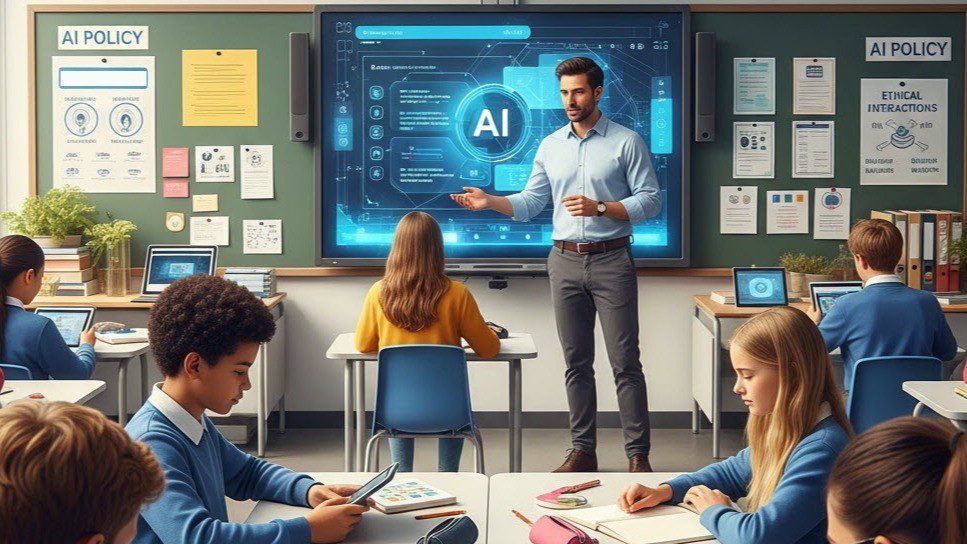
The Norwegian government has announced a near-total ban on the use of generative AI in schools for primary school pupils, declaring a broad regulatory push to prioritize foundational literacy and numeracy over rapid technology integration. The move makes Norway one of the first European countries to roll back classroom AI rather than expand it.
The new educational standards will take effect at the start of the next academic year in late August, marking one of the strictest classroom AI policies in Europe.
The structural breakdown of the age-based policy outlines a tiered restriction framework:
- Grades 1 to 7 (Ages 6 to 13): A near-total ban on generative AI tools. Students are restricted from using AI assistants to complete classroom assignments or homework. Exceptions will only be permitted for students who require specialized digital accessibility tools.
- Grades 8 to 10 (Ages 14 to 16): Lower secondary students will be allowed to use generative AI tools strictly under the direct, physical supervision of a teacher who has completed designated technical training.
- Upper Secondary (Ages 17 to 19): Older students will face no bans. Instead, AI literacy and responsible platform usage will be formally integrated into the curriculum to prepare them for higher education and the modern workforce.
Prime Minister Jonas Gahr Støre explained the reasoning behind the intervention during a press conference, stating that unrestricted AI usage increases the risk of young children bypassing critical cognitive development milestones. “The most important thing in school is that our children learn to read, write, and do mathematics,” Støre emphasized, warning that relying on automated engines prevents children from acquiring basic problem-solving skills.
The AI ban forms part of a broader “digital reset” across Norway’s public education system. Following a decade of intense digitization that replaced paper textbooks with tablets and iPads, the country has faced a steady decline in national standardized test scores. In response, the government instituted a complete smartphone ban in schools in 2024 and has now introduced new legislation to aggressively fund physical, printed books to phase out classroom tablets.
Minister of Education Kari Nessa Nordtun backed the decision by highlighting that primary school children lack the critical thinking frameworks required to evaluate AI-generated outputs. To support the transition, the Directorate for Education has been tasked with drafting concrete compliance guidelines for schools and developing training modules to help teachers enforce the restrictions.
The decision lands at a time when consumer AI tools are becoming harder to keep out of classrooms. Popular assistants are shipping productivity features such as ChatGPT’s new scheduled page feature, and AI labs continue to push more capable models, as seen in Anthropic reportedly finishing training of its Mythos 6 model. Norway’s stance is a notable counterpoint to that momentum, betting that children learn core skills better without AI shortcuts.
Frequently Asked Questions
Why is Norway banning AI in schools?
Norway argues that heavy reliance on generative AI lets young children skip key cognitive development milestones in reading, writing and mathematics. Officials say primary pupils lack the critical-thinking skills to judge AI-generated answers, so the ban is meant to protect foundational learning.
What are the disadvantages of AI in schools?
Common concerns include students outsourcing thinking to AI, weaker problem-solving and writing skills, plagiarism risks, and over-reliance on screens. Norway links its decade of classroom digitization to falling standardized test scores, which is part of why it is now pulling back.
Does the Norway AI ban apply to all students?
No. The near-total ban targets Grades 1 to 7 (ages 6 to 13). Grades 8 to 10 may use AI only under trained teacher supervision, while upper-secondary students (ages 17 to 19) face no ban and instead learn formal AI literacy as part of the curriculum.