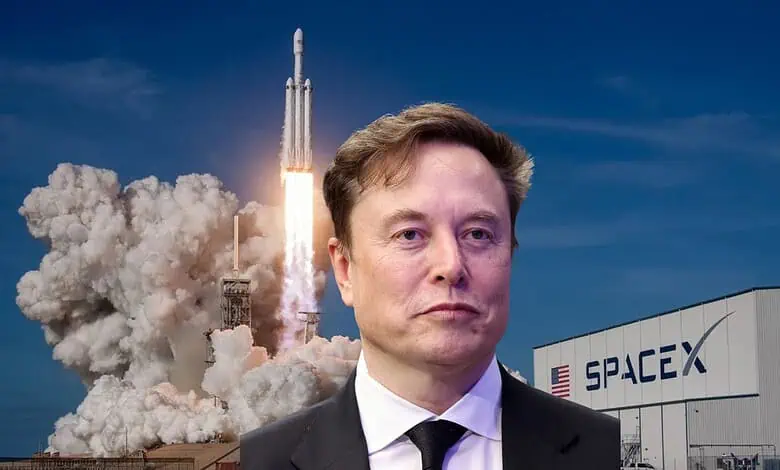
Just days after shattering financial records with a historic Nasdaq public listing, Elon Musk has fundamentally reset expectations for SpaceX (ticker: SPCX). Responding to long-term projections compiled by underwriters over the weekend, Musk predicted that SpaceX is capable of generating approximately $1 trillion in annual revenue by 2030.
The ultra-bullish forecast arrives as the aerospace and satellite infrastructure giant experiences a powerful post-IPO surge, pushing its market capitalization well past $2 trillion. However, the sheer scale of Musk’s target has exposed a massive gap between internal projections and the relatively conservative mathematical modeling mapped out by Wall Street investment banks.
The Growth Math: A 53-Fold Mountain to Climb
To put Musk’s $1 trillion vision into perspective, the target demands an unprecedented, vertical acceleration in corporate earnings. According to SpaceX’s official S-1 public registration documents, the firm managed $18.7 billion in revenue for 2025.
While that baseline represents a highly resilient 33% year-on-year expansion from the $14 billion pulled in across 2024, scaling to $1 trillion in five years would require an approximate 53-fold jump in revenue. No corporation of this size in industrial history has ever scaled at that velocity.
| Year / Metric | Reported & Estimated Revenue | Primary Underlying Driver |
| 2023 (Actual) | ~$10.0 Billion | Falcon 9 Launch dominance |
| 2024 (Actual) | $14.0 Billion | Starlink retail & enterprise expansion |
| 2025 (Actual) | $18.7 Billion | Baseline IPO filing metric |
| 2028 (Morgan Stanley Est.) | $160.0 Billion | Starlink Gen-3 & heavy Starship commercialization |
| 2030 (Morgan Stanley Est.) | $330.0 Billion | Mature satellite data & deep telecom integration |
| 2030 (Elon Musk Prediction) | ~$1,000.0 Billion ($1T) | AI data fabric & orbital computing infrastructure |
Musk made his stance perfectly clear on X, adding a definitive timeline extension for good measure: “I think SpaceX might be able to reach approximately $1T revenue in 2030. And I would be surprised if revenue is not greater than $1T in 2031.”
The Disconnect: Wall Street vs. The Founder
Lead underwriters are taking a significantly more measured approach to their long-range discount models. Leading the banking cohort, Morgan Stanley models a still-staggering climb to $330 billion by 2030, while Goldman Sachs projects the firm to land closer to $470 billion.
The core explanation for this multi-hundred-billion-dollar delta lies in how the respective parties classify SpaceX’s long-term total addressable market (TAM). While traditional analysts view SpaceX primarily as a satellite broadband provider (Starlink managed $11.4 billion in 2025 across 10.3 million active subscribers) and a launch monopoly, SpaceX’s internal offering documents pitch a $28.5 trillion TAM.
Strikingly, roughly 90% of that addressable market is tied directly to artificial intelligence infrastructure rather than standard rocket hardware. The company is positioning itself to leverage its low-Earth-orbit constellation as a massive, decentralized, air-gapped data transport layer optimized specifically for global AI computing clusters.
Market Hurdles and the Supply Unlock
Despite the overnight enthusiasm pushing SPCX shares higher, institutional analysts are urging retail investors to maintain structural caution. SpaceX’s historical financials continue to demonstrate steep net losses and immense capital expenditure demands, primarily driven by the continuous, expensive engineering iterations of the Starship program.
Furthermore, a significant short-term equity event is rapidly approaching. According to the company’s amended SEC filings, a major lock-up expiration will occur exactly two days after SpaceX drops its first public quarterly earnings report. This mechanism will allow restricted insiders and early employees to liquidate roughly 7% of all outstanding shares on the open market—an immense single-day supply unlock that will thoroughly test the depth of public market demand.